Lee Soo-hyeok
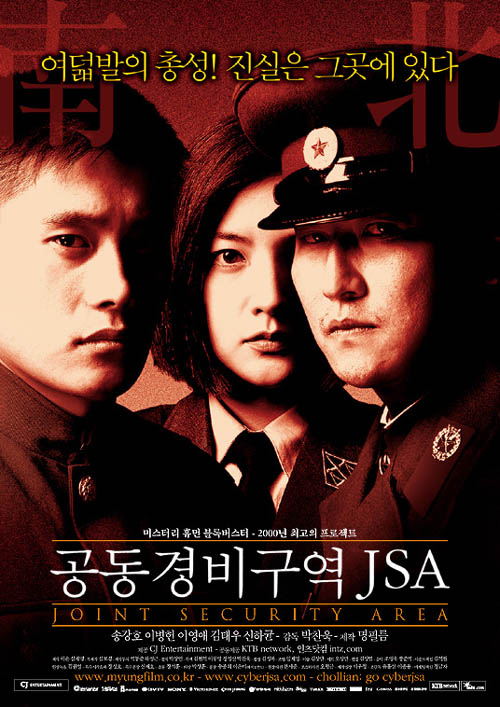
Lee Soo-hyeok symbolizes the point where personal friendship and human desire collide with a towering ideological wall inside the extreme tension of the Joint Security Area. Through the everyday private emotions he experiences at the inter-Korean border, he speaks for the anguish and vulnerability of the individual caught inside the structural violence of division — posing deep questions to the audience.
Lee Soo-hyeok: A Record of Humanity at the Border
Sergeant Lee Soo-hyeok is both the central figure who sets the film's events in motion and the 'individual' with whom audiences most deeply identify. As a sergeant in the Republic of Korea Army's UN Command Security Battalion — with discharge approaching — his situation is imbued with a kind of finality, lending weight to every emotional tremor he experiences.
1. Character Arc: Vulnerability Between the Everyday and Tragedy
Soo-hyeok's character holds an external toughness coded as 'masculinity' alongside an internal contradiction of 'human fragility in the face of circumstance.' His arc unfolds in the following stages.
- Calm Everyday Life (The Formation of Friendship): The film introduces him through a flashback set long before the incident, in which he narrowly escapes stepping on a land mine — a crisis he survives with the help of Gyeong-pil and Woo-jin. He then begins exchanging notes with them across 'the Bridge of No Return,' building a friendship. In this period he reveals the deeply human side of a young man approaching discharge — pursuing dreams and seeking pure connection. (F11)
- The Temptation of the Border (Freedom and Desire): Even while on duty at the inter-Korean border, he plays games with his friends and engages in the ordinary pleasures of human connection. (F3) Even in moments when he gives voice to his loyalty to his country, he speaks of his dreams in a way that suggests the border is on the verge of dissolving. (F4)
- At the Center of the Incident (Conflict and Flight): His unauthorized crossing into the North Korean guard post and the ensuing gunfight arise from his pursuit of an uncontrollable desire for freedom. The South claims he was abducted and escaped; the North claims he opened fire indiscriminately — his actions become an object of ideological interpretation. (F6, F7)
2. Key Scenes: The Weight of Gunshots and Guilt
Soo-hyeok's fate is compressed into a handful of decisive scenes.
- Farewell to Friends (The Seeds of Tragedy): The night he accompanies Gyeong-pil, Woo-jin, and Seong-sik back to the North Korean post to say goodbye is the moment their friendship collides with the ideological wall. The gunfight that erupts becomes the symbol of that friendship's ruin. (F18)
- Fragments of Truth (The Discovery of Evidence): Major Sophie's investigation excavates the evidence surrounding Soo-hyeok's actions. The mismatch in bullet counts at the scene, the discovery that the sidearm had been switched — these details hint that he is not a simple 'terrorist' but a person swept up in an extraordinarily complex situation. (F10)
- The Final Exit (Guilt): At the film's end, Soo-hyeok steals an officer's pistol, overcome by guilt for Woo-jin's death and Seong-sik's attempted suicide. This act is the most tragic possible conclusion — the final proof that he could not bear the weight of everything that happened.
3. Interpretation: The Individual Inside Structural Violence
Lee Soo-hyeok is a victim of the massive structural violence that is division. His life makes starkly visible the collision between 'individual happiness' and 'state ideology.'
- The Value of Friendship: The friendship he shared with Gyeong-pil, Woo-jin, and Seong-sik is the purest human value, transcending borders and ideology. This friendship is both the force that places him at the center of the gunfight and, simultaneously, his greatest vulnerability — the thing that leads him toward catastrophe.
- The Absence of Truth: The contradictory testimonies surrounding him — abduction versus terrorism — mean that the truth of Soo-hyeok's experience can never be established as historical fact. His story ultimately circles back to the question: who has the right to speak truth?
- Conclusion: Lee Soo-hyeok is not merely a sergeant who fired a gun and fled. He is the most tragic portrait of modern man — someone who tried to live a human life within that special space of the border, only to have that attempt crushed by the weight of a vast historical tragedy.
Why It Matters
Lee Soo-hyeok is not simply a victim or perpetrator of an incident. He carries the full weight of what it means to be an 'individual' inside the enormous ideological frame of the two Koreas. The ordinary, human dimensions of his existence — the play, the dreams, the exchange with friends — amplify the tragedy of the gunfight and investigation that surround him. His actions reveal how the most primal of human instincts — friendship and survival — are suppressed and distorted by the vast system of nation and ideology. His private anguish is the direct corollary of the film's central question: what is the value intrinsic to human beings?
Other Character dives3
- arrow_outward
Senior Lieutenant Choi Man-su
Senior Lieutenant Choi Man-su functions in the film not as the direct instigator of the incident but as a dramatic device that detonates the 'temporary peace' formed between soldiers of the two Koreas. He arrives in the final confrontation scene and in a single gesture converts the emotional current of 'human friendship' back into 'military confrontation.' His appearance symbolizes how easily — and how violently — ideological boundaries can be reasserted, maximizing the film's thematic intent.
- arrow_outward
Sophie (Major Sophie Jean)
Major Sophie Jean bears the narrative axis of this film. She is a Swiss Army major serving with the Neutral Nations Supervisory Commission, with the background of being Korean-mixed — a complex identity that places her as an 'outsider' belonging to neither camp, providing the legal and psychological foundation to pursue only the objective truth of the incident.
- arrow_outward
Gyeong-pil
Oh Gyeong-pil is one of the most emotionally complex characters in the film. A seasoned professional who has lived as a military instructor across many countries for more than a decade, he initially keeps the world at arm's length — revealing little emotion to either Soo-hyeok on the South Korean side or to his superiors. This initial reserve reflects the military environment and ideological formation he has lived within.
Back to the title
Joint Security Area
12 deep dives in total