arrow_back
Oldboy
Special Pick
Oldboy

Oldboy

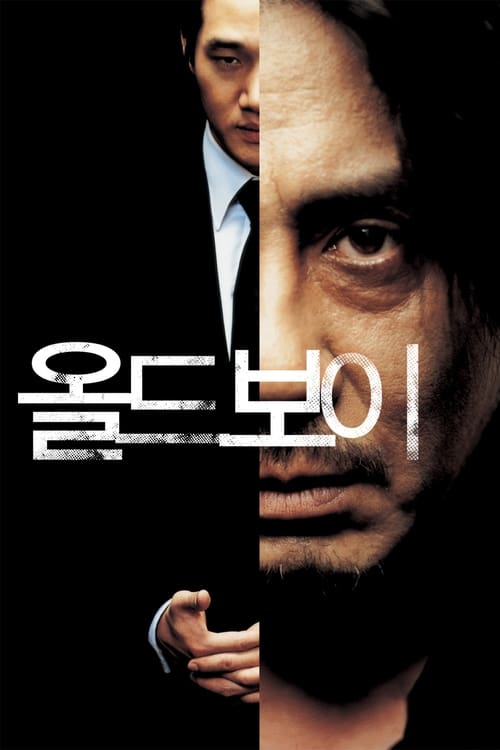
올드보이

Directed by Park Chan-wook · 2003

In 1979, one careless line of gossip Oh Dae-su dropped to a single friend drove his schoolmate Lee Soo-ah to jump from the Hapcheon Dam. Twenty-four years later her younger brother Lee Woo-jin takes his revenge — fifteen years of private imprisonment, and a love affair Oh Dae-su unknowingly enters with his own daughter. When the revenge ends, both men hand down their own sentences on themselves.

Chapter 1

Web of Characters

9 characters and 13 relationships that hold this story together.

Mini Map

Oh Dae-su

protagonist

Choi Min-sik (child role: Oh Tae-kyung)

Talks too much — one careless line to a friend in 1979 helped drive a woman (Lee Soo-ah) to her death, and the price was fifteen years (1988–2003) in an eight-pyeong private prison. His fighting ability is the product of fifteen years of shadow-boxing in front of the TV, and is plainly outmatched by Mr. Han. At the end of the film he cuts off his own tongue.

Dig in →

Lee Woo-jin

antagonist

Yoo Ji-tae (child role: Ahn Yeon-seok = Yoo Yeon-seok)

Lives with a pacemaker for a congenitally weak heart. The handle 'Evergreen' is the English rendering of his alma mater Sangnok ('evergreen') High School. The architect of a revenge plot that punishes Oh Dae-su and the boy who once let go of his sister's hand at the Hapcheon Dam — himself — in the same motion. Shoots himself in the head immediately after the revenge is complete.

Dig in →

Mido

protagonist

Kang Hye-jung

Sous-chef at the Japanese restaurant Jichunghae ("the Mediterranean"). For five years she has received anonymous support from her chat friend Evergreen. She is in fact Oh Dae-su's daughter Oh Yeon-hee, and never knows it — or pretends not to know — for the length of the film. The hypnosis Lee Woo-jin has placed on both of them turns the two of them into lovers.

Dig in →

No Joo-hwan

supporting

Ji Dae-han (child role: Yoo Il-han)

Oh Dae-su's best friend. The one person who first heard the Lee Soo-ah story from Oh Dae-su in 1979; twenty-four years later, gossiping about his friend's family inside his own PC bang, he is murdered with a snapped CD by Lee Woo-jin, who has been bugging the place. The true ignition point of the rumor that spread through the school via his friend Young-ja's friend Chun-sim.

Dig in →

Lee Soo-ah

trigger

Yoon Jin-seo

Lee Woo-jin's older sister, same school (Sangnok High) and same age as Oh Dae-su. As rumor of her relationship with her brother spread through school she developed a phantom pregnancy and jumped from the Hapcheon Dam on July 5, 1979. Almost no living frame of her remains in the film, but the entire twenty-four years every character lives through is a way of metabolizing her absence.

Dig in →

Yoo Hyung-ja

supporting

Lee Seung-sin

The figure Lee Woo-jin commissions to place hypnosis on both Oh Dae-su and Mido. At the end of the film Oh Dae-su returns to her, asking her to erase the memory that Mido is his daughter. The love between Oh Dae-su and Mido is in effect the sum of her two hypnoses.

Dig in →

Park Cheol-woong

supporting

Oh Dal-su

The man who locked Oh Dae-su away from 1988 to 2003. On the surface a figure who suffers at Oh Dae-su's hands, losing even a hand to him — in fact Woo-jin's accomplice from day one, an ally who traded his own wrist for the deed to a new prison building.

Dig in →

Mr. Han

supporting

Kim Byung-ok

His name is never spoken in the film. Almost no words, almost no visible emotion, and a physical force that drops the human weapon Oh Dae-su with a single shoulder throw. After Oh Dae-su stabs him through the ear in the penthouse and he loses his composure to kill Oh Dae-su, Lee Woo-jin shoots him dead with a handgun.

Dig in →

Suicide-man

minor-but-axial

Oh Kwang-rok

The man who is trying to kill himself on a rooftop while holding his dog. The first person Oh Dae-su meets after being released. Park Chan-wook said in commentary that he told Oh Kwang-rok privately the man is about to kill himself because he has been caught engaging in bestiality, but the actor himself has noted it isn't really material to the film as a whole. The single line he leaves — 'Even someone lower than an animal still has the right to live, doesn't he?' — becomes the line that moves the hypnotist at the end of the film (a perfect bookend).

Dig in →

Chapter 2

Threads of Time

8 pivotal scenes that shaped this story, in order.

  1. July 5, 1979, Hapcheon Dam — neither a beginning nor an end, but a middle

    Lee Soo-ah jumps from the Hapcheon Dam. Her younger brother Lee Woo-jin is there with her, and lets go of her hand. The camera leaves two shutter clicks behind — one just before the jump, one as a close-up of the jump itself. Lee Soo-ah's last words set the question-form for the entire film. Park Chan-wook places the closing day of the film twenty-four years later on the same July 5, locking in the structural premise that 'the whole film is a machine for repeating this one day.'

    Woo-jin… you have to remember me. Promise? I have no regrets. Do you?

    Lee Soo-ah · Lee Woo-jin

    Dig in →

  2. 1988 — Yeon-hee's fourth birthday, a purple umbrella

    A drunk Oh Dae-su is making a scene at a police station. Released with a pair of toy angel wings still strapped to his shoulders, he calls his daughter Yeon-hee from a payphone — 'Yeon-hee-yah, Daddy, that I, Daddy that Daddy, Daddy, I, I got Yeon-hee a present, huh?' For the brief moment he hands the receiver to his friend No Joo-hwan, someone under a purple umbrella abducts him. Not a single person in the film, after his release, ever remembers that Mido's name used to be Yeon-hee.

    Oh Dae-su · No Joo-hwan · Lee Woo-jin · Mido

    Dig in →

  3. The three-minute corridor — the scene that makes Oh Dae-su a myth, but was in fact an accident

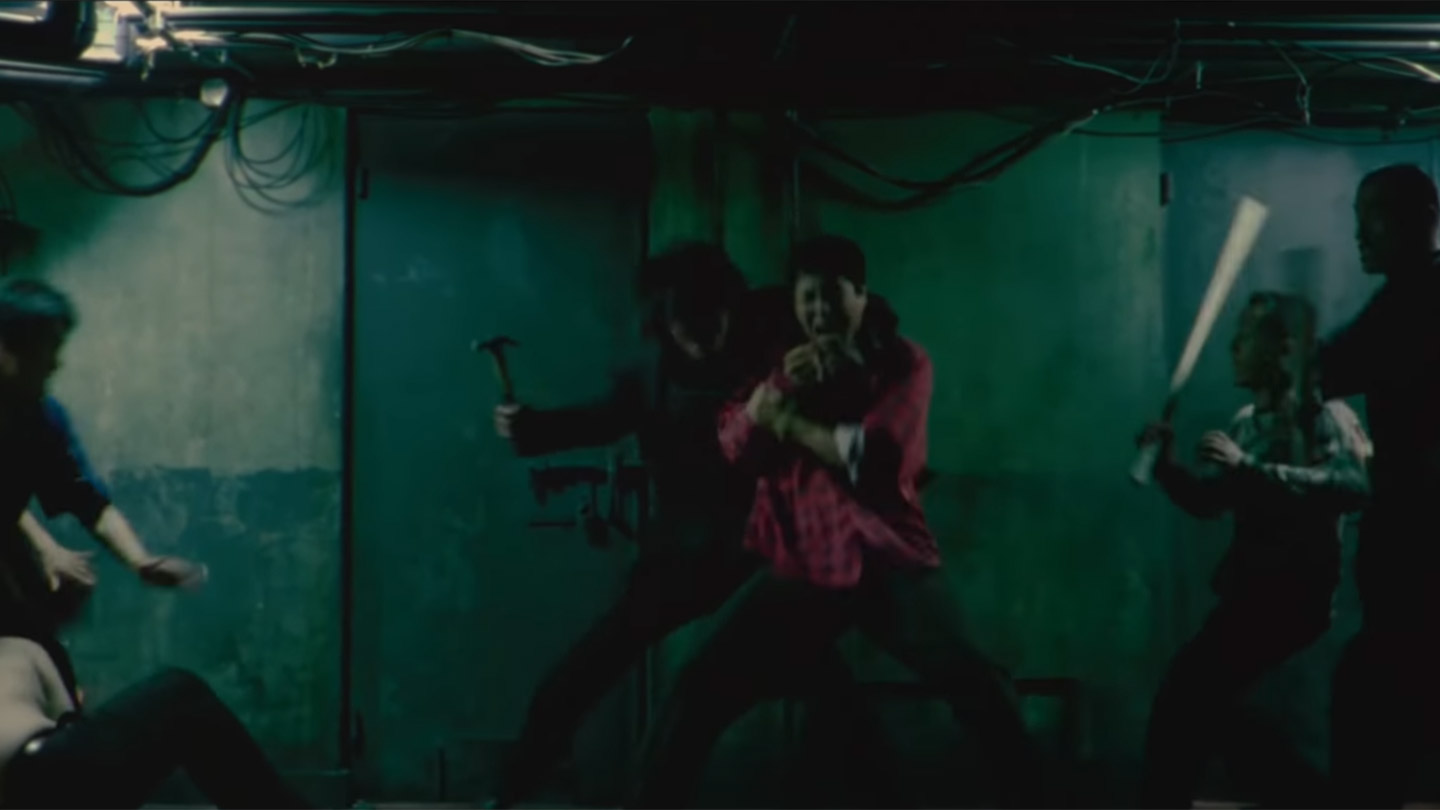
    Oh Dae-su demolishes eighteen staff members of the seven-and-a-half-floor private prison with a single hammer. Park Chan-wook had drawn a manga-style storyboard for it. On the last day of shooting, with footage still short, Park looked at Choi Min-sik slumped on the floor and threw the storyboard out for an impromptu one-take decision. Seventeen takes over three days. The knife stuck in his back is CG. Outside the film this single scene became the seal of the whole work.

    If I tell anyone, you — from the top of your head to the tip of your toes, anywhere on this earth, north, south, east, west, no one will find your body. Why? Because I'll chew you up.

    Oh Dae-su · Park Cheol-woong · Mr. Han

    Dig in →

  4. Evergreen — the chatroom handle that turned out to be the name of a soul

    Released, Oh Dae-su sits in the Japanese restaurant Jichunghae and chews a live octopus whole. The first phone call he receives there — 'Do you… like the clothes?' Mido takes Oh Dae-su's hand (the hypnotic cue) and he faints. Waking in Mido's apartment he meets, through a monitor, the friend 'Evergreen' he chatted with for five years. The handle Evergreen is the English transliteration of his alma mater Sangnok ('evergreen') High School. The man who killed Soo-ah at the Hapcheon Dam in event #1 turns out, in event #3, to have been Mido's five-year sponsor.

    Do you… like the clothes?

    Oh Dae-su · Mido · Lee Woo-jin · Yoo Hyung-ja

    Dig in →

  5. No Joo-hwan's PC bang + the penthouse yoga — two places weeping at the same hour

    No Joo-hwan, reminiscing in his PC bang about the old Lee Soo-ah, re-utters it: 'She was a slut, you know.' Oh Dae-su has ripped out all the bugs, severing Woo-jin's reach, so Woo-jin has come in person. He snaps a CD and stabs No Joo-hwan in the chest, then shouts into the headphones at Oh Dae-su — 'No Joo-hwan died because of you. Okay?' At the same hour, in the penthouse, Lee Woo-jin is doing yoga in headphones and weeping. The first time in the film he is officially shown to cry.

    Mr. Oh Dae-su, Mr. Oh Dae-su? My sister was no slut. You hear me? You really need to know that. You ripped out all the bugs, which is why I had to come here in person. Huh? To eavesdrop. So No Joo-hwan… died because of you. Okay?

    Lee Woo-jin · No Joo-hwan · Oh Dae-su

    Dig in →

  6. Penthouse — 'Why did he let me out?' and the scissors

    Oh Dae-su cracks the door code 0604 (Proverbs 6:4 + the Maxim building + 'penthouse' = a three-stage trick), but in fact the number Mr. Han had himself pressed was 0604. Listening to Oh Dae-su's reasoning, Woo-jin rejects 'He was afraid' as the wrong answer and reveals that the right question is not 'why did he lock me up' but 'why did he let me out?' — Mido is his real daughter, and their love is the result of hypnoses placed on both. Oh Dae-su drops to his knees, barks 'I am Lee Woo-jin's dog from now on,' and finally cuts off his own tongue with the scissors. Instead of a self-defense handgun, Woo-jin tosses him the remote for the recorder said to control his own heart-pacemaker and walks out.

    Your real mistake was not failing to find the answer. You keep asking the wrong question — of course no right answer comes out. It's not 'why did Lee Woo-jin lock Oh Dae-su up?' — it's 'why did he let him out?' Now, again — 'why did Lee Woo-jin let Oh Dae-su out after exactly fifteen years… hm?'

    Oh Dae-su · Lee Woo-jin · Mr. Han · Park Cheol-woong +1

    Dig in →

  7. Elevator — the hand that once let go now grips a gun

    His revenge complete, Woo-jin steps into the elevator with a clean smile and leaves the line, 'Soo-ah and I knew everything, and we loved each other anyway. Could the two of you do that?' The screen cuts to a flashback of the 1979 Hapcheon Dam — the young Woo-jin clutching his sister's hand turns somewhere in the shot into the present-day Woo-jin, and the hand that let her go shifts into the shape of a hand gripping a gun. The elevator doors open on no one entering and no one leaving, and inside that empty car Woo-jin shoots himself in the head. His final spoken line — 'And me — what am I supposed to live for now?'

    Soo-ah and I knew everything, and we loved each other anyway. …Could the two of you do that?

    Lee Woo-jin · Lee Soo-ah

    Dig in →

  8. The snowfield — a final scene where who is embracing whom remains ambiguous to the end

    After the storm, a white-haired Oh Dae-su returns to the hypnotist and asks her to erase 'the memory that Mido is his daughter.' She says she has been moved by the last line of his letter — 'Even someone lower than an animal still has the right to live, doesn't he?' — and places a hypnosis that kills the self that knows the truth. The film does not tell us whether the hypnosis worked. As Mido, in a red coat, comes into his arms and says 'I love you, mister,' Oh Dae-su makes a face that may be weeping or smiling. Park Chan-wook asked his actor to play 'an expression that supports both readings — as if the memory has been erased and as if it has not.'

    I love you, mister.

    Oh Dae-su · Mido · Yoo Hyung-ja · Suicide-man

    Dig in →

Chapter 3

Forks of Depth

3 central characters examined in their own dedicated essays.

Character study

Lee Soo-ah

trigger

The film's point of origin, missing from the published version

Played by Yoon Jin-seo. Lee Woo-jin's older sister; the same age as Oh Dae-su, at the same school (Sangnok High). Her screen time is brief — the rooftop flashback, the Hapcheon Dam jump. Yet the entire film is a twenty-four-year aftermath of her death. The very existence of the character Mido is the substitute Lee Woo-jin designs for her, and Oh Dae-su's fifteen years of imprisonment are a temporal equivalent of the roughly twenty-four years of Soo-ah's absence.

+ 2 more sections

Read the full dive →

Character study

Lee Woo-jin

antagonist

A man whose loneliness disguised itself as rage

He kills No Joo-hwan and weeps the moment after. He finishes his revenge on Oh Dae-su, smiles cleanly as the elevator descends, and the moment after that puts a gun to his own head. The interval between his rage and his sorrow is essentially zero. The most terrifying line in raw — 'I watched you for fifteen years. Thanks to you I was actually fine. Never bored. Never lonely.' — is a confession that fifteen years of surveilling Oh Dae-su was not revenge but, simply, a way of being together.

+ 2 more sections

Read the full dive →

Character study

Mido

protagonist

A person every choice of whose was someone else's design

The chat friend Evergreen with whom she talked for five years, the anonymous benefactor who sent help every time she — raised without parents — had a hard time, and at some point the person who, without ever showing his face, told her he loved her — were all the same face of the man who used her. Mido does not know this to the end of the film, or pretends not to. That is the double cruelty Park Chan-wook designed.

+ 2 more sections

Read the full dive →

Appendix

Ripples and Threads

Context (9)

  • Lee Soo-ah's pregnancy was a phantom pregnancy. The 'slut / pregnant' rumor that spread through the school sank deep enough into her own mind to feel real, and only the autopsy revealed it as a phantom pregnancy. What she feared as her brother's child was, inside the film, not an actual pregnancy but the force of rumor.
  • Mido's real name is Oh Yeon-hee. The four-year-old whose angel wings Oh Dae-su was trying to buy on her birthday at the start of the film, 1988. The name 'Yeon-hee' is spoken once across the payphone by her father and never called again. The presence of fully written-out female characters in Park Chan-wook's later collaborations with screenwriter Jeong Seo-kyeong (Lady Vengeance, Thirst, I'm a Cyborg But That's OK, The Handmaiden) throws the gap in Mido's place here into the sharpest relief.
  • From the purple box that reaches the imprisoned Mido (= Yeon-hee) come a pair of angel wings. Bewildered, she shakes her body trying them on — and the shot exactly mirrors a drunk Oh Dae-su at the police station at the start of the film, shaking the angel wings on his own shoulders. Mido herself does not understand, but it is a device that, for the audience, re-engraves the relationship between the two.
  • The corridor fight ranks 12th on IGN's Top 20 Asian Movie Fights. For the church action in Kingsman: The Secret Service, Matthew Vaughn pressed the Oldboy DVD into the hands of action-newcomer Colin Firth. Daredevil Season 1 corridor scene, Deadpool & Wolverine, Thunderbolts* (top-down view, personally acknowledged by Jake Schreier), Guardians of the Galaxy Vol. 3, Teenage Mutant Ninja Turtles: Mutant Mayhem — all openly acknowledged homages.
  • In the original Japanese manga Oldboy, tears are the core keyword of Kakinuma Takaaki (the figure in Lee Woo-jin's position). Park Chan-wook placed those tears inside the physical hell of a yoga posture in the penthouse, immediately after the No Joo-hwan murder — the one who weeps does not weep lying down, but in the hardest possible posture.
  • At the time of shooting Yoo Ji-tae was 28 and Choi Min-sik was 41. The character Lee Woo-jin's nominal age of 43 is plainly handled as 'baby-faced' — a conscious contrast to the visibly aged Oh Dae-su, visualizing a man who has not moved an inch from 1979. The reading that the stress in the title 'Old Boy' falls on 'Old' for Oh Dae-su and on 'Boy' for Lee Woo-jin is directly anchored in raw. Park Chan-wook's first choice for Woo-jin was Han Seok-kyu (who declined), and Yoo Ji-tae was cast on Choi Min-sik's recommendation.
  • Park Chan-wook asked Choi Min-sik to play the final expression so that 'both readings are simultaneously possible — as if the memory has been erased, and as if it has not.' On the commentary, however, Park notes that Choi himself played it 'on the premise that Oh Dae-su still retains the memory that Mido is his daughter' — meaning the actor's own reading tips clearly to one side.
  • A perfect bookend pair: just after his release, on the rooftop, Oh Dae-su holding the necktie of the suicide-man (Oh Kwang-rok) sits at the same compositional point as the young Woo-jin holding his sister's hand at the 1979 Hapcheon Dam. The line the suicide-man leaves behind — 'Even someone lower than an animal still has the right to live, doesn't he?' — is re-written by Oh Dae-su as the last line of his handwritten letter at the end of the film. The film's opening and closing are caught by the same single sentence.
  • On the Park-Chan-wook special of Bang-gu-seok 1-yeol (Cinema in a Corner) — recorded in Park's absence — screenwriter Jeong Seo-kyeong raised the question 'is Mido really unaware?' Some critics read Kang Hye-jung's expression just before the purple box arrives as an 'already-knowing' face. Park Chan-wook does not answer.

Production (7)

  • Park Chan-wook had a manga-style storyboard for the corridor fight. On the last day of shooting, with footage still short and Choi Min-sik slumped on the floor, Park scrapped the storyboard and made the one-take call on the spot. Seventeen takes, three days. Choi lost 5 kg over two days and, when it was over, said only: 'I will never do tachimawari again.'
  • The knife stuck in Oh Dae-su's back is CG. At Cannes, Tsui Hark personally asked Park Chan-wook 'how did you shoot that?' and, on hearing it was CG, ran off shouting 'I've cracked the secret!' Quentin Tarantino has the same anecdote attached to him.
  • Choi Min-sik ate four live octopuses and prayed for their rest before each take. The sound effect is the sound designer working ketchup-soaked surgical gloves together. On the DVD commentary Park Chan-wook joked, 'I felt sorrier for the octopuses than for Choi Min-sik.'
  • Yoo Ji-tae wanted to perform the yoga poses without wires and trained in yoga for months. Park Chan-wook insisted on wires for safety and the scene was eventually shot with wires. Song Kang-ho came to the set and said to Park, in earnest, 'Director Park, are you trying to kill Ji-tae?!' Possibly because of that intervention, Song Kang-ho's name is engraved in the 'with thanks to' section of the end credits.
  • Oh Dae-su's tongue-cutting was originally written as a castration. Choi Min-sik personally proposed the change to Park Chan-wook — 'if Oh Dae-su's rumor is what fundamentally drove Lee Soo-ah to suicide, cutting the tongue makes more sense' — and it was accepted. Castration would have read as guilt over the incest with Mido and broken the logic. If Oedipus put out his eyes for the sin of seeing, Oh Dae-su cut out his tongue for the sin of speaking — a variation Park Chan-wook consciously embedded.
  • The ending snowfield was shot in New Zealand. Park Chan-wook spent 100 million won on the location for this single scene — 'I wanted you to hear the sound of the New Zealand snowfield wind.' The airline lost the wardrobe and equipment, so everything had to be reassembled locally. The Korean technique of pulverizing real snow and dropping it from overhead astonished the New Zealand crew — some shots were even handled with popcorn.
  • Every track title on the OST is taken from a classic film (mostly noir): 'In a Lonely Place' (Oh Dae-su's theme, composed by Shim Hyun-jung / Lee Ji-soo), 'Cries and Whispers' (Lee Woo-jin's theme), 'Farewell, My Lovely,' 'The Big Sleep,' 'Kiss Me Deadly,' 'Out of the Past.' Mido's theme 'The Last Waltz' and Woo-jin's 'Cries and Whispers' are the same melody arranged differently — two characters as two faces of the same sorrow. The single exception is 'The Old Boy.'

Trivia (3)

  • The shirtless bald muscle (number 18) who appears early in the fight is Heo Myeong-haeng, action director of The New World. He later made his directorial debut with The Roundup: Punishment.
  • Lee Woo-jin's handle 'Evergreen' is the English rendering of his alma mater Sangnok ('evergreen') High School. The real Sangnok High School opened in 2013, ten years after the film — the school within the film is fictional.
  • The penthouse code 0604 = Proverbs 6:4 ('… deliver thyself as a roe from the hand of the hunter…') + the building name Maxim ('maxims / proverbs') + the penthouse location, a three-stage trick. The verse actually cited in the film is in fact Proverbs 6:5 — 6:4 is 'Give not sleep to thine eyes, nor slumber to thine eyelids.' The whole film, in this sense, circles a time four days ahead of Lee Soo-ah's death (July 5).

Interpretations & Debates

Is Mido really unaware to the end of the film, or did she know and embrace it anyway?

Raw anchors two lines: (1) screenwriter Jeong Seo-kyeong raising the question 'is Mido really unaware?' on Cinema in a Corner, and (2) the reading among some critics that Kang Hye-jung's expression just before the purple box arrives is 'an already-knowing face.' Park Chan-wook does not answer. If she knew and loved anyway, the final 'I love you, mister' becomes crueler — the deepest of the film's unresolved places.

Is the cutting of his own tongue submission or love?

The raw fact that the scene was originally a castration and was changed at Choi Min-sik's suggestion is the interpretive lever. The accompanying raw meta-note — that castration would have read as guilt over the incest with Mido and broken the logic — points to a double charge: (a) the self-punishment of an organ by the man whose 1979 gossip killed Soo-ah, and at the same time (b) a vow never to tell Mido the truth. If Oedipus put out his eyes for the sin of seeing, Oh Dae-su cut out his tongue for the sin of speaking — Park Chan-wook's deliberate variation.

Ending — was the memory really erased?

Park Chan-wook intends an open ending. Choi Min-sik plays it 'on the premise the memory remains' (per Park's commentary). What Park asked of him on set was 'an expression that supports both readings.' The red coat (red, in this film, being the code color for forbidden emotion) — either way, the incest emotion is still present. The screenplay had a flashback in which the hypnotist meets Woo-jin and is asked to 'tell him good luck,' but Park cut it: 'the film leaned too much toward Woo-jin's design.' Park consciously left the place of Mido and Oh Dae-su outside of Woo-jin's picture.

Who bears direct responsibility for Lee Soo-ah's death — sand grain or boulder, do they sink the same?

Raw holds four positions: (1) Oh Dae-su's tongue (Lee Woo-jin's self-defense), (2) the Lee Woo-jin who let go of her hand at the dam (the film's final flashback), (3) Lee Soo-ah herself, accepting a phantom pregnancy as real (mental suicide), and (4) the distributed responsibility of No Joo-hwan, Chun-sim, and the school. What Young-ja first heard was on the order of 'she was a clean girl but had a man,' and someone embroidered it into 'slut.' Park, through Woo-jin's mouth, says 'a grain of sand or a boulder, they sink the same' — but at the same time the film paints all four positions as both correct and insufficient. The reason it cannot be cleanly closed as a revenge story.

Credits

Screenplay
Park Chan-wook · Lim Joon-hyung · Hwang Jo-yoon
Music
Cho Young-wuk
Production
Egg Films · CJ Entertainment
Original work
Garon Tsuchiya, Nobuaki Minegishi · Old Boy (manga)
Oldboy (2003) — feature pick — PAGOPAGO