Deckard's Guilt and Emotional Turmoil
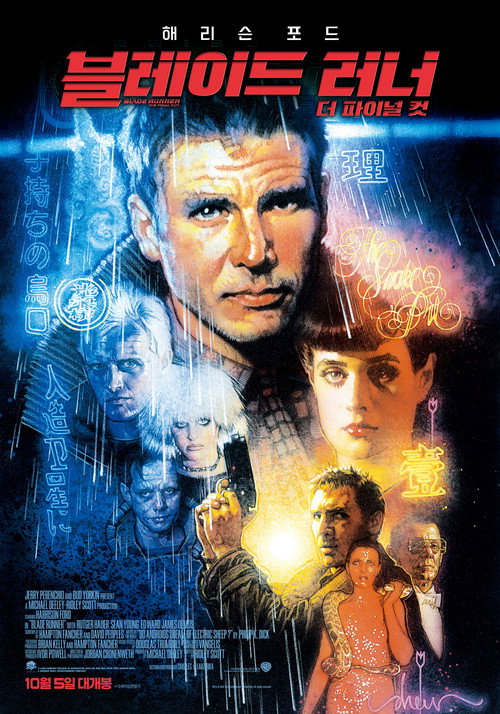
This pivotal scene traces the psychological disintegration of retired Blade Runner Rick Deckard as he carries out his mission to hunt replicants. Having initially dismissed replicants as 'useful or dangerous machines,' his cold professional facade is shattered by his encounter with Rachael — and he comes to stand at the very boundary he was sent to enforce.
Deckard's Emotional Collapse: From Pursuer to Doubter
The emotional turmoil Deckard experiences goes far beyond a simple romance — it visually enacts the process by which the 'clear boundary between human and replicant' he has believed in all his life collapses. This scene is the core narrative device through which he is tested on his convictions and identity at the ambiguous border between hunter and hunted.
🔍 The Planted Moment: The Cold Professional's Gaze
At the film's opening, Deckard defines himself as a specialist police officer — a 'Blade Runner' — and maintains extreme professionalism and cold detachment. When dealing with replicants he keeps emotional distance, treating them as 'useful or dangerous objects no different from other machines.' This demonstrates that he perceives his own emotions as an obstacle to the performance of professional duty. Deckard at this point is closer to a perfectly functioning 'tool' than a feeling being.
💔 The Retrieval Point: The Backwash of Emotion Through Rachael
The decisive catalyst by which Deckard's emotional defenses collapse is his encounter with Rachael. Rachael is a Tyrell Corporation replicant, but the device of 'human memory' she carries throws an unpredictable variable at Deckard. He seeks to perceive Rachael solely as a target for pursuit — but the subtle emotional responses and intellectual depth she displays stimulate the 'human feelings' he had long suppressed.
In this process, Deckard confronts the pain and existential questioning of the being he is pursuing, and his belief that he occupies a superior position begins to waver. In particular, the questions Rachael poses are the very questions Deckard should be asking himself.
"I'm not in the business. I am the business."
This line starkly reveals the gulf between the 'professional definition' Deckard has been pursuing and 'personal existence' — hinting that he is far more than a simple hunter.
💡 The List of Foreshadowing: Details That Blur the Boundary
The foreshadowing that underlies Deckard's emotional turmoil is planted throughout the film. Most important is the ambiguity of 'memory' and 'truth.'
- The nature of the Voigt-Kampff test: This test is depicted as the only method for distinguishing human from replicant, but it is in fact nothing more than a tool for measuring 'emotional response.' The very act of repeatedly administering this test paradoxically reveals that Deckard is censoring his own emotional responses.
- Deckard's past and memory: There are aspects of his own past events and memories that Deckard cannot fully explain. This plants the suspicion that he may not be a 'perfect human' — opening the possibility that he may be fundamentally the same 'imperfect being' as the replicants he is hunting.
- Environmental backdrop: The backdrop of a ravaged Los Angeles blanketed in London-style smog and acid rain symbolizes the environmental and moral pollution humanity has undergone. This connects the very existence of replicants to the vast theme of 'the failure of civilization.'
🧠 Why This Is Central to the Film's Identity
This scene establishes Blade Runner as a philosophical tech-noir that interrogates human ontology rather than a simple sci-fi action thriller. Deckard's emotional turmoil also prompts the audience to ask: if emotion is the proof of humanity, is Deckard human? The very process of seeking an answer to this question is the film's greatest attraction — elevating Deckard from simple 'hunter' to 'seeker.'
Why It Matters
Deckard's emotional turmoil is this film's most important philosophical pillar. Blade Runner pursues the 'other' in the form of a replicant — but in the process makes Deckard see himself through the eyes of that 'other.' This causes the film to transfer the question 'Who is really human?' to the audience — inducing viewers to empathize with Deckard's guilt and confusion. This psychological depth is the core engine that places Blade Runner as the defining existentialist masterwork of the cyberpunk era, elevating it beyond a simple science-fiction genre piece.
Other 명장면 dives5
- arrow_outward
Replicant Life Expectancy and Rebellion
The replicant four-year lifespan is not a simple plot device — it is the 'built-in obsolescence' mechanism the Tyrell Corporation designed to control the value of their existence. This setting goes far beyond science-fiction interest into a sharp critique of how capitalist society controls and depletes its labor.
- arrow_outward
How the Voigt-Kampff Test Works
The Voigt-Kampff test is the key mechanism in the Blade Runner universe for drawing the boundary between human and replicant. It poses questions designed to provoke subtle emotional responses, then measures the pupil dilation of the subject to distinguish human from replicant — and the film raises fundamental doubts about its reliability.
- arrow_outward
Implanted Memories and Identity
The implantation of memories in replicants is the film's most central philosophical device. Far beyond merely providing information, it defines the replicants' reason for existence and their claim to 'humanity.' Replicants like Rachael — who hold implanted human memories — embody the film's deepest ambiguity about what it means to be human.
Back to the title
Blade Runner
14 deep dives in total