Government Neglect and the Slum
The City of God favela — the film’s setting — is more than a mere spatial backdrop; it is the very core of the work’s thematic consciousness. In this space created by government neglect and structural poverty, where law and order are absent, survival itself is forced into dependence on crime and violence. All violence unfolding there is portrayed not as individual wrongdoing but as the inevitable result of systemic deficiency.
City of God: The Favela Become an Ecosystem of Violence
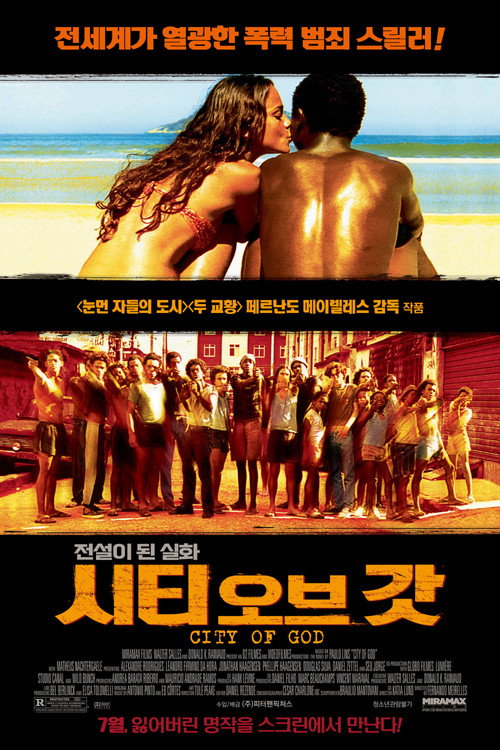
The “City of God (Cidade de Deus)” that serves as the film’s setting is modeled on the favela of Rio de Janeiro, Brazil. This space, beyond its geographical location, condenses the structural contradictions and history of violence of Brazilian society spanning from the 1960s to the 1970s. The film calls this place the City of God, but behind it lies only the struggle for survival created by the institutional neglect of government and the indifference of capital.
1. Setting Definition: A Space Where Law and Order Are Absent
City of God exists in the gaps where the law and order of the outside world cannot reach. The harsh environment — lacking even basic infrastructure like electricity and running water — forces residents to construct their own survival methods rather than expecting outside help. In this process, violence and crime become not mere deviation but the most efficient and essential economic activity and social currency.
- The economics of survival: Poverty is the driving force of crime. The gaze of protagonist Rocket records the process of taking photos to earn money in this space, while gangs secure funds through drugs and robbery. Violence is part of the capital circulation itself.
- The self-control system: Because external police or judicial systems do not function properly, gangs form a kind of alternative order. This order is maintained by the logic of force — creating a cycle of violence where the strongest becomes the ruler.
2. How It Operates in the Work: The Stratification of Violence
The film shows how this favela operates as a stage for the stratification of violence and power struggles. The early Tender Trio’s activities begin with simple robbery, but their actions gradually evolve toward the grand goal of territorial struggle and power seizure.
- The transfer of power: The order initially led by the Tender Trio is gradually absorbed and replaced by the more brutal and ambitious Li’l Zé. He is the figure who most extremely exploits this space’s structural deficiencies, proving through violence that he is the city’s de facto ruler.
- Principle and corruption: Knockout Ned’s character best shows the contradictions of this space. He sets the principle of not killing innocent people, but ultimately breaks that principle under the pressure of revenge and survival. This symbolizes how easily the City of God environment demolishes individual moral boundaries.
- The gaze as recorder: Buscápe’s camera serves as the lens recording all these scenes of violence. He tries to objectively record the tragedy of this space, but ultimately the recording itself becomes the core element completing the narrative of violence.
3. The Symbolism of City of God
This favela is not simply a poor place. It is a massive social experiment — a place where Brazilian society turned away, where human life is sustained only by violence and survival instinct outside the institutional framework. Through this space, the film overwhelmingly shows how poverty and violence combine to destroy individual lives and ultimately create a vast cycle of violence.
Why It Matters
The favela setting of City of God is the most important thematic consciousness of this film. This space is not simply a stage where events unfold — it is itself the environmental condition that makes violence and crime inevitable. The director uses this space to expose the structural contradiction of Brazilian society: that the absence of institutional support destroys individual lives and forces violent survival methods. Therefore this setting serves as the fundamental cause of all character arcs and conflicts in the film, the core axis throwing a socially critical message beyond a simple crime thriller.
Other 설정 dives4
- arrow_outward
The City Through a Photographer’s Lens
Buscápe’s camera goes beyond a simple recording device — it is a mirror projecting the moral boundaries of City of God, mixed with violence and poverty, onto the audience. Through the professional gaze of photographer, he tries to objectify criminal scenes, but ultimately the very act of survival and recording draws him deep into the cycle of violence, playing a paradoxical role.
- arrow_outward
The Cycle of Violent Ambition
Li’l Zé’s violent growth is not a mere catalog of evil deeds — it shows the fatalistic cycle of violence created by the extreme environment of Rio de Janeiro’s favela. This dive uncovers the structural meaning of how the protagonist grows from successor to the Tender Trio to de facto ruler of the city, combining survival instinct and ambition.
- arrow_outward
The Systematic Seizure of Power
Li’l Zé’s emergence in City of God is the core narrative showing how power is systematically seized in the special space of the favela — beyond simple violence accumulation. Beyond occupying physical territory through gang warfare, he seizes the drug routes and economic structure and even gains the implicit trust of residents, ruling the city as its de facto governor. This is an analysis of how order is redefined in violent ways where poverty and violence combine.
Back to the title
City of God
12 deep dives in total