The Cycle of Violent Ambition
Li’l Zé’s violent growth is not a mere catalog of evil deeds — it shows the fatalistic cycle of violence created by the extreme environment of Rio de Janeiro’s favela. This dive uncovers the structural meaning of how the protagonist grows from successor to the Tender Trio to de facto ruler of the city, combining survival instinct and ambition.
The Fatalism of Violence: Li’l Zé’s Growth Narrative
Li’l Zé’s character arc compressively embodies one of the film’s most powerful themes: the cycle of violence. His growth is interpreted not as a matter of individual wickedness but as the inevitable result of a violent survival method created by government neglect and poverty. From childhood he proves his value through violence, and gradually nurtures the grand ambition to dominate the entire city — going beyond being a mere enforcer.
1. The Habituation of Early Violence: From Dadinho to Li’l Zé
Li’l Zé originally appears under the name Dadinho and learns how to use violence as a member of the early Tender Trio. His early crimes, going beyond simple robbery, form the habit of using violence as a means to satisfy his desires. Through this process he embodies that violence is power, and power is survival.
- The manifestation of early violence: Robbery and violence during gang activities take root in him as habit rather than rules. This becomes the first stage in which he acquires social status through violence.
- The seed of ambition: Beyond simply belonging to a gang, he wants to become a boss who seizes most of the city’s drug routes. This ambition makes him the successor to the Tender Trio.
2. The Decisive Turning Point: Benny’s Death and the Explosion of Vendetta
The event that decisively triggered Li’l Zé’s violent growth was Neguinho accidentally killing Benny. This is not merely an accidental murder — it gives Li’l Zé the powerful motive of personal grudge, maximizing his violence.
- The confrontation with Cenoura: Neguinho’s act triggers a vast war between Li’l Zé and Cenoura — a struggle over order and dominance. Li’l Zé expands his power through this war.
- The logic of violence: The violence occurring in the process of touching Cenoura’s territory shows how he constantly demolishes moral boundaries to realize his ambition. He follows a merciless logic where any means are acceptable to achieve his goals.
3. The Completion of Violence: The Uncontrollable Cycle
In the film’s climax, Li’l Zé eliminates all competition and approaches becoming the boss of City of God. But his violent ambition ultimately leads him to his own ruin. Violence gave him power, but that power isolated him and ultimately made him a victim of the innocent violence he most despised.
- The final tragedy: The result of the most brutal violence he wielded returns through the hands of the young lackeys he had trampled. This symbolically shows that his violent growth was not for himself but was the cycle of violence of that very environment.
- The conclusive meaning: Li’l Zé’s death means the inevitable tragedy that occurs when violence and ambition combine in the favela, and the fatalistic conclusion he could never escape.
Why It Matters
Li’l Zé’s narrative is the core device proving that this film is a socially critical epic transcending a simple crime thriller. His violent growth cannot be dismissed as individual wickedness — it must be interpreted as the result of structural violence created by the favela as spatial and social background. The cycle of ambition he undergoes poses questions to the audience about how human moral boundaries collapse when poverty and violence combine, and how violence is justified in the name of survival through that process. His downfall symbolizes the fundamental contradiction of the system called the favela.
Other 떡밥 dives4
- arrow_outward
The City Through a Photographer’s Lens
Buscápe’s camera goes beyond a simple recording device — it is a mirror projecting the moral boundaries of City of God, mixed with violence and poverty, onto the audience. Through the professional gaze of photographer, he tries to objectify criminal scenes, but ultimately the very act of survival and recording draws him deep into the cycle of violence, playing a paradoxical role.
- arrow_outward
The Systematic Seizure of Power
Li’l Zé’s emergence in City of God is the core narrative showing how power is systematically seized in the special space of the favela — beyond simple violence accumulation. Beyond occupying physical territory through gang warfare, he seizes the drug routes and economic structure and even gains the implicit trust of residents, ruling the city as its de facto governor. This is an analysis of how order is redefined in violent ways where poverty and violence combine.
- arrow_outward
The Cycle of Violence and Its Tragic End
The central theme of City of God is the cycle of violence and its tragic conclusion. Through the process of the gangs seizing the city, the film meticulously shows how violence begins from a survival instinct but gradually loses its reason and moral boundaries. Ultimately, all violence loses its purpose and resolves into the meaningless cycle of war for war’s sake.
Back to the title
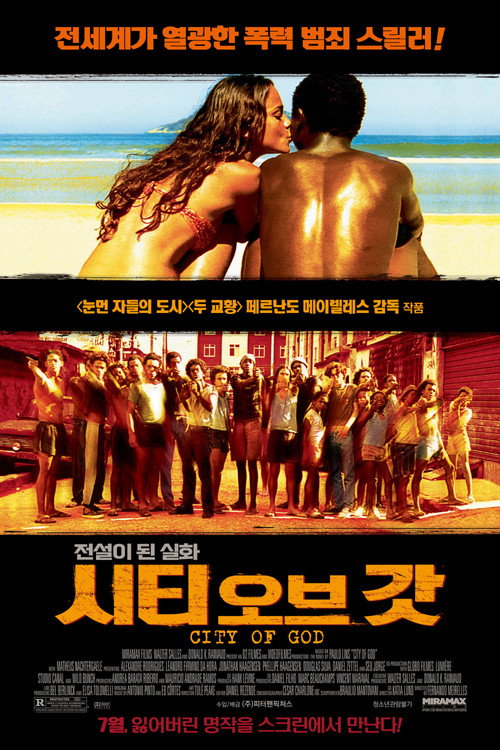
City of God
12 deep dives in total