Cardarrow_outward
The Challenges and Importance of the SETI Project
The SETI project symbolizes the domain of pure science — the exploration for intelligent extraterrestrial life. The project has the fundamental goal of collecting radio signals, but in the work it constantly faces funding shortfalls, scientific skepticism, and obstruction from power structures that prioritize practicality. SETI's journey poses the fundamental question of what place the value of 'experience' and 'belief' without scientific evidence should occupy in modern scientific society.
Cardarrow_outward
The Alien Civilization's Perception of Time
The alien civilization's perception of time is not merely a scientific setting — it is the central theme that tests humanity's ontological limits. They do not see past, present, and future as separate linear time, but understand everything simultaneously in a circular vision (the Hamiltonian way) where all moments coexist. This concept deepens the collision of scientific evidence and religious belief in the film, forcing us to question our very definition of human 'truth.'
Cardarrow_outward
The Vega Signal and Hitler's Broadcast
In Contact, the signal received from Vega was not simply alien communication — it contained a shocking video record of one of humanity's most controversial and darkest moments. This signal contains Adolf Hitler's opening declaration at the 1936 Berlin Olympics, serving as key evidence proving that an alien civilization had objectively observed and recorded human history. It becomes the occasion for humanity's dark history to be reexamined on a cosmic scale.
Cardarrow_outward
Arecibo Observatory and Radio Reception
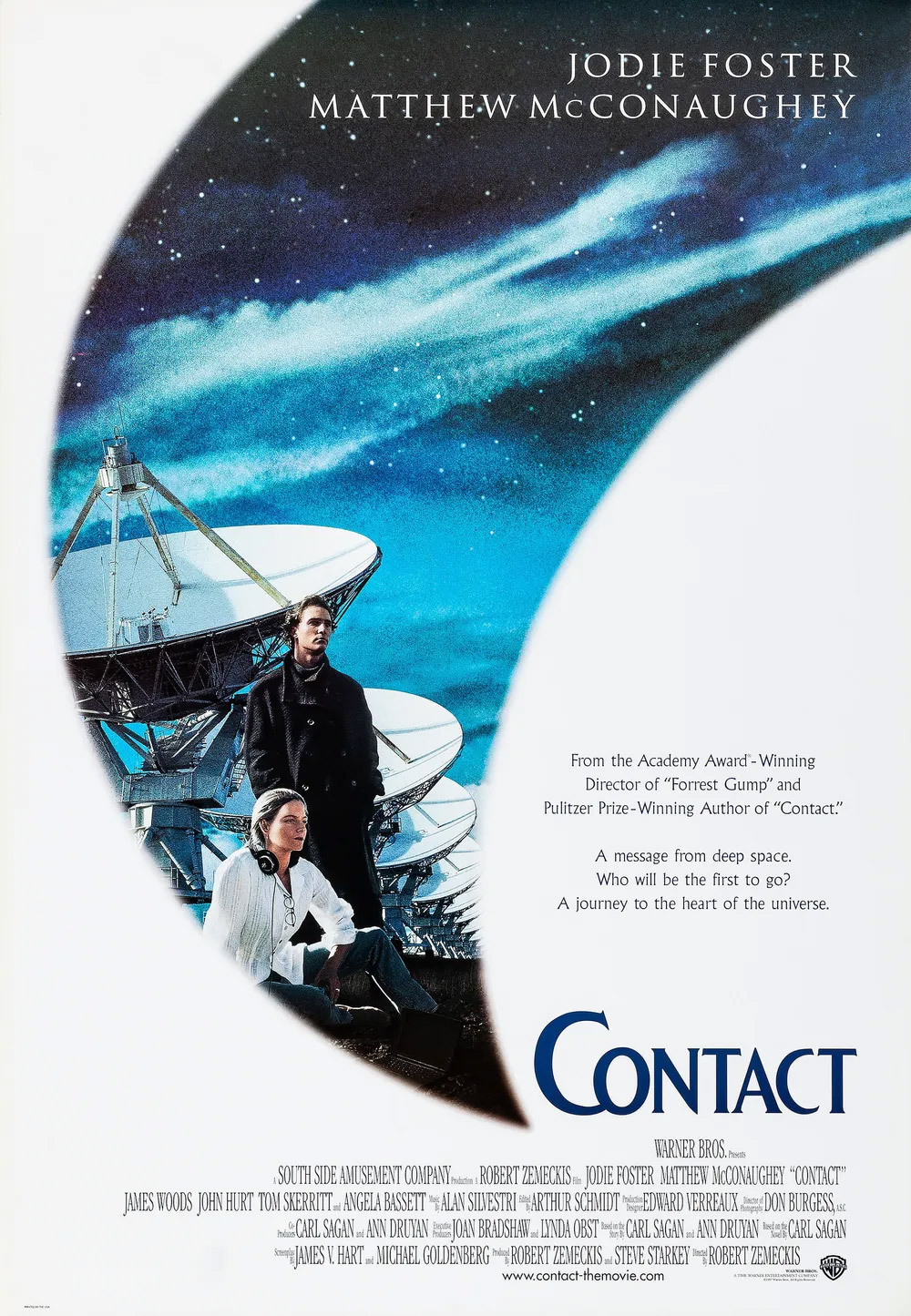
Arecibo Observatory is the physical heart of Contact and the pivotal stage for contact with intelligent life. This giant radio telescope goes beyond a simple scientific instrument to serve as an intermediary for humanity's most fundamental questions — scientific evidence versus religious belief. The signal from Vega received here provides humanity with a blueprint for a great civilization, while vividly exposing the limits of scientific 'proof.'
Cardarrow_outward
The Value of Scientific Evidence vs. Personal Experience
In Contact, the conflict between scientific evidence and personal experience is the core philosophical axis. The 'experience' Ellie Arroway gains through contact with an alien civilization cannot, no matter how passionately she testifies, be presented as objective evidence — exposing the limits of scientific proof. This process paradoxically shows that truth does not depend solely on measurable data but can also exist in the domain of human belief and thought.
Characterarrow_outward
Ellie Arroway (Eleanor Arroway)
Ellie Arroway is more than an astrophysicist — she is a figure who explores the boundary between scientific evidence and human spiritual experience. Her life is a journey in search of cosmic truth, and she paradoxically proves the value of 'meaning' and 'hope' that scientific methodology alone cannot capture. Her anguish poses the deepest question humanity faces: 'What should we believe?'
Characterarrow_outward
Palmer Joss
Palmer Joss is a theologian who poses the most fundamental question — 'faith' — to Ellie Arroway, who seeks to define truth only through scientific proof. He goes beyond being a simple religious advisor to symbolize the value of a domain that humans cannot reach by rational knowledge alone, making him the decisive figure who enables the coexistence of science and faith — the central theme of the film.
Characterarrow_outward
David Drumlin
David Drumlin measures alien contact — that towering subject — against the yardstick of 'scientific pragmatism' and 'national security.' He cares only about results that can be immediately sold to the public or military, constantly raising skepticism about Ellie Arroway's research. Drumlin symbolizes the point where the ideal of pure science collides with capitalist pragmatism.
Quotearrow_outward
If it's just us, it seems like an awful waste of space.
"If it's just us, it seems like an awful waste of space" is the reason for being of protagonist Ellie Arroway, and the core belief that runs through the entire film. This phrase extends humanity's intellectual curiosity from the limited space of Earth to a cosmic scale, placing the discovery of extraterrestrial intelligent life as the ultimate goal of scientific inquiry. It is more than an academic hypothesis — it is a philosophical declaration exploring the fundamental loneliness and meaning of humanity.
Readingarrow_outward
The Boundary Between Scientific Proof and Faith
Contact deeply explores the chasm between the limits of scientific methodology — the objective evidence that can be measured and verified — and the subjective realm of human spiritual belief. The film criticizes the scientific arrogance that would define cosmic truth solely by data, paradoxically arguing that human experience and intuitive insight are a vital part of existence that scientific knowledge alone cannot explain.
Readingarrow_outward
The Debate Over Representing Humanity and Political Pressure
In Contact, contact with an alien civilization is portrayed not merely as a scientific achievement but as a stage for political and cultural debate over who gets to represent humanity. The process by which Ellie Arroway is eliminated from the final astronaut candidates on the grounds that she 'does not believe in God' is a core interpretation showing that humanity cannot overcome the barrier of the religious and social consensus it has set for itself, no matter how clear scientific truth may be.