If it's just us, it seems like an awful waste of space.
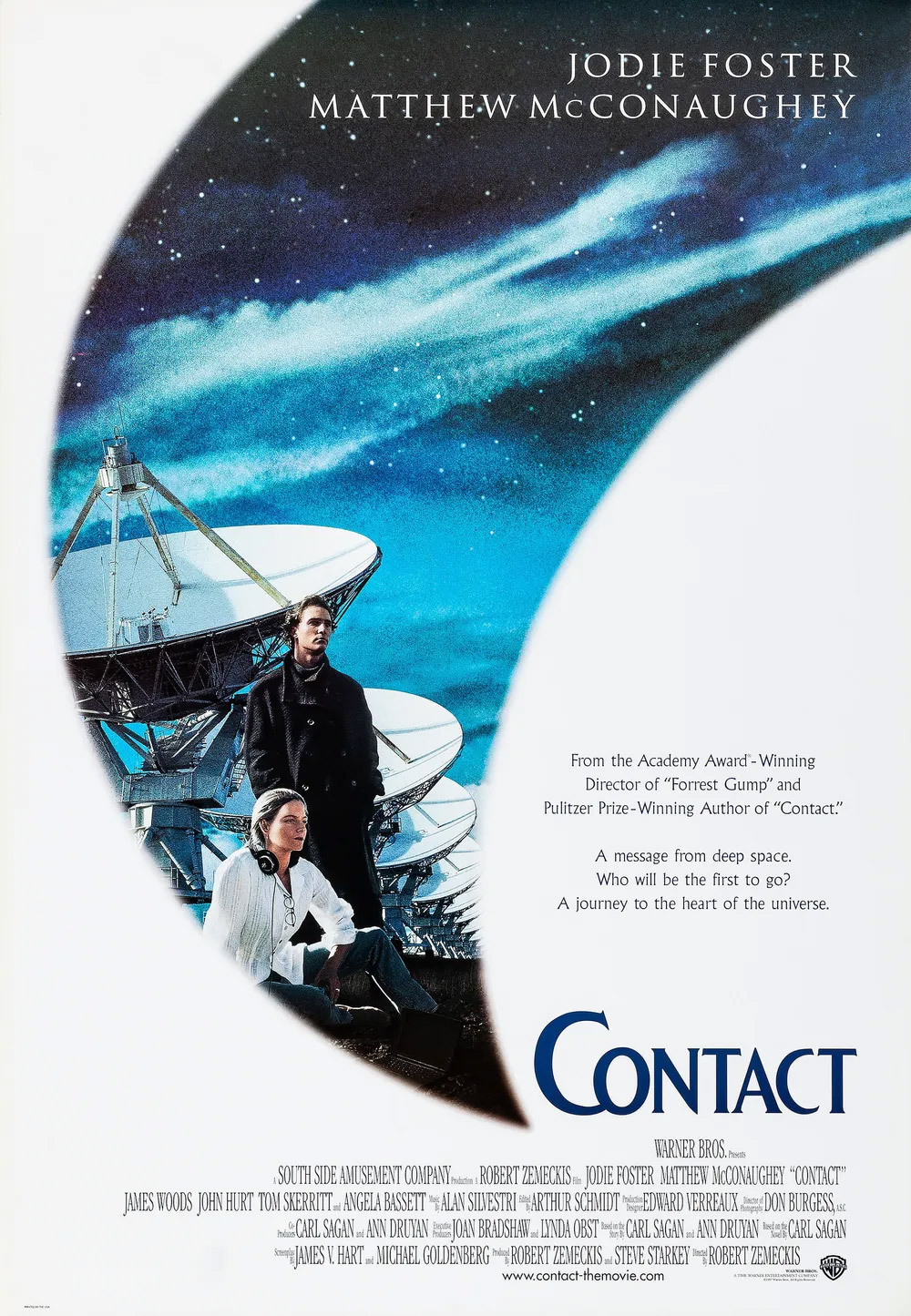
"If it's just us, it seems like an awful waste of space" is the reason for being of protagonist Ellie Arroway, and the core belief that runs through the entire film. This phrase extends humanity's intellectual curiosity from the limited space of Earth to a cosmic scale, placing the discovery of extraterrestrial intelligent life as the ultimate goal of scientific inquiry. It is more than an academic hypothesis — it is a philosophical declaration exploring the fundamental loneliness and meaning of humanity.
"If It's Just Us, It Seems Like an Awful Waste of Space": A Declaration Staked on the Reason for Existence
This phrase transforms Ellie Arroway from a mere astrophysicist into an explorer with a cosmic sense of mission. It is a "cosmic healing" manifesto in which her personal grief and scientific aspirations are intertwined.
🌌 Context of Utterance: Breaking the Bonds of Earth
Behind this belief lies a deep personal sense of loss. Losing her mother and father in childhood led Ellie to pose fundamental questions about the meaning of existence. For her, the universe is not simply an object to observe; it is the only space where the connection she lost — "truth" — might exist.
In the early stages of research, Ellie realizes that Earth's resources and phenomena cannot quench her intellectual thirst. Her gaze turns, within the vast SETI framework, toward the territory humanity has not yet reached: an alien intelligent civilization.
🔬 Position in the Work: The Point of Collision with Pragmatism
This belief is the driving force of every moment Ellie collides with "pragmatism." When Drumlin criticizes SETI's practicality and urges her to halt the project, she stands her ground using this belief as a shield. For her, the hypothetical possibility that "we might not be alone" was far more important than the immediate funding shortage or government skepticism.
This belief also becomes the decisive trigger for Ellie to announce the Vega signal to the world despite insufficient scientific evidence — an attempt to drag truth beyond the strict framework of scientific methodology into the realm of human instinctive belief in "experience" and "possibility."
💡 Viewer/Fan Reaction: Giving Voice to Universal Loneliness
This phrase resonates deeply as the theme of "the universal loneliness of humanity." We all hope something immense is watching over us, or that an existence like ours is out there somewhere. Ellie's belief transcends the domain of scientific knowledge to represent the longing for "meaning" and "connection" that the human soul instinctively pursues.
🚀 Subsequent Influence: Redefining the Definition of Truth
Ellie's belief leads, in the film's conclusion, to a question about "the definition of truth." Her extraterrestrial travel experience is dismissed at the congressional hearing as "hallucination." But Ellie insists it is "a truth sufficiently meaningful" for her. The audience is asked: must truth be proven only by objective data, or does an "experience" that fundamentally transforms an individual's life hold sufficient value in itself?
In the end, Ellie chooses to live awaiting contact with the cosmos while teaching science to the children who visit her research station — showing her belief was sublimated into "a sustainable form of faith."
Why It Matters
This phrase is the most important philosophical pillar defining the identity of Contact. Ellie's entire life is the process of trying to prove this belief, connecting three axes: science, faith, and human intellectual curiosity. The film focuses not on proving the existence of alien civilizations but on answering the question 'What can humans believe to be true?' This phrase symbolizes the primordial driving force behind humanity's pursuit of non-material values like 'possibility' and 'meaning' even in the absence of scientific evidence.
Back to the title
Contact
11 deep dives in total