Cardarrow_outward
Tearing the Textbook: An Emphasis on Creativity
The act of tearing a specific page from the textbook goes beyond mere rebellion to become the most powerful and symbolic rejection of the rote-learning system and the score-based knowledge framework. The process in which Keating encourages students to tear the page functions as the decisive educational shock that awakens them to the realization that thinking for themselves and exercising creativity is the true meaning of learning.
Characterarrow_outward
Principal Gale Nolan
Principal Gale Nolan is the symbolic authority of Welton Academy and the embodiment of institutional order. He prizes the school's reputation and tradition above all and labels the students' free-spirited cries as 'deviance.' Yet as the film progresses, he witnesses the students' inner growth and gradually develops cracks in his own convictions — undergoing a slow, complex transformation.
Characterarrow_outward
Todd Anderson
Todd Anderson is the most timid and introverted student, living in the shadow of his high-achieving brother. Through John Keating's challenges he discovers the 'wild spirit' and artistic sensibility latent within him, undergoing a dramatic transformation. His growth goes beyond personal development to show the symbolic process of an individual reclaiming free will within a suppressive system.
Readingarrow_outward
The Essence of Education: Rote Knowledge vs. Spontaneous Passion
Dead Poets Society goes beyond literary inspiration to pose the fundamental question: 'What is the purpose of education?' The film argues against the rote-learning system that forces a single goal of 'success' upon students, and makes the case for spontaneous passion — the importance of individuals thinking and questioning for themselves, allowing their own buds to bloom.
Readingarrow_outward
The Collision of Parental Expectation and Self-Actualization
The core theme of this film is a critique of the danger of parents viewing their children not as independent persons but as proxies for their own desires. Neil Perry's tragic end shows how external coercive expectations and social discipline destroy genuine self-actualization, and argues that true education means listening to the inner voice.
Characterarrow_outward
John Keating
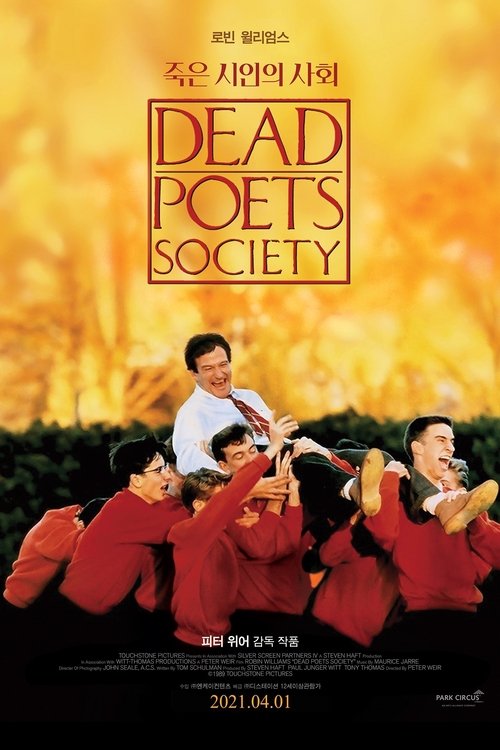
John Keating is the revolutionary English teacher who breaks Welton Academy's conservative mold and throws his students the message 'seize the day (Carpe Diem).' He teaches that poetry need not deal with grandiose themes, and through the process of awakening the 'wild spirit' latent within each student, proves that genuine education is free will beyond the mere transmission of knowledge.
Quotearrow_outward
Seize the day (Carpe Diem).
'Seize the day (Carpe Diem)' is far more than a Latin phrase — it is the most powerful message thrown to the souls trapped within the conservative mold of Welton Academy. In this film the phrase functions as a refusal of the forced way of life prescribed by 'textbook answers,' and as an existential declaration that individuals must discover their own passion and free will.
Characterarrow_outward
Charlie Dalton
Charlie Dalton is the first among Welton Academy's students to give voice to a 'free spirit.' He may appear to be a rebellious class clown, but in reality he is the most quickly perceptive of Keating's teaching and the most honest critic of the school's absurdities. His actions function as a catalyst — not mere pranks, but the sharpest questions thrown at a suppressive system.
Characterarrow_outward
Neil Perry
Neil Perry is a person who tried to hold onto his artistic dream amid the enormous pressure of parental expectations and social discipline. He discovers his identity through theater, but ultimately collapses under his father's coercive control and realistic expectations, meeting a tragic end. His story is the most tragic and central narrative of the film — showing how an individual collides with the track of success laid down by society.
Readingarrow_outward
Carpe Diem: The Courage to Live in the Present
The 'Carpe Diem' in the film is not a light slogan to 'enjoy the present.' It signifies the courage to be honest with oneself in this very moment, representing the process by which individuals reject the framework of socially prescribed success and discover their true passion. The theme functions as the most powerful engine driving the awakening of suppressed souls.
Cardarrow_outward
The Symbolism of Todd's Desk-Stand
Todd Anderson's act of standing on his desk in the final scene goes beyond a simple moment of emotion to become the most powerful visual symbol of 'free will' that the film presents. This means the moment when an individual escapes the heavy desk of social expectation and proves their existence through their own voice — encapsulating the film's core theme.
Cardarrow_outward
The Tragic Ending and Social Critique
Neil Perry's tragic end is not a simple individual failure but a powerful critique of the systemic violence of parents' distorted desires and a society that evaluates individual worth solely by achievement or material indicators. Through the film, the process of labeling dreams and passion as 'deviance' and transferring responsibility raises the fundamental question of what genuine education is.
Cardarrow_outward
The Philosophical Meaning of Carpe Diem
Carpe Diem goes beyond its Latin meaning of 'enjoy the present' to carry a philosophical message that surpasses mere moment-savoring. In Dead Poets Society this concept is the core engine that breathes courage into students trapped by external expectations — to focus on 'this present moment' and discover their own passion, living a subjective life. It symbolizes the eternal tension between individual free will and social responsibility.
Cardarrow_outward
Welton Academy's Rigid Discipline
Welton Academy goes beyond a setting to become the great systemic pressure itself that causes individuals to lose their souls. This conservative elite prep school, which prioritizes Ivy League admission rates above all, forces only a single goal of 'success' upon students and labels individual dreams and free thought as 'deviance.' The film sharply critiques how Welton's strict discipline and expectations suppress the students' selves and ultimately bring about a tragic result.