John Keating
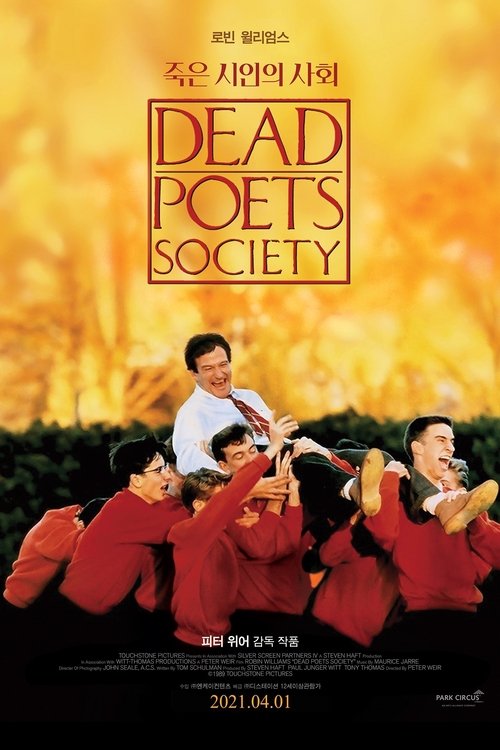
John Keating is the revolutionary English teacher who breaks Welton Academy's conservative mold and throws his students the message 'seize the day (Carpe Diem).' He teaches that poetry need not deal with grandiose themes, and through the process of awakening the 'wild spirit' latent within each student, proves that genuine education is free will beyond the mere transmission of knowledge.
📚 The Educator Who Demolished the Boundaries of the Textbook
When John Keating arrived at Welton Academy, he called into question the very method of existing, rigid, score-based education. He taught students that poetry need not deal with grandiose or beautiful themes — that poems can emerge from everyday, simple things like cats, flowers, and rain. Keating argued that poetry can be anything as long as it has the material of 'revelation,' urging students not to make poetry ordinary.
His lessons were a kind of spiritual liberation that transcended the mere transmission of knowledge. He guided students to draw out the 'barbaric' instinct within them, encouraging them to break through the frame of thought and free their minds. He encouraged students to express even complete gibberish, making them believe there was a poet even in that disordered thinking.
🎭 The Practice of 'Carpe Diem' and the Crisis
Keating's teaching gave students the freedom to think independently. Students came to feel passion through him, and this led to the formation of the Dead Poets Society — a gathering for liberating suppressed emotion.
Keating also delivered concrete messages beyond abstract concepts. Speaking of a 'blanket' that would not fully cover us, he taught the courage to face truth directly. Such teaching led students to become honest with themselves, but this simultaneously became the occasion for colliding with the enormous wall of social gaze and conservative prejudice.
🕊️ Keating as Scapegoat and His Enduring Legacy
Keating's teaching method taught students genuine dreams and happiness, but the film's ending closes with the painful sight of that happiness having to be brought back to reality — leaving a deep resonance.
Neil Perry's tragic death arose when students' passionate activities collided with the school's conservative order. The school and Neil's parents sought to shift the blame onto Keating, and ultimately Keating becomes a scapegoat.
After Keating has left, one day while Principal Nolan is teaching 'the understanding of poetry' in his place, Keating enters the classroom and the students pay him their final tribute. Todd Anderson climbs onto his desk and calls out "O Captain! My Captain!" — a scene symbolizing that the students have grasped genuine 'free will' rather than the inertia of choices made under compulsion.
Keating's teaching remains with the students forever, planting within them the courage to find their own genuine voice even amid the pressure of society.
Why It Matters
John Keating symbolizes 'individual free will' and 'the meaning of genuine education' — the core themes of this film — beyond being a simple teacher. He sought to teach not the acquisition of knowledge but 'how to think,' and this was the most beautiful and dangerous resistance against the authoritarian system of Welton Academy. His existence paradoxically shows — through the very process of his becoming a scapegoat — the irrationality of the system and the nobility of the individual spirit, making him an indispensable device that prompts audiences to ask: 'What is the proper purpose of education?'
Other Character dives4
- arrow_outward
Principal Gale Nolan
Principal Gale Nolan is the symbolic authority of Welton Academy and the embodiment of institutional order. He prizes the school's reputation and tradition above all and labels the students' free-spirited cries as 'deviance.' Yet as the film progresses, he witnesses the students' inner growth and gradually develops cracks in his own convictions — undergoing a slow, complex transformation.
- arrow_outward
Todd Anderson
Todd Anderson is the most timid and introverted student, living in the shadow of his high-achieving brother. Through John Keating's challenges he discovers the 'wild spirit' and artistic sensibility latent within him, undergoing a dramatic transformation. His growth goes beyond personal development to show the symbolic process of an individual reclaiming free will within a suppressive system.
- arrow_outward
Charlie Dalton
Charlie Dalton is the first among Welton Academy's students to give voice to a 'free spirit.' He may appear to be a rebellious class clown, but in reality he is the most quickly perceptive of Keating's teaching and the most honest critic of the school's absurdities. His actions function as a catalyst — not mere pranks, but the sharpest questions thrown at a suppressive system.
Back to the title
Dead Poets Society
14 deep dives in total