Ich will meinen Sohn. Und zwar lebend.
"Ich will meinen Sohn. Und zwar lebend." transcends simple paternal love — it is the most primal and powerful declaration of resistance to protect an individual life in the face of the great violence of war. In the midst of the grandiose propaganda logic of Nazi Germany, this line — delivered through the most private and human of voices — symbolically condenses the fall of the Third Reich and the tragedy of war.
"Ich will meinen Sohn. Und zwar lebend.": A Declaration of the Most Private Resistance
This line erupts from an utterly private and personal domain, in sharp contrast to the film's vast historical backdrop. Unlike Nazi Germany's propaganda, which always deployed grand discourse around 'nation,' 'war,' and 'destiny,' this sentence is grounded in the most fundamental human desire — only 'a son' and 'being alive.'
1. The Context of Utterance: Refusing to Play at War
Peter's father witnesses his son about to join a youth organization like the Hitler Youth and participate in the war. This scene is a crucial juncture setting the tone for the film's early portion. The son's passion and naïve enthusiasm are ensnared by the illusion of 'glorious war' instilled by the state. The father, perceiving the situation as mere 'play,' expresses his deep despair in the act of stopping his son.
This line is a warning the father delivers to his son, and simultaneously a question he poses to himself. "Ich will meinen Sohn. Und zwar lebend." — "I want my son. And alive, at that." — it maximizes the paternal resistance that refuses to allow the son to be consumed as an instrument of war.
2. Its Position and Meaning in the Film: The Individual's Rebuttal of Grand Discourse
The film calmly records the grand power struggles and the process of defeat of the Nazi high command. Their conversations are always filled with grand political terminology — 'strategy,' 'front lines,' 'purges,' 'orders.' In this context, this iconic line serves as a kind of 'stop signal.' Amid the din of the vast war machine turning, the most human and illogical of emotions — paternal love — bursts forth, causing audiences to stop and think.
This line reaches beyond the desire to simply protect a son, posing the fundamental question: "In the logic of this war, what value does a human life hold?" The father wants his son to have value as a 'living being,' not as an abstraction called 'victory in war.'
3. Subsequent Impact: The Price of Speaking Truth
Through this iconic line, the father makes his opposition to the war explicit. But the film shows that he pays the price for speaking this truth. He ultimately meets a tragic end, killed on charges of being a Communist. This symbolizes the core message the film conveys — that 'the individual who speaks truth is eliminated first, and most cruelly, within a vast totalitarian system.'
In this way, the line does not end as a simple emotional cry, but functions as a narrative engine showing how an individual's conscience is trampled by the system.
Why It Matters
This iconic line is the point most deeply connected to the film's thematic consciousness. If the film portrays the 'collapse of power' of the Nazi high command with a dry, objective gaze, this line seeks the fundamental cause of that collapse in 'the loss of humanity.' What the Nazi leaders demonstrated was not tactical failure, but an absence of human empathy. The father's cry of "Ich will meinen Sohn. Und zwar lebend." is precisely the final utterance of that 'human empathy.' Through this line, the film sublimates the defeat not merely as military defeat, but as moral and spiritual defeat — guiding audiences to empathize with historical tragedy on the individual level.
Back to the title
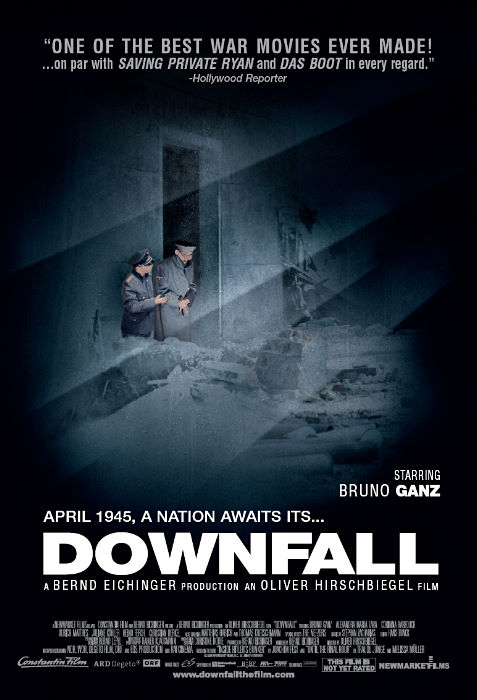
Downfall
14 deep dives in total