Foreshadowing the Nature of Memory and Love
Through the sci-fi premise of memory erasure, this film paradoxically proves that even the painful memories we suffer through are an indispensable part of our existence. Love, it argues, is not simply a sequence of happy moments, but a philosophical question about 'existence itself' — an existence that embraces even the small sensory traces and pains surrounding those moments.
The Reconstruction of Memory: The Sum of Senses Beyond a Sequence of Events
Just as the film's title is drawn from Alexander Pope's poem "Eloisa to Abelard," this work treats love and memory not as simple matters of emotion, but as concepts rooted in knowledge, art, and philosophy. As the audience follows Joel through the process of erasing his memories of Clementine, they come to understand that memory is not merely 'a sequence of events.'
Memory is the sum of the minor sensory cues that surround those events — a scent, a color, an object, even the angle of light. The film's visual rendering of this — letters disappearing from the pages of books, the colors of library book covers bleaching away, entire background objects hurling off — amplifies the importance of these 'sensory fragments.' Each time Joel tries to erase a memory, he loses not only the pain of that moment but every minute detail that gave that pain its shape.
Those Who Preserve the Pain: Foreshadowing Within Lacuna
These questions about the 'nature of memory' are not confined to the lead couple. The staff inside the Lacuna clinic are also important foreshadowing devices that illuminate the relationship between memory and truth.
- The relationship between Mary and Director Howard: The most explicit example is the affair between receptionist Mary Svevo and director Howard Mierzwiak. Mary was able to erase the memory of loving Howard, but she could not erase the 'feeling of love itself' for him. This shows that memory erasure is a physical act — it cannot erase the emotional core of a human being. Mary ultimately propagates this truth to patients in the form of recorded tapes and case files, asserting the authenticity of memory.
- Patrick's role: Technical assistant Patrick secretly steals objects bearing Joel's memories during the process of erasing Clementine's. He stages himself as if he were Clementine's ideal type, yet the anxiety Clementine experiences is ultimately evidence of an unconscious resistance to the fact that 'real memory' still exists.
The Closing Tape: A Flaw Is the Proof of Love
The tapes Joel and Clementine receive at the film's climax are the conclusion of all this foreshadowing. On the tapes, each has spoken harshly about the other: Clementine calls Joel 'dull and boring,' and Joel accuses Clementine of being 'uneducated and low-brow.' Hearing each other's flaws so nakedly exposed, they both fear beginning to love again.
But the moment Joel says "What the hell? Okay." and chooses to embrace those flaws, their love is finally completed — not as 'perfect memory' but as 'imperfect beings.' This ending declares that love takes its full shape only when it can embrace even the dark shadows of pain and flaw.
Why It Matters
The reason this film is celebrated as a masterpiece beyond a simple sci-fi romance is that it used the familiar subject of 'memory' as a tool for philosophical inquiry. Through the extreme premise of memory erasure, screenwriter Charlie Kaufman argues that human identity is not the accumulation of facts, but the sum of the sensory experiences and pain (Emotion) that surround those facts. In particular, the staff subplot at Lacuna parallels and reinforces this theme alongside the main plot, showing that the very act of erasing memory is a violence against the human essence. Ultimately this work demands of the audience a deep reflection: 'The pain you want to forget may be the most important part of what made you.'
Other 기타 dives4
- arrow_outward
The Reverse-Order Memory Erasure
The structure in which the memory-erasure process proceeds in reverse chronological order in Eternal Sunshine transcends a mere sci-fi device — it is the core mechanism for exploring human existential pain and love. Within this reverse flow of time, protagonist Joel feels the terror of his happiest memories disappearing, resists desperately to preserve them, and ultimately comes to understand how to embrace even the pain.
- arrow_outward
The Color-Coded Point-of-View Device
Eternal Sunshine uses a color-coded point-of-view system to visually imprint on the audience how subjective and malleable memory itself is. The shifts between green, orange, and blue go far beyond background decoration — they serve as the film's core visual language, functioning as a crucial metaphor for the characters' psychological states and the evolution of their relationship.
- arrow_outward
The Night Outing on the Frozen Charles River
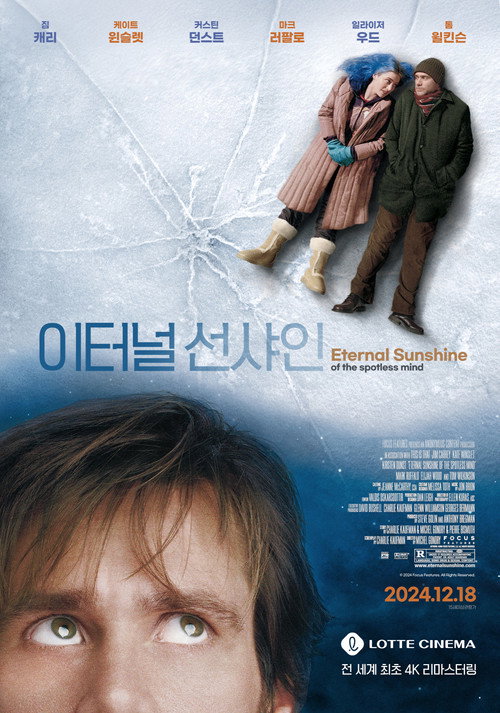
The night-outing scene on the frozen Charles River is far more than a simple recreation of a memory — it is the pivotal turning point in the film's exploration of love's true nature through the sci-fi premise of memory erasure. By re-staging the language and emotion of a letter Joel once wrote to Clementine, the scene amplifies the most beautiful and most painful moment the two shared. This meeting is a ritual of confirming each other's existence, and a paradoxical device that, within the very memory being erased, causes love to be rediscovered.
Back to the title
Eternal Sunshine of the Spotless Mind
14 deep dives in total