The Cyclical Ending of the Original Script
The 'cyclical ending' that existed in early drafts of the screenplay was an attempt to symbolically portray the fateful, repeating patterns of love and loss that define human life. Yet the final film abandons this grand cyclical structure and instead chooses an 'imperfect present' — embracing even pain and flaws — thereby emphasizing that love's true nature is not fate but a continuous act of choice.
The Repetition of Love: The Contrast Between Early Conception and Final Choice
The film's theme is the eternal conflict between 'the calm gained by erasing memory' and 'the pain endured by preserving memory.' Interestingly, when this film was first conceived, the screenplay held a far grander and more fateful narrative than the sci-fi device of 'memory erasure' as we know it.
🔄 The Early Screenplay: A Cyclical, Fateful Pattern
Early drafts reportedly included a cyclical ending in which Joel and Clementine do not end with a single meeting — instead, across multiple lifetimes, they fall in love, fail, erase their memories, and meet again as if by fate. The intention was to portray love and loss repeating like a great circular pattern — a fateful destiny built into human life. The film was not simply a romance about one couple's breakup; it sought to pose the philosophical question of 'human relationships as a repeating cycle.'
This conception amplifies the film's central theme of love's repetitive nature and prompts the audience to ask: 'Why do we keep making the same mistakes?'
💔 The Final Structural Choice: A Return to the Imperfect Present
But Michel Gondry and Charlie Kaufman ultimately abandon this grand cyclical structure. Instead, they choose not the moment when everything is perfectly resolved and one possesses a 'clean mind,' but rather an 'imperfect present' — one in which even pain and flaws, and mutual criticism, are shared.
This structural shift fundamentally alters the film's message. If love perfectly cycles by fate, the process should seem to be heading toward a beautiful resolution — yet the film refuses that resolution.
The Significance of the Final Ending:
- Fate vs. Choice: If the early conception focused on 'fate,' the final ending focuses on 'choice.' After Joel and Clementine meet again and listen to tapes on which they have criticized each other, yet ultimately say "Okay" — this act does not recreate a perfect love but shows a deliberate choice: acknowledging each other's flaws and wounds, and choosing to sustain the relationship in spite of them.
- The Value of Memory: The cyclical ending focuses on 'result,' but the final ending focuses on 'process.' All the small, painful moments that Joel fought to hold on to as memories were erased — the very 'pain he did not want to lose' — become the core elements that constitute their existence.
💡 Structural Depth: The Roles of 'Montauk' and 'the Tape'
This structural choice is underpinned by the film's two most crucial devices.
- Montauk Beach: Just before Joel's memories are completely erased, Clementine says "Meet me in Montauk." This location becomes the 'place of restart' where the two meet again after everything has been reset. It is not only a physical location — it is a symbolic space where the two make a promise of a new beginning that transcends their perfect past memories.
- The Tape: The tape Mary Svevo sends objectifies the wounds and criticism each inflicted on the other, presenting them in the open. The process of confronting this 'unwelcome truth' is precisely the realistic weight they must endure — greater than any of their previously perfect memories. Through this tape, the film declares that love is not 'the reconstruction of beautiful memories' but 'the act of living while acknowledging each other's flaws.'
Why It Matters
The cyclical ending conceived in the early screenplay represents the grandest and most philosophical theme this film could have explored: 'the fateful repetitiveness of human beings.' If the film had followed that cyclical structure, love would have appeared to be a destiny converging toward a perfect happy ending. But the filmmakers deliberately rejected that grand fatalism and — by capturing the most trivial, most flawed, most 'imperfect' moment of the present — established the work's identity. Thanks to this structural choice, the film transcends simple romance to deeply explore how illogical, painful, yet ultimately sustainable human relationships are — an endless series of 'choices.'
Other 비화 dives4
- arrow_outward
The Reverse-Order Memory Erasure
The structure in which the memory-erasure process proceeds in reverse chronological order in Eternal Sunshine transcends a mere sci-fi device — it is the core mechanism for exploring human existential pain and love. Within this reverse flow of time, protagonist Joel feels the terror of his happiest memories disappearing, resists desperately to preserve them, and ultimately comes to understand how to embrace even the pain.
- arrow_outward
The Color-Coded Point-of-View Device
Eternal Sunshine uses a color-coded point-of-view system to visually imprint on the audience how subjective and malleable memory itself is. The shifts between green, orange, and blue go far beyond background decoration — they serve as the film's core visual language, functioning as a crucial metaphor for the characters' psychological states and the evolution of their relationship.
- arrow_outward
The Night Outing on the Frozen Charles River
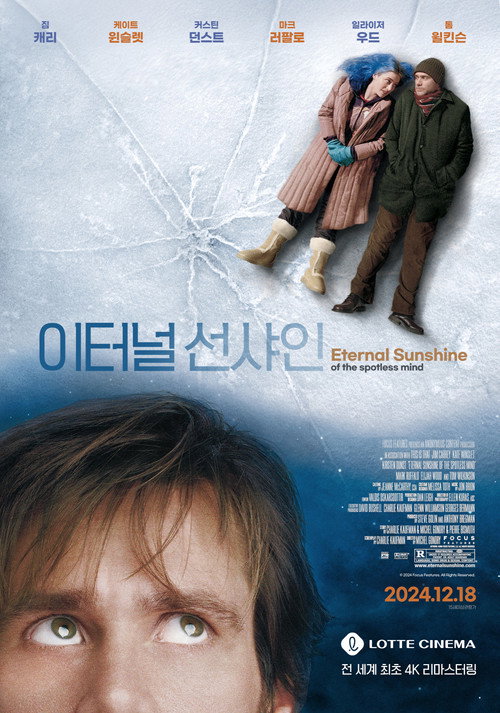
The night-outing scene on the frozen Charles River is far more than a simple recreation of a memory — it is the pivotal turning point in the film's exploration of love's true nature through the sci-fi premise of memory erasure. By re-staging the language and emotion of a letter Joel once wrote to Clementine, the scene amplifies the most beautiful and most painful moment the two shared. This meeting is a ritual of confirming each other's existence, and a paradoxical device that, within the very memory being erased, causes love to be rediscovered.
Back to the title
Eternal Sunshine of the Spotless Mind
14 deep dives in total