Tyler's Subliminal Appearances and Foreshadowing
The one-frame flashes of Tyler that appear in the early moments of *Fight Club*, the call from a payphone that cannot receive incoming calls, and the address on the non-existent 'Paper Street'—these hints that Tyler is a fantasy projected from the Narrator's suppressed self are the core foreshadowing devices that intricately engineer the shock of the twist.
Tyler Durden: A Fracture in Existence Engineered from a Single Frame
David Fincher's Fight Club uses cunning narrative tricks to make audiences believe Tyler Durden is a real person—while simultaneously planting precise foreshadowing throughout the film announcing that he is the Narrator's illusion. These devices operate not as simple hints but as psychological suggestions that exploit the nature of film as a medium.
A Momentary Intrusion: Five Subliminal Flashes
Many audiences remember meeting Tyler for the first time on a plane—but in fact he already appears five times as a 'flash' in the early portion of the film, when the Narrator is suffering from acute insomnia and alienation. These appearances last only one frame (approximately 1/24 of a second), so they are perceived only subconsciously—a technique exploiting the 'subliminal effect.'
- The first four appearances: Tyler appears at moments when the Narrator is under stress. His image flickers like a flash of light—beside a copier at the office (around the 4-minute mark), in the doctor's office where the Narrator pleads for help with insomnia (7 minutes), behind the group leader at the testicular cancer support group (11 minutes), and when the Narrator sees Marla Singer off on a dark street (12 minutes).
- The fifth flash—the hotel commercial: As already noted, the waiter standing on the far right in the 'Welcome' promotional video playing on the hotel TV is Tyler. This is the last foreshadowing before the Narrator concretizes Tyler as a specific 'ideal male image'—showing the stage just before Tyler materializes.
A Physical Contradiction: The Secret of the 'No Incoming Calls' Payphone
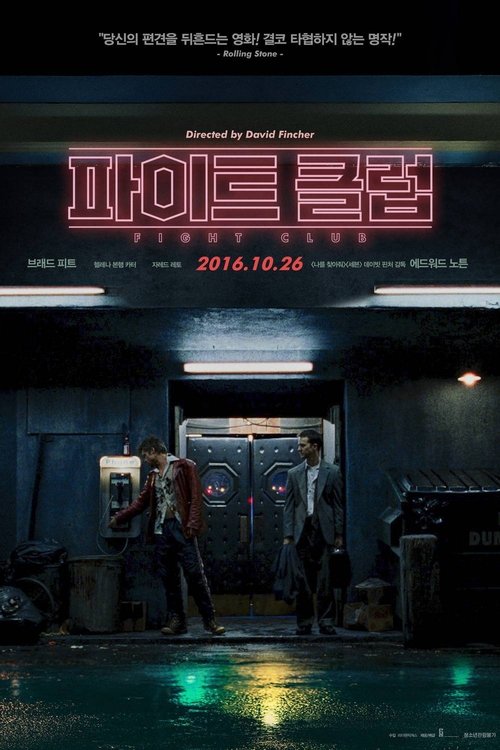
After the Narrator's apartment explodes, he calls Tyler from a payphone asking for help. This scene contains a decisive piece of physical evidence proving Tyler is not real.
On the body of the payphone the Narrator used, the notice 'No Incoming Calls Allowed' is clearly displayed. Yet moments later, Tyler calls the Narrator back on that very phone. This physically impossible call implies that the conversation with Tyler is not communication with the outside world but a self-to-self dialogue happening inside the Narrator's own head—a moment of genius.
Paper Street: A Home That Does Not Exist
Tyler's residence—the decrepit house on 'Paper Street'—is equally symbolic. 'Paper Street' is a geographical term: roads that were planned in the cartographic process to prevent copyright theft, or roads designed in city planning but never actually built—'ghost roads.' The setting of Tyler living on a street of this name declares that he exists not at real physical coordinates but as a 'figure on paper'—a fictitious refuge born of the Narrator's inner world.
These foreshadowing devices provide new layers of interpretation with each re-watch, visually and perfectly embodying how the Narrator's fractured mental state seeps through the cracks of reality.
Why It Matters
These foreshadowing devices elevate *Fight Club* from a simple twist film to an intricate psychological thriller. In particular, the 'no incoming calls' payphone and 'Paper Street' provide the audience with logical clues, intellectually proving that Tyler is the 'most perfect yet entirely unreal illusion' created by a modern person who has lost their self in a consumer society.
Other 떡밥 dives7
- arrow_outward
The Film's Cult Reevaluation
*Fight Club*—met with critical derision and box-office disappointment upon its 1999 release, surviving Roger Ebert's attacks—sold over six million DVD copies, spawned an obsessive fan following that excavated its every detail, and was reborn as an unparalleled cult text that penetrates the heart of modern capitalism.
- arrow_outward
How the Film's Ending Differs from the Novel
*Fight Club* chose the audacious ending of Project Mayhem's success—diverging from Chuck Palahniuk's source novel, where a detonator malfunction and the protagonist's institutionalization conclude with a cynical reality. David Fincher turned the system's collapse into a visual catharsis, completing a cinematic reinterpretation of whether rebellion can succeed.
- arrow_outward
The Thermostat Color Detail in the Boss Confrontation
During the scene in which the Narrator assaults himself and threatens his boss, a thermostat in the background alternates between white and black with each cut—a precise mise-en-scène device that visualizes the protagonist's fractured self and distorted perception of reality.
Back to the title
Fight Club
17 deep dives in total