Characterarrow_outward
Skylar
Skylar is the figure who awakens Will Hunting to the value of a 'human life' beyond intellectual ability. Symbolizing Will's deepest fears—abandonment and the future—she serves as the catalyst who triggers Will to dismantle his defenses and achieve genuine emotional growth.
Characterarrow_outward
Morgan O'Mally
Morgan O'Mally is the backdrop of Will Hunting's life and the figure who symbolizes the 'ordinary everyday life' he wishes to preserve. As one of the friends living in South Boston alongside Will and Chuckie, he represents warm, grounded human relationships that contrast with the isolation inherent in Will's genius.
Quotearrow_outward
Son of a bitch, he stole my line.
'Son of a bitch, he stole my line' is the spontaneous final remark Sean Maguire makes after discovering a letter Will left at the mailbox. Far beyond a simple farewell, it is a meta device revealing that the bond between Will and Sean—threaded through deep healing—is equally woven from the playful camaraderie of old friends.
Readingarrow_outward
The Balance of Knowledge and Emotion: Redefining Genius
This piece dismantles the view of 'genius' as mere intellectual ability, locating the core of true growth in 'emotional vulnerability' and 'self-acceptance.' By juxtaposing Will Hunting's journey through mathematical problems with his process of psychological healing, it argues that knowledge alone cannot sustain a full life.
Readingarrow_outward
The Essence of Mentoring: Questions, Not Directives
This analysis defines the essence of mentoring in the film as a process of emotional healing rather than knowledge transmission. Sean Maguire's relentless questions serve as a 'mirror,' compelling Will to look inward rather than depend on external answers. The true power of mentoring lies not in directives but in questions that ask 'what do you really want?'—enabling the client to dismantle defenses and face their authentic self.
Cardarrow_outward
MIT Janitor and the Equation on the Blackboard
The series of events in which Will Hunting, working as a janitor at MIT, writes equations on the blackboard is the decisive trigger that forcibly exposes his genius to the outside world. This incident creates a structural tension between Will's defense mechanism of hiding his talent and the outside authority (Professor Lambeau) that discovers it—securing the film's core narrative momentum.
Cardarrow_outward
Matt Damon and Ben Affleck's Screenplay Involvement
The personal backgrounds and creative struggles of co-writers Matt Damon and Ben Affleck are the deepest behind-the-scenes story of Good Will Hunting. They participated as more than just writers, and the revision process of the early screenplay—even the controversial scenes and decisive lines in the film—were born through the twists and turns of production.
Cardarrow_outward
Sean's 'It's Not Your Fault' Comfort
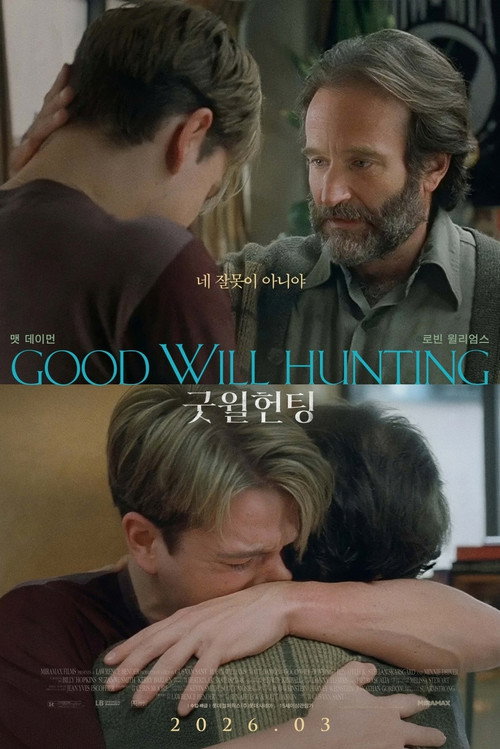
Sean Maguire's comfort 'It's not your fault,' which crowns the film's climax, goes beyond simple reassurance—it is the healing language that dismantles the guilt and responsibility Will Hunting has imposed on himself all his life. This scene symbolizes the decisive moment when Will's intellectual defense mechanism crumbles, he confronts his childhood trauma, and finally enters the realm of human emotion.
Cardarrow_outward
Robin Williams's Ad-Lib Line
The line Robin Williams delivers at the film's closing—'Son of a bitch, he stole my line'—is more than mere humor: it is the film's deepest behind-the-scenes story and a symbolic device. This ad-lib implies that the bond between Will and Sean has not truly ended, and playfully concludes the theme of 'sharing inspiration' that arises in the creative process.
Cardarrow_outward
The 1971 Nova His Friends Gifted Him
The 1971 Chevrolet Nova that his friends gift Will Hunting is more than mere transportation—it is a symbol of encouragement and blessing from friends sending Will beyond the narrow confines of the South Boston slum. This car visually proves Will's potential has broken into the real world and that he has crossed the threshold of genuine growth.
Characterarrow_outward
Will Hunting
Will Hunting possesses mathematical genius but, scarred by childhood abuse, uses his extraordinary talent as a defense mechanism—shutting the door to his heart. This character explores the gap between intellectual ability and emotional vulnerability, ultimately confronting his own trauma through the comfort of 'It's not your fault' and setting out on the path of true growth.
Characterarrow_outward
Sean Maguire
Sean Maguire goes beyond being a simple psychology professor—he serves as an emotional catalyst that dismantles Will Hunting's intellectual defenses. Rather than acknowledging Will's genius, he focuses on the childhood trauma Will has endured, comforting the fundamental human pain that knowledge cannot resolve. His presence is the central pillar that runs through the film's theme: 'What is true healing?'
Characterarrow_outward
Chuckie Sullivan
Chuckie Sullivan is Will Hunting's human anchor—filling what pure genius cannot—and his warmest ally. He embodies the perspective of a friend who accepts Will's troubled past and wounds as they are, rather than simply acknowledging his talent. Chuckie's presence is the most realistic and emotional anchor that allows the film to transcend intellectual drama and be completed as an epic of healing.
Characterarrow_outward
Gerald Lambeau
Gerald Lambeau is the first person to publicly announce Will Hunting's genius to the world. As a renowned mathematics professor at MIT, he views Will's intellectual ability through the lens of academic achievement and social success. Lambeau strives to make Will his protégé and acknowledges Will's boundless potential, but clashes with Will's attitude of trapping that potential inside emotional defenses—forming a central axis of conflict.