Sean Maguire
Sean Maguire goes beyond being a simple psychology professor—he serves as an emotional catalyst that dismantles Will Hunting's intellectual defenses. Rather than acknowledging Will's genius, he focuses on the childhood trauma Will has endured, comforting the fundamental human pain that knowledge cannot resolve. His presence is the central pillar that runs through the film's theme: 'What is true healing?'
The Power of Empathy Beyond the Realm of Knowledge
Sean Maguire intervenes in the domain Will Hunting fears most: 'emotion.' Will receives intellectual recognition from MIT's Gerald Lambeau, but this only places on Will the pressure that 'my worth depends solely on my intellectual achievement.' Sean confronts this intellectual superiority head-on, guiding Will to face his own emotions.
1. A Contrast in Mentoring: Lambeau vs. Sean
In the film, Sean's role is magnified through his clash of values with Lambeau. When Lambeau tries to view Will's talent through objective, structural 'future success' and present the 'right path,' Sean argues that Will must determine his own direction. Their fierce argument in the pub is a philosophical confrontation: is Will's life 'a problem to be completed through knowledge' or 'an emotional journey he must work through himself'?
Sean tells Will that you cannot judge a person's life by reading only Oliver Twist, making Will realize that books and knowledge alone cannot contain the laughter and tears of a complex human life. This is the decisive trigger that dismantles Will's defense mechanism of trying to define his past only through the single frame of 'an unfortunate environment.'
2. The Healing Power of 'It's Not Your Fault'
Sean's counseling process gradually dismantles Will's defensive walls. Will at first dismisses all of Sean's advice with cold sarcasm, even crossing lines by mentioning Sean's wife. Rather than being swayed, Sean touches Will's deepest wound—the childhood abuse and trauma.
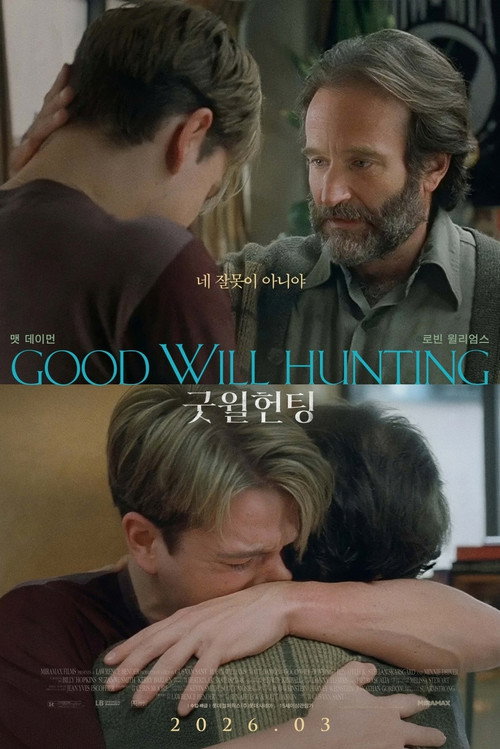
The most decisive moment comes when Sean repeatedly says 'It's not your fault' while referencing the violence Will suffered. This sentence shatters the shackle of guilt ('I wasn't enough') that Will had placed on himself all his life. In that moment, Will breaks down sobbing—signifying that Will has finally begun learning 'how to love himself.'
3. Ad-Libs and the Truth Actors Create
What deepens this film is Robin Williams's acting detail. The scene in which Will laughs listening to Sean's story, and the film's final line 'Son of a bitch, he stole my line,' were both Williams's ad-libs. Sean was not merely a 'healer' scripted in the screenplay—infused with the actor's spontaneity and vitality, he came across even more vividly and truthfully. These ad-libs symbolically complete the relationship between Will and Sean as a deep communion between human and human.
Why It Matters
Sean Maguire symbolizes the thematic gap between 'intellectual talent' and 'emotional healing' in this work. Will Hunting possesses the highest intellectual ability, but uses that ability as a defense mechanism to fill an emotional deficit. Sean teaches Will not to deny the value of knowledge but to appreciate the value of 'human connection'—the thing knowledge alone cannot fill. Thanks to Sean's presence, Will gains the courage to live not as a 'genius' label but as one 'human being,' and this is the core reason the film is celebrated as an epic of healing that transcends a simple coming-of-age drama.
Other Character dives5
- arrow_outward
Skylar
Skylar is the figure who awakens Will Hunting to the value of a 'human life' beyond intellectual ability. Symbolizing Will's deepest fears—abandonment and the future—she serves as the catalyst who triggers Will to dismantle his defenses and achieve genuine emotional growth.
- arrow_outward
Morgan O'Mally
Morgan O'Mally is the backdrop of Will Hunting's life and the figure who symbolizes the 'ordinary everyday life' he wishes to preserve. As one of the friends living in South Boston alongside Will and Chuckie, he represents warm, grounded human relationships that contrast with the isolation inherent in Will's genius.
- arrow_outward
Will Hunting
Will Hunting possesses mathematical genius but, scarred by childhood abuse, uses his extraordinary talent as a defense mechanism—shutting the door to his heart. This character explores the gap between intellectual ability and emotional vulnerability, ultimately confronting his own trauma through the comfort of 'It's not your fault' and setting out on the path of true growth.
Back to the title
Good Will Hunting
14 deep dives in total