Sean's 'It's Not Your Fault' Comfort
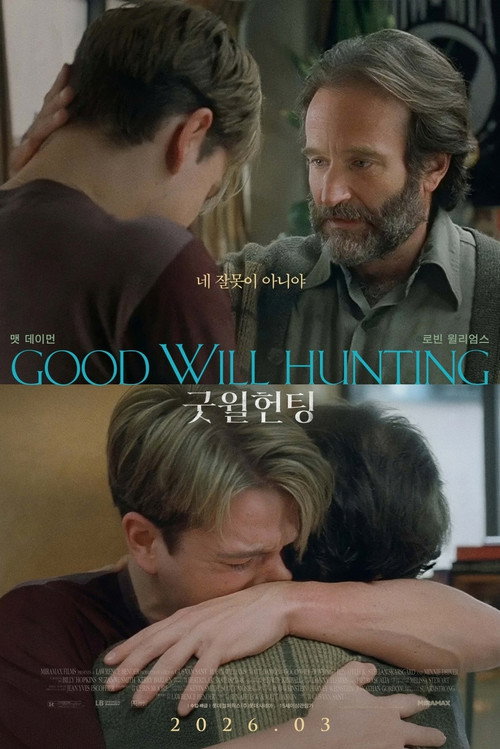
Sean Maguire's comfort 'It's not your fault,' which crowns the film's climax, goes beyond simple reassurance—it is the healing language that dismantles the guilt and responsibility Will Hunting has imposed on himself all his life. This scene symbolizes the decisive moment when Will's intellectual defense mechanism crumbles, he confronts his childhood trauma, and finally enters the realm of human emotion.
'It's Not Your Fault': The Language of Healing That Dismantles Defenses
Will Hunting's life was a paradoxical structure in which the light of 'genius' and the shadow of 'trauma' coexist. He kept the world at a distance using his intellectual ability as a shield, and tried to find answers to all problems in 'knowledge.' But Sean Maguire's sessions forced on him the realm of emotion—the one thing knowledge cannot resolve.
Sean's repeated words—'It's not your fault'—directly negate the psychological pattern by which Will blamed himself for all misfortune. This line was the decisive 'linguistic shock' that dismantled Will's defenses.
1. The Recurrence of Trauma and Sean's Intervention
The memories of abuse and domestic violence Will suffered implanted the guilt of 'I wasn't enough' and 'it was my fault.' He tried to cover this emotion with knowledge and logic, but Sean disregarded Will's intellectual logic and dug only into emotional truth. Sean continually reminded Will that the root cause of his pain was not Will's own deficiencies but external violence and absent love.
By repeating 'It's not your fault,' Sean unfastened one by one the 'shackle of responsibility' Will had unconsciously imposed on himself. This was not simply the comfort of 'it's okay'—it was the work of psychological re-grounding that separates and protects Will's very existence from external violence.
2. The Moment of Sobbing: The Collapse of Intellectual Defense
When this line reaches Will, he finally breaks down sobbing. This was not a simple expression of grief. It was the sound of the 'perfect defense' he had maintained all his life cracking. Will, who had been protecting himself with knowledge and logic, returned to the most primal, vulnerable emotional state.
This scene is considered one of the film's climaxes, visualizing the moment when Will grants himself the emotional permission that 'I deserve to be loved.' Sean's comfort delivered to Will the message that 'you are a person worthy of love,' and Will, accepting that message, begins his journey of healing.
3. The Psychological Meaning of 'It's Not Your Fault'
This phrase psychologically serves the role of facilitating 'shifting responsibility.' Will had a strong tendency to interpret all the misfortune of his life as 'his own choice' or 'his own deficiencies.' Sean's words shatter this interpretive framework itself. This grants Will a new identity—'you can be a victim'—preparing the psychological safe space in which he can finally ask others for help, and accept that help.
Why It Matters
This scene is the central axis that defines Good Will Hunting as not a simple 'genius success story' but an 'epic of healing.' Will's talent was the cause of his isolation from the world, but Sean's comfort becomes the medium connecting that talent to the world. The line 'It's not your fault' shows that intellect cannot overwhelm emotion, paradoxically making the audience realize that 'self-acceptance' and 'connection with others' are the most fundamental driving forces of human growth. Without this scene, Will would have remained merely a rebellious young man with a brilliant mind.
Other 명장면 dives4
- arrow_outward
MIT Janitor and the Equation on the Blackboard
The series of events in which Will Hunting, working as a janitor at MIT, writes equations on the blackboard is the decisive trigger that forcibly exposes his genius to the outside world. This incident creates a structural tension between Will's defense mechanism of hiding his talent and the outside authority (Professor Lambeau) that discovers it—securing the film's core narrative momentum.
- arrow_outward
Matt Damon and Ben Affleck's Screenplay Involvement
The personal backgrounds and creative struggles of co-writers Matt Damon and Ben Affleck are the deepest behind-the-scenes story of Good Will Hunting. They participated as more than just writers, and the revision process of the early screenplay—even the controversial scenes and decisive lines in the film—were born through the twists and turns of production.
- arrow_outward
Robin Williams's Ad-Lib Line
The line Robin Williams delivers at the film's closing—'Son of a bitch, he stole my line'—is more than mere humor: it is the film's deepest behind-the-scenes story and a symbolic device. This ad-lib implies that the bond between Will and Sean has not truly ended, and playfully concludes the theme of 'sharing inspiration' that arises in the creative process.
Back to the title
Good Will Hunting
14 deep dives in total