Matt Damon and Ben Affleck's Screenplay Involvement
The personal backgrounds and creative struggles of co-writers Matt Damon and Ben Affleck are the deepest behind-the-scenes story of Good Will Hunting. They participated as more than just writers, and the revision process of the early screenplay—even the controversial scenes and decisive lines in the film—were born through the twists and turns of production.
The Pain of Creation: Matt Damon and Ben Affleck's Personal Struggle
Good Will Hunting goes beyond a simply successful screenplay—it is a work in which the personal growth stories and struggles of co-writers Matt Damon and Ben Affleck are deeply embedded. They identified the film's theme of 'finding one's true self' with their own lives, and insisted on acting in it themselves, deeply involved throughout production.
1. The History of the Early Screenplay: From Thriller to Healing Narrative
The screenplay Damon and Affleck first wrote was not the psychological healing drama we know today. The early version was divided into two broad parts: Part One addressed Will's psychological counseling with Sean, but Part Two was a thriller in which Will and Chuckie are pursued by the government. This mixed-genre draft came to receive feedback from legendary screenwriter William Goldman, who advised: 'Just make it into a movie up to Part One. Drop everything after that.' This feedback fundamentally changed the film's direction, settling into the current narrative that focuses on emotional healing rather than intellectual talent.
2. Controversial Scenes and Ad-Libs: The Imperfect Early Draft
The early screenplay contained very provocative scenes far removed from the current tone. One episode reveals that a scene completely out of step with the rest was included, which Harvey Weinstein pointed out and had deleted—showing that the film went through countless revisions before reaching completion.
The backgrounds of the film's iconic scenes are also products of ad-lib and coincidence. The scene in which Will laughs listening to Sean's story is a moment when Matt Damon genuinely burst out laughing. The final line 'Son of a bitch, he stole my line' was Robin Williams's improvised acting. According to Damon's recollection, the moment Williams delivered that line, both Damon and Gus Van Sant had to barely suppress the urge to cry out 'That's it!'
3. The Connection Between Talent and Emotion: The 'Lottery Ticket'
One of the film's symbolic lines—'You have a lottery ticket and you won't cash it in!'—is a story Matt Damon received directly from Ben Affleck. The fact that the film's core lines were born through personal exchanges and experiences between the actors shows just how deeply grounded in 'authenticity' this film is.
Why It Matters
This screenplay behind-the-scenes story extends Good Will Hunting's thematic consciousness of 'authenticity' and 'self-acceptance' to the production process itself. Will Hunting hiding and defending his talent mirrors the countless setbacks, rejections, and revision processes the writers themselves went through to complete the work. The early screenplay's provocative content—or the process of pivoting from a thriller to a healing narrative—paradoxically shows that an artwork takes its true form only after numerous failures and the feedback of others. This perfectly resonates with the journey in which Will discovers his 'true heart' through Sean.
Other 떡밥 dives4
- arrow_outward
MIT Janitor and the Equation on the Blackboard
The series of events in which Will Hunting, working as a janitor at MIT, writes equations on the blackboard is the decisive trigger that forcibly exposes his genius to the outside world. This incident creates a structural tension between Will's defense mechanism of hiding his talent and the outside authority (Professor Lambeau) that discovers it—securing the film's core narrative momentum.
- arrow_outward
Sean's 'It's Not Your Fault' Comfort
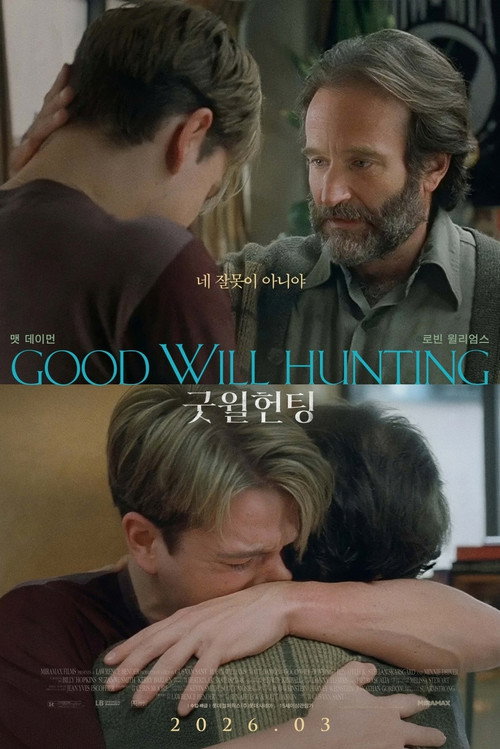
Sean Maguire's comfort 'It's not your fault,' which crowns the film's climax, goes beyond simple reassurance—it is the healing language that dismantles the guilt and responsibility Will Hunting has imposed on himself all his life. This scene symbolizes the decisive moment when Will's intellectual defense mechanism crumbles, he confronts his childhood trauma, and finally enters the realm of human emotion.
- arrow_outward
Robin Williams's Ad-Lib Line
The line Robin Williams delivers at the film's closing—'Son of a bitch, he stole my line'—is more than mere humor: it is the film's deepest behind-the-scenes story and a symbolic device. This ad-lib implies that the bond between Will and Sean has not truly ended, and playfully concludes the theme of 'sharing inspiration' that arises in the creative process.
Back to the title
Good Will Hunting
14 deep dives in total