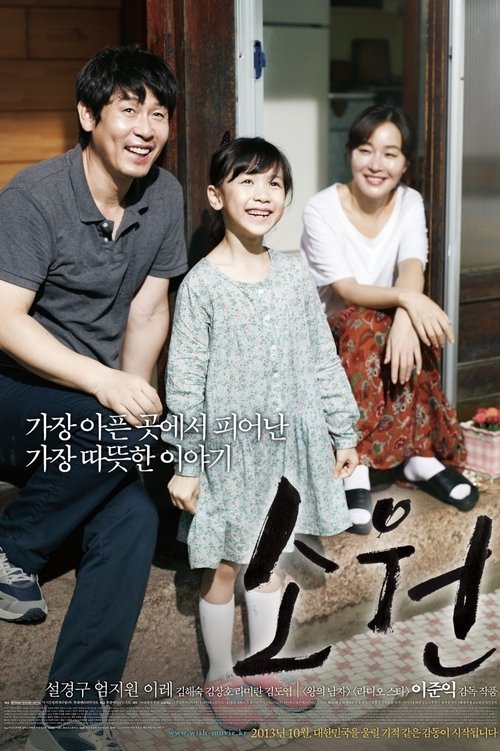
Dong-hoon (Sol Kyung-gu)
Dong-hoon symbolizes the father who is both closest to and farthest from So-won in the wake of her accident-induced deep trauma. Rather than anger or direct consolation, he approaches indirectly — through the Cocomong mascot costume, bypassing So-won's psychological defenses — and redefines his role as a father, healing his daughter's heart.
The Father's Distance and an Indirect Approach
Dong-hoon is So-won's father and the family breadwinner who works at a factory. In the film's first act, So-won's terrible accident brings him enormous shock and despair. Torn between his responsibility as a provider and his role as a father, Dong-hoon is shown breaking down psychologically, unable to bear the depth of the trauma his daughter has experienced.
The trauma of child sexual violence that So-won experienced goes beyond a simple physical wound; it triggers androphobia and makes her refuse even her father's touch. This refusal is the greatest pain for Dong-hoon and the most difficult challenge he must solve.
The Cocomong Costume: A Medium of Healing
The way Dong-hoon approaches So-won is far from the typical paternal approach. He decides to use 'a third entity' as a medium — one that So-won does not find frightening. That is the Cocomong mascot costume from the animated show "Cocomong's Refrigerator World," which So-won loves.
- Bypassing the psychological barrier: When So-won refuses her father as a presence itself, Dong-hoon appears at the hospital ward in the costume. This serves to separate what So-won fears — 'her father' — from 'the character mascot.' This process goes beyond mere acting; it is a crucial device that makes So-won feel psychologically safe.
- Symbol of the father's effort: Through the costume, Dong-hoon approaches So-won trying to prove that his efforts have not been wasted. When So-won learns that the person inside the costume is her father and — rather than fearing him — wipes his sweat, she takes the first step of healing, acknowledging her father's existence.
Character Arc: From Despair to Support
Dong-hoon's character arc traces the change from 'rage and frustration' to 'patience and support.'
- Early Stage (Shock and Frustration): Right after the accident, Dong-hoon despairs at So-won refusing him. He tries to fulfill his role as a provider but feels helpless before the depth of the trauma.
- Middle Stage (Indirect Effort): Using So-won's beloved Cocomong mascot costume, he makes efforts to narrow the psychological distance through an indirect approach rather than direct contact. In this process he realizes that a father's role must go beyond 'protector' to become 'healer.'
- Late Stage (Acceptance and Support): As So-won gradually recovers and receives support from those around her, Dong-hoon finally redefines his role as father. He becomes the most solid psychological pillar for So-won as she returns to society.
This appearance of Dong-hoon is the most concrete personal example embodying the film's core theme — 'rather than anger and revenge, the love of those around us and psychological therapy as support.'
Why It Matters
Dong-hoon is the core figure who proves that this film is not a simple crime thriller or revenge drama. If the film had focused on the emotional explosion of anger and revenge, Dong-hoon's character represents the value of healing by suppressing that explosion and standing for 'patience' and 'support.' His indirect approach using the Cocomong costume shows that what trauma victims most need is not coercive consolation but a gradual building of trust through a safe, predictable 'distance.' This is the very reason the film earns high evaluation — 'excluding manufactured sentiment and capturing the healing process with rare delicacy.'
Other Character dives4
- arrow_outward
So-won (Lee Re)
So-won is the victim of the terrible trauma of child sexual violence and the central axis of the film Hope. Her journey goes beyond the simple retrial of the incident — it is the healing process itself, confronting physical and psychological wounds and, through the support of those around her and psychological therapy, gradually finding 'hope.' So-won's recovery emphasizes the importance of a victim-centric narrative and conveys a warm message of seeking return to ordinary life rather than anger and revenge.
- arrow_outward
Mi-hee (Um Ji-won)
Mi-hee is a character who is strong-willed and prickly but, going through So-won's trauma, gradually experiences her own healing. Her character arc runs from anger and suspicion, through trusting those around her, and ultimately to bringing the family's recovery to fruition by giving birth to a second child, So-mang. This delicately captures not merely motherly love but how a human being who has endured a painful incident finds the hope called everyday life again.
- arrow_outward
Jung-sook (Kim Hae-sook)
Jung-sook goes beyond the simple role of counselor to be the core figure who guides So-won through the healing process as a survivor who has experienced her own deep wound — the loss of her daughter. The combination of her personal experience of loss and pain with professional knowledge acts as the key support that breaks down the deepest wall in So-won's inner life and leads her gradually back to the everyday life called hope.
Back to the title
Hope
14 deep dives in total