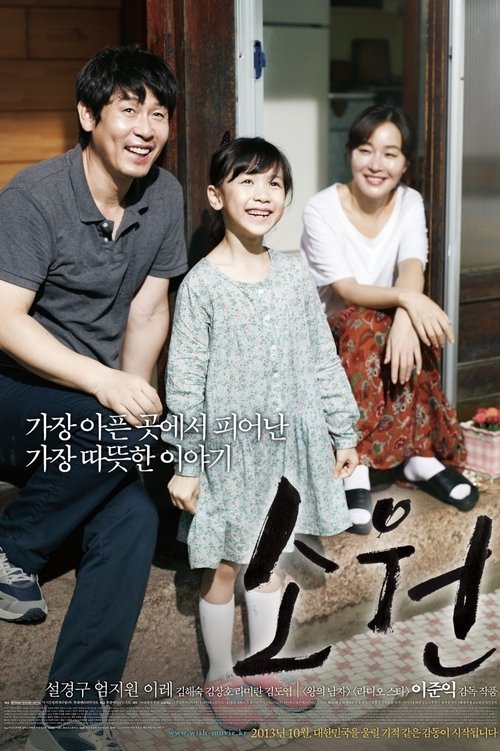
Mi-hee (Um Ji-won)
Mi-hee is a character who is strong-willed and prickly but, going through So-won's trauma, gradually experiences her own healing. Her character arc runs from anger and suspicion, through trusting those around her, and ultimately to bringing the family's recovery to fruition by giving birth to a second child, So-mang. This delicately captures not merely motherly love but how a human being who has endured a painful incident finds the hope called everyday life again.
A Journey of Healing That Begins with Pride and Suspicion
Mi-hee is depicted in the film's first act as a proud woman with strong self-respect who has difficulty trusting those around her, as she runs a stationery shop near the school. Following her daughter's terrible accident, her emotions are filled with deep resentment and suspicion. At this time Mi-hee tries to maintain her emotional control rather than accepting outside help or consolation. This symbolizes the extreme psychological shock experienced by the victim's family and the 'relational rupture' it causes.
The Actor's Effort That Created the Depth of Character
Actor Um Ji-won took on the role of Mi-hee and is evaluated as successfully embodying the character's inner transformation. Her depth of immersion demanded physical and psychological effort beyond mere acting.
- Physical immersion: For this role, Um Ji-won made a devoted effort to put on weight little by little from the beginning to the end of filming. This is interpreted as an attempt to visually express the psychological pain and physical exhaustion Mi-hee endures.
- Psychological immersion: She has stated that during filming she committed to the mindset of 'don't try to look pretty,' concentrating on maintaining the character's restrained emotional line. This can be seen as a case of sublimating into performance the emotion of 'loss' Mi-hee experiences.
- On-set effort: Rather than using a makeup van on location, the actors dressed and commuted in costume, making efforts to become embedded in the character's daily life. This shows that the film focuses not merely on depicting the incident but on the 'everyday life' and 'recovery' within it.
The Decisive Scene Bundle: Rebuilding Trust
Mi-hee's healing process is most dramatically revealed in the courtroom scenes and the interactions between family members. At first mistrustful of those around her, she gradually opens her heart within the support of the people in her life (especially her husband Dong-hoon and counselor Jung-sook).
- Rage and awakening in the courtroom: When the verdict is delivered and she rages at the result, Mi-hee explosively expresses her emotions. This scene shows that she has grown from simply dwelling in grief as a victim to becoming a subject who fights back against the absurdity of the incident.
- The family's recovery: The most important change is the scene late in the film when she gives birth to a second child, So-mang. This symbolizes that Mi-hee has overcome the trauma and resentment of the past and has come to hold the positive energy of 'life' and 'future.'
Interpretation of Mi-hee's Character: The Will Toward 'Hope'
The director emphasized that the film is not about tears, stressing that tears are not the goal. Mi-hee's character runs directly through this point. Her journey focuses not on grief about 'what was lost' but on the will of 'how to go on living.'
Like the film's title 'So-won' (meaning wish or hope), Mi-hee's life — though it went through a despairing incident — shows through the love of those around her and psychological therapy the strong, positive energy of trying to live 'a life worth living again.' Her healing is the core axis conveying to audiences the message that 'after enduring the greatest of wounds, life goes on.'
Why It Matters
Mi-hee is the core figure who proves that this film is not a simple crime thriller but a 'healing drama.' Her character arc handles in depth the complex, realistic emotional layers experienced by a victim's family. Um Ji-won's devoted performance makes Mi-hee's inner conflict three-dimensional, and this acts as the most powerful device by which the film conveys its theme of 'support and recovery' rather than anger and revenge to the audience. Mi-hee's rebirth plants in audiences the warmest 'wish' — hope.
Other Character dives4
- arrow_outward
So-won (Lee Re)
So-won is the victim of the terrible trauma of child sexual violence and the central axis of the film Hope. Her journey goes beyond the simple retrial of the incident — it is the healing process itself, confronting physical and psychological wounds and, through the support of those around her and psychological therapy, gradually finding 'hope.' So-won's recovery emphasizes the importance of a victim-centric narrative and conveys a warm message of seeking return to ordinary life rather than anger and revenge.
- arrow_outward
Dong-hoon (Sol Kyung-gu)
Dong-hoon symbolizes the father who is both closest to and farthest from So-won in the wake of her accident-induced deep trauma. Rather than anger or direct consolation, he approaches indirectly — through the Cocomong mascot costume, bypassing So-won's psychological defenses — and redefines his role as a father, healing his daughter's heart.
- arrow_outward
Jung-sook (Kim Hae-sook)
Jung-sook goes beyond the simple role of counselor to be the core figure who guides So-won through the healing process as a survivor who has experienced her own deep wound — the loss of her daughter. The combination of her personal experience of loss and pain with professional knowledge acts as the key support that breaks down the deepest wall in So-won's inner life and leads her gradually back to the everyday life called hope.
Back to the title
Hope
14 deep dives in total