Quotearrow_outward
When you have to shoot, shoot. Don't talk.
Tuco's line in the bathhouse ambush — 'When you have to shoot, shoot. Don't talk.' — is a decisive moment that strips away his flamboyant, garrulous character and lays bare his pure survival instinct and cold efficiency. The line defines the film's violence not as mere action spectacle but as the most primal, utilitarian language of survival.
Cardarrow_outward
Reinterpreting the Western Through the Backdrop of the Civil War
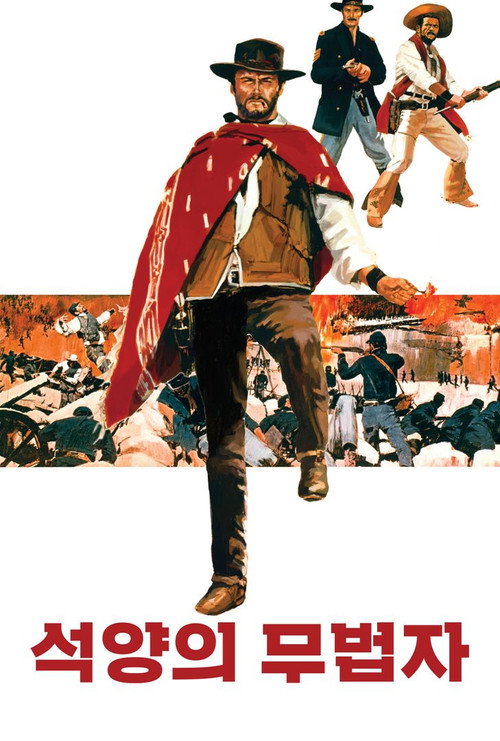
The Good, the Bad and the Ugly goes beyond borrowing the western backdrop to deconstruct the western myth itself — using the Civil War as its stage. Through the tragic premise that the cost of human lives in wartime is on par with gold, it shows that the outlaws' actions are not simple crimes but part of a vast historical tragedy, and is an epic exploring humanity's primal greed and the weight of survival.
Characterarrow_outward
Pablo Ramirez
Pablo Ramirez is more than a simple Catholic priest — he symbolizes the human conscience torn between sin and redemption. He despises the wandering outlaw Tuco's way of life yet cannot turn a blind eye to him, bearing a complex emotional bond. His presence illuminates Tuco's dark past and adds a layer of faith and moral responsibility to the film's violent western backdrop.
Readingarrow_outward
Reinterpreting the Western Through Historical Context
The Good, the Bad and the Ugly uses the monumental historical backdrop of the American Civil War not as a simple stage but as a 'fateful arena' that legitimizes the outlaws' survival and greed. The film deconstructs the traditional western myth of 'frontier spirit' and is elevated to an epic exploring the primal survival struggle and moral gray zone amid war's absurdity and ruins.
Cardarrow_outward
The Bathhouse Ambush and Tuco's Survival Instinct
The bathhouse ambush scene maximally illustrates that Tuco is not a simple criminal but a man of primal, wild survival instinct who thrives in extreme situations. The scene proves his survival instinct and outstanding firearms skill, and is the pivotal moment showing how he redefines the western myth's archetype of the 'outlaw.'
Characterarrow_outward
Maria
Maria is not a mere background figure but a decisive informant holding clues to the gold within the grand historical context of the American Civil War. Her presence serves as a crucial catalyst showing how the 'outlaw' myth pursued by the protagonists is deconstructed by actual historical context and humanity's survival instincts.
Characterarrow_outward
Blondie
Blondie goes beyond a simple bounty hunter — he symbolizes the very moral boundary line of the western. Possessed of great marksmanship and a taciturn manner, his actions nonetheless straddle 'good' and 'evil.' Endlessly torn between the greed for gold, the survival instinct, and the conscience within, he is a three-dimensional character showing humanity's most primal desires and the minimal conscience discovered within them.
Cardarrow_outward
The $200,000 Gold Cache and the Division of Information
The premise that information about the location of $200,000 in gold exists as two separate pieces — the name of the cemetery and the name of the grave — is the most central plot device of this film. This division of information is the narrative engine showing how human greed and survival instinct destroy relationships and ultimately drive the most desperate cooperation.
Cardarrow_outward
Angel Eyes' Perfect Plan and Pursuit
Angel Eyes is not a simple outlaw but the apex predator of a thoroughly calculated criminal system. He focuses solely on gold without emotional disturbance, using informant interrogation, hostage coercion, and the structural environment of a prison camp to achieve his goals. His meticulous planning and pursuit prove that this film is an epic addressing the logic of organized crime.
Readingarrow_outward
Greed and the Deconstruction of Myth: Human Nature Through Gold
The Good, the Bad and the Ugly is a grand tragic epic that deconstructs the traditional good-versus-evil framework of the western genre through material greed — embodied by gold. Rather than abstract values like justice or honor, it shows that only survival and avarice drive human beings, placing Blondie, Tuco, and Angel Eyes in a moral gray zone. This film is a masterwork exploring how easily human nature crumbles before external pressure or material reward.
Characterarrow_outward
Tuco
Tuco goes beyond the image of a simple villain or bandit — he is a three-dimensional character in whom survival and vengeance, tinged with family affection, are inextricably mixed. Behind his fast-talking buffoonery, the cunning and remarkable survival instinct he hides are the core driving force deconstructing the western myth, simultaneously displaying humanity's most primal desires and emotional connections amid extreme situations.
Cardarrow_outward
Blondie's Ambiguous Morality and Conscience
Blondie is a character who, despite his professional identity as a bounty hunter, possesses complex morality that transcends simple greed. He displays formidable skills among outlaws yet shows a wary respect for innocent life and a minimum of conscience toward his companions — deconstructing the traditional western boundary between 'good' and 'evil.'
Characterarrow_outward
Angel Eyes
Angel Eyes is not a simple villain — he is an ultra-cold and calculating contract killer who tracks only information about gold. He lends the romantic outlaw myth of the western a modern, cold motive of 'pure greed,' and is a character who mercilessly crosses human moral boundaries to achieve his goals.