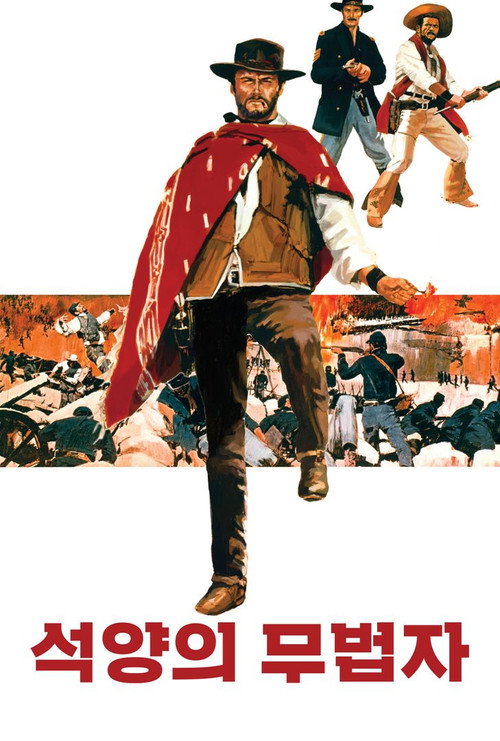
Blondie
Blondie goes beyond a simple bounty hunter — he symbolizes the very moral boundary line of the western. Possessed of great marksmanship and a taciturn manner, his actions nonetheless straddle 'good' and 'evil.' Endlessly torn between the greed for gold, the survival instinct, and the conscience within, he is a three-dimensional character showing humanity's most primal desires and the minimal conscience discovered within them.
The Bounty Hunter Blondie: The Meaning of the Epithet 'The Good'
Blondie is called 'The Good' within the film, yet his actions exist in a gray zone where the boundary between good and evil is indistinct. He shows no mercy to criminals and his marksmanship is formidable, yet he tends to spare the innocent — making the moral standard he maintains closer to 'survival' and 'personal conscience' than to 'law.'
1. The Curve of Relationship: From Swindler to Ally
Blondie's journey is a series of repetitions of 'cooperation' and 'betrayal.' Initially he functions as a swindler partnered with Tuco, targeting bounty money. He repeatedly runs the scheme of turning Tuco in and then rescuing him at a decisive moment — displaying a duplicitous side. (F1) This shows him to be a pragmatic survivor capable of using anyone if money demands it.
Yet this relationship reaches its catastrophic end in betrayal. Blondie abandons Tuco in the wilderness, severing the relationship. Thereafter, witnessing the devastation of the Civil War and Tuco's complex family situation (F5), he experiences an emotional disturbance that prevents him from destroying Tuco entirely.
2. Overwhelming Skill and Moral Choice
The most salient characteristic of Blondie is his overwhelming marksmanship. He is portrayed as one of the world's supreme gunfighters, and the process of dealing with Angel Eyes in the final showdown starkly demonstrates his skill.
- Merciless toward criminals: He does not hesitate to shoot at criminals but appears to avoid killing the innocent wherever possible.
- Command of the final showdown: The sight of Blondie firing first and claiming the upper hand in the three-way contest with Angel Eyes proves he is not merely a survivor but the central figure who steers the situation.
3. Reinterpreting 'The Good': The Weight of Conscience
Blondie deceives Tuco to obtain the gold, negotiates with Angel Eyes, and even finds himself in a position to kill Tuco. Yet the 'goodness' he displays is not moral perfection.
- Compassion for life: The scene in which he sees a wounded, dying captain and tells him to hold on a little longer before blowing up the bridge shows that even among gunfighting outlaws he retains a minimum of human conscience.
- A final act of consideration: The act of leaving half the gold for Tuco after obtaining it, and later shooting apart the rope that binds Tuco when he is in despair, reveals that he has a complex emotional tie to Tuco that prevents him from ever truly letting him go. Thus Blondie's 'goodness' is grounded not in duty but in emotional compassion.
Why It Matters
Blondie is the character who best embodies the film's core theme of 'deconstructing the outlaw myth.' The protagonist of a traditional western is a hero who fights evil with clear moral standards — but Blondie's boundaries are blurred. He is constantly tested against the primal desire for gold. His actions pose a question to the audience: what does it mean to be 'good,' and how far can one allow the conscience sacrificed for survival to go? Blondie is the figure who offers the most agonizing and captivating answer to that question.
Other Character dives4
- arrow_outward
Pablo Ramirez
Pablo Ramirez is more than a simple Catholic priest — he symbolizes the human conscience torn between sin and redemption. He despises the wandering outlaw Tuco's way of life yet cannot turn a blind eye to him, bearing a complex emotional bond. His presence illuminates Tuco's dark past and adds a layer of faith and moral responsibility to the film's violent western backdrop.
- arrow_outward
Maria
Maria is not a mere background figure but a decisive informant holding clues to the gold within the grand historical context of the American Civil War. Her presence serves as a crucial catalyst showing how the 'outlaw' myth pursued by the protagonists is deconstructed by actual historical context and humanity's survival instincts.
- arrow_outward
Tuco
Tuco goes beyond the image of a simple villain or bandit — he is a three-dimensional character in whom survival and vengeance, tinged with family affection, are inextricably mixed. Behind his fast-talking buffoonery, the cunning and remarkable survival instinct he hides are the core driving force deconstructing the western myth, simultaneously displaying humanity's most primal desires and emotional connections amid extreme situations.
Back to the title
The Good, the Bad and the Ugly
13 deep dives in total