Reinterpreting the Western Through the Backdrop of the Civil War
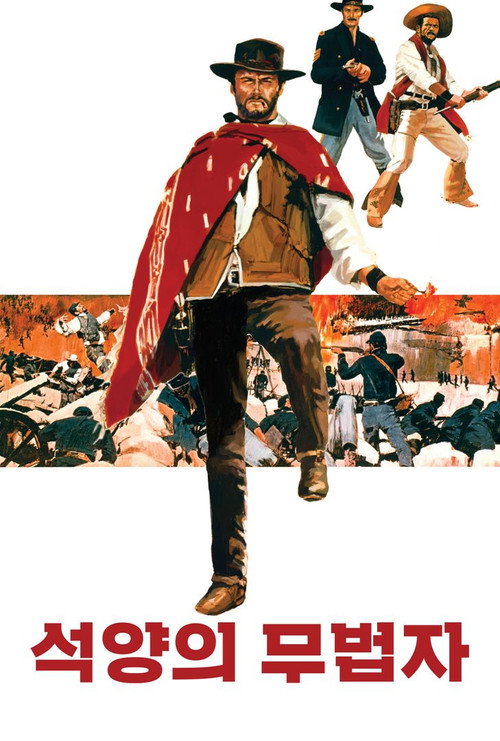
The Good, the Bad and the Ugly goes beyond borrowing the western backdrop to deconstruct the western myth itself — using the Civil War as its stage. Through the tragic premise that the cost of human lives in wartime is on par with gold, it shows that the outlaws' actions are not simple crimes but part of a vast historical tragedy, and is an epic exploring humanity's primal greed and the weight of survival.
The Civil War: The Device Deconstructing the Western Myth
The Good, the Bad and the Ugly follows the western clichés yet, by situating its backdrop within the explicitly historical context of the Civil War, poses a fundamental question to the genre itself. In this film, war is not a device that merely paints the background — it is both a grand 'setting' and 'fate itself' that compels every character's actions and moral choices.
1. The Tragic Realism War Supplies
Where traditional westerns deal with the struggle toward 'civilization' and 'order,' this work takes as its backdrop the 'ruins of war' where that order has collapsed. As a result, the outlaws' actions are elevated not as simple crime but as a desperate struggle for survival.
- The value of survival: The film lays the tragic premise that soldiers' lives are traded for gold. This gives the characters' goals the weight of survival itself, beyond mere wealth. (F10)
- The contamination of space: The images of ruined towns and battlefields visually show that the very spaces in which they operate are already contaminated by the tragedy of war. (F10)
- Moral ambiguity: The vast tragic backdrop of war blurs the line between good and evil. Blondie and Tuco are bitter enemies, yet they are forced to cooperate before a shared goal, and the process in which Tuco disguises himself as a Confederate soldier (F6) maximizes this ambiguity.
2. The Narrative Devices Created by War's Traces
The Civil War elements serve as key propellants of the plot. These elements physically bind the characters and redefine their relationships.
- The space of the battlefield: The stage extends beyond ordinary wilderness to include cemetery and prison camp (F11) — spaces thick with the traces of war. These spaces constantly evoke images of death and loss, imposing psychological pressure on the characters.
- The importance of information: The setting of the gold being buried in 'Sad Hill' cemetery — a product of the Civil War — implies that this treasure is not merely a fortune but something placed atop the wreckage of historical tragedy. (F8)
- Disguise and deception: The process in which Tuco disguises himself as a Confederate soldier and Blondie and Tuco become prisoners of the Union (F6) shows that war creates an environment where even individual identity can be temporarily disguised and deceived.
3. Reinterpreting the Western: The Combination of Greed and Tragedy
In the end this film comes down to the story of villains who profited at the cost of countless soldiers' lives. (F12) If the traditional western's theme was 'pioneering and justice,' this work deals with the far darker and vaster theme of 'war and greed.'
- The ultimate outcome: The process of obtaining gold necessarily entails violence and betrayal. The sight of Blondie sparing Tuco and feeling an emotional stir at wounded soldiers shows them exploring the realm of human conscience hidden behind the 'outlaw' title. (F12)
- The concluding message: All of this process ends with a question about how easily human moral limits can collapse before even the greatest cache of gold, and what remains at the end.
Why It Matters
The film's greatest virtue is that it did not consume the Civil War as a simple backdrop but used it as the core driving force of the narrative structure. The outlaws in the western were originally 'uncivilized' denizens of the wilderness — but the outlaws in this work operate in a space where 'civilization has collapsed due to war.' Therefore their crimes are interpreted not as simple swindling or robbery but as the inevitable extension of a tragic struggle for survival. Thanks to this setting, the characters' conflicts transcend personal grudges and acquire a greater, more agonizing narrative weight entangled with the era's tragedy. This is the decisive reason The Good, the Bad and the Ugly is celebrated as an epic capturing an era's tragedy.
Other 설정 dives4
- arrow_outward
The Bathhouse Ambush and Tuco's Survival Instinct
The bathhouse ambush scene maximally illustrates that Tuco is not a simple criminal but a man of primal, wild survival instinct who thrives in extreme situations. The scene proves his survival instinct and outstanding firearms skill, and is the pivotal moment showing how he redefines the western myth's archetype of the 'outlaw.'
- arrow_outward
The $200,000 Gold Cache and the Division of Information
The premise that information about the location of $200,000 in gold exists as two separate pieces — the name of the cemetery and the name of the grave — is the most central plot device of this film. This division of information is the narrative engine showing how human greed and survival instinct destroy relationships and ultimately drive the most desperate cooperation.
- arrow_outward
Angel Eyes' Perfect Plan and Pursuit
Angel Eyes is not a simple outlaw but the apex predator of a thoroughly calculated criminal system. He focuses solely on gold without emotional disturbance, using informant interrogation, hostage coercion, and the structural environment of a prison camp to achieve his goals. His meticulous planning and pursuit prove that this film is an epic addressing the logic of organized crime.
Back to the title
The Good, the Bad and the Ugly
13 deep dives in total