Characterarrow_outward
Senior Lieutenant Choi Man-su
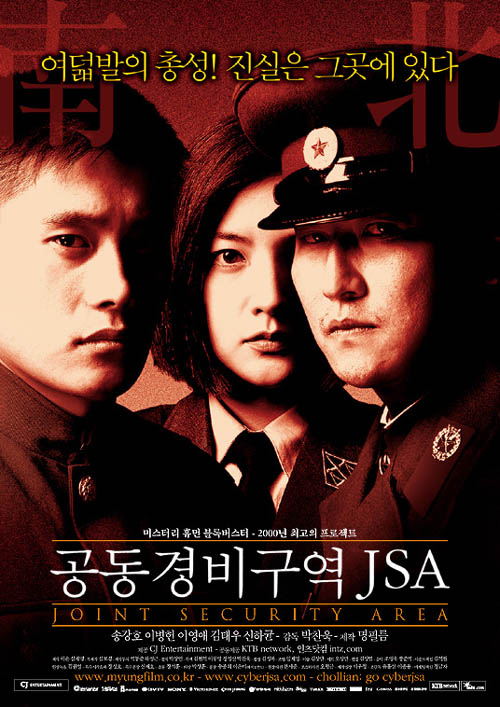
Senior Lieutenant Choi Man-su functions in the film not as the direct instigator of the incident but as a dramatic device that detonates the 'temporary peace' formed between soldiers of the two Koreas. He arrives in the final confrontation scene and in a single gesture converts the emotional current of 'human friendship' back into 'military confrontation.' His appearance symbolizes how easily — and how violently — ideological boundaries can be reasserted, maximizing the film's thematic intent.
Quotearrow_outward
My dream is this: someday, our Republic will make candy that tastes a whole lot better than anything in South Korea.
The line Gyeong-pil delivers to Lee Soo-hyeok — 'My dream is this: someday, our Republic will make candy that tastes a whole lot better than anything in South Korea' — is one of the film's most symbolic. Though it appears on the surface to be a joke tossed out during a casual allusion to defection, it contains a powerful force: the force of 'everyday desire,' potent enough to bring down the enormous ideological wall between the two Koreas.
Readingarrow_outward
Division and the Meaning of the 'Third Space'
The film's title itself gives the JSA its interpretive frame as a 'third space.' This space sits on the front line where the two great ideological blocs of the South and the North are physically confronting each other. The JSA is thus positioned not merely as a military demarcation line but as the one and only place where 'human exchange' capable of transcending ideological division can exist.
Readingarrow_outward
Truth and the Subjectivity of Memory
The film Joint Security Area raises fundamental questions about the concept of 'objective truth' through the process of uncovering the facts of the shooting incident. In this work, truth is not completed by forensic evidence or unambiguous testimony — it is distorted and reconstructed through the subjective filters of 'memory' and 'emotion' that the characters share.
Characterarrow_outward
Sophie (Major Sophie Jean)
Major Sophie Jean bears the narrative axis of this film. She is a Swiss Army major serving with the Neutral Nations Supervisory Commission, with the background of being Korean-mixed — a complex identity that places her as an 'outsider' belonging to neither camp, providing the legal and psychological foundation to pursue only the objective truth of the incident.
Cardarrow_outward
The Geopolitics and Function of the JSA
The Joint Security Area (JSA) is geographically situated at the most forward point of the front line where South and North Korea stand in confrontation. It is not merely a military boundary — it is the physical materialization of the vast historical tragedy of Korea's division. In the film, the JSA itself functions as a kind of enormous character, visually delivering the tension that runs twenty-four hours a day.
Cardarrow_outward
The Mystery of the Incident's Unfolding
The film continually shows the audience the process of finding 'the truth,' but that very process emphasizes the ambiguity of truth. The mystery of the incident goes beyond the dimension of a criminal investigation into who fired the gun — it is a structural device that shows how human emotion operates in the face of the enormous ideological wall of the two Koreas.
Cardarrow_outward
The Director's Intent and the Changing Ending
The ending of Joint Security Area is one of the most fascinating behind-the-scenes stories of the film's production — a result that went through multiple discussions and revisions. The iconic 'black-and-white photograph of four soldiers standing guard' that audiences remember most was in fact one of several alternatives, and the very process of choosing it reveals the depth of the director's deliberation.
Cardarrow_outward
Differences Between the Source Novel and the Film
The appeal of Joint Security Area deepens through the differences between the source novel and the film. Where the source novel proceeded from the first-person perspective of a neutral Swiss officer, weaving in the history of prisoners who chose a third country and the protagonist's father's past, the film refocuses on the 'bond of fellow Koreans' between North and South, reimagining Sophie as 'a Korean-mixed outsider.' These changes expand the work's themes from personal historical trauma to a universal exploration of human essence connected to the themes of The Square.
Cardarrow_outward
The Decisive Moment of Truth
The conference room of the Neutral Nations Supervisory Commission in the Joint Security Area, in the film's second half, operates under the highest tension in the name of uncovering the truth. As all testimony and circumstantial evidence converges toward the conclusion that Soo-hyeok trespassed into the North Korean post and carried out a terrorist attack, Gyeong-pil refuses to allow this situation to stand.
Characterarrow_outward
Gyeong-pil
Oh Gyeong-pil is one of the most emotionally complex characters in the film. A seasoned professional who has lived as a military instructor across many countries for more than a decade, he initially keeps the world at arm's length — revealing little emotion to either Soo-hyeok on the South Korean side or to his superiors. This initial reserve reflects the military environment and ideological formation he has lived within.
Characterarrow_outward
Lee Soo-hyeok
Lee Soo-hyeok symbolizes the point where personal friendship and human desire collide with a towering ideological wall inside the extreme tension of the Joint Security Area. Through the everyday private emotions he experiences at the inter-Korean border, he speaks for the anguish and vulnerability of the individual caught inside the structural violence of division — posing deep questions to the audience.