The Geopolitics and Function of the JSA
The Joint Security Area (JSA) is geographically situated at the most forward point of the front line where South and North Korea stand in confrontation. It is not merely a military boundary — it is the physical materialization of the vast historical tragedy of Korea's division. In the film, the JSA itself functions as a kind of enormous character, visually delivering the tension that runs twenty-four hours a day.
The Space Where Division's History Is Concentrated: The Geographic Character and Symbolism of the JSA
The Joint Security Area (JSA) is geographically situated at the most forward point of the front line where South and North Korea stand in confrontation. This is not simply a military boundary — it is the physical materialization of the vast historical tragedy of the division of the Korean peninsula. In the film, the JSA itself functions as a kind of enormous character, visually delivering to the audience the tension that runs twenty-four hours a day.
1. The Six Positions and the Enclosed Sense of Space
The JSA is composed of six positions in total, located at the 10, 12, 2, 4, 6, and 8 o'clock positions. This precisely demarcated geographic structure confers a 'closure' from which the characters cannot escape. The shooting incident and investigation process that unfold within this narrow, limited space create a sense of claustrophobic pressure — as though all the truth of every event is trapped within this small perimeter.
In particular, positions at the 12 and 6 o'clock — visible to the naked eye — are extreme demonstrations of just how physically close the two Koreas are while simultaneously being cut off from each other. This 'visible distance' symbolizes the gap between the possibility of friendship the characters share and the reality blocked by the ideological wall.
2. The Boundary Line Itself as a Narrative Device
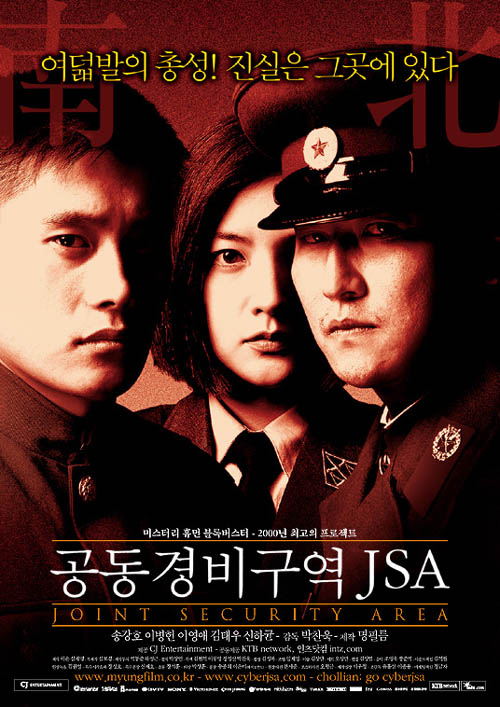
The JSA's boundary line is not a simple military demarcation. It is the point where the essence of 'the human being' and the ideology of 'the nation' collide. Against this boundary as backdrop, the film captures the strange friendship blooming between the soldiers of both sides — the 'human-to-human' exchange that transcends political ideology. The process through which Sergeant Lee Soo-hyeok, Corporal Oh Gyeong-pil, and Private Jeong Woo-jin exchange notes across the boundary line and spend time together is the most paradoxical attraction of this space.
This place is simultaneously the 'scene of an incident' where gunshots ring out and, paradoxically, the location where 'the most human exchange' takes place. The way in which this geographic character performs a narrative function causes the audience to ask the foundational question: 'What would it look like if this boundary didn't exist?'
3. Spatial Constraint and Psychological Pressure
The physical constraints of the JSA translate into psychological pressure on the characters. Every figure struggles within this narrow space — suspecting one another, concealing the truth, fighting for survival. All the testimony and truth that emerge in the investigation pass back and forth between these narrow posts and positions, and the very process of uncovering the truth unfolds as a high-stakes psychological thriller. In this way, the JSA goes beyond a setting — it is a core structure that reflects the psychological states of the characters and sustains the tension of the drama.
Why It Matters
The JSA functions in this film the way Elsinore functions in Hamlet — as a space so charged with history and obligation that the characters cannot simply leave, even when staying destroys them. The six positions in a circle, visible to each other, create a stage on which everyone can see everyone else but no one can speak freely. The film's geography is its argument: when you can see across the border but cannot cross it, the wall is not physical — it is absolute.
Other 설정 dives4
- arrow_outward
The Mystery of the Incident's Unfolding
The film continually shows the audience the process of finding 'the truth,' but that very process emphasizes the ambiguity of truth. The mystery of the incident goes beyond the dimension of a criminal investigation into who fired the gun — it is a structural device that shows how human emotion operates in the face of the enormous ideological wall of the two Koreas.
- arrow_outward
The Director's Intent and the Changing Ending
The ending of Joint Security Area is one of the most fascinating behind-the-scenes stories of the film's production — a result that went through multiple discussions and revisions. The iconic 'black-and-white photograph of four soldiers standing guard' that audiences remember most was in fact one of several alternatives, and the very process of choosing it reveals the depth of the director's deliberation.
- arrow_outward
Differences Between the Source Novel and the Film
The appeal of Joint Security Area deepens through the differences between the source novel and the film. Where the source novel proceeded from the first-person perspective of a neutral Swiss officer, weaving in the history of prisoners who chose a third country and the protagonist's father's past, the film refocuses on the 'bond of fellow Koreans' between North and South, reimagining Sophie as 'a Korean-mixed outsider.' These changes expand the work's themes from personal historical trauma to a universal exploration of human essence connected to the themes of The Square.
Back to the title
Joint Security Area
12 deep dives in total