Gyeong-pil
Oh Gyeong-pil is one of the most emotionally complex characters in the film. A seasoned professional who has lived as a military instructor across many countries for more than a decade, he initially keeps the world at arm's length — revealing little emotion to either Soo-hyeok on the South Korean side or to his superiors. This initial reserve reflects the military environment and ideological formation he has lived within.
Friendship Beyond the Border: A Character Analysis of Oh Gyeong-pil
Oh Gyeong-pil is one of the most emotionally complex presences in the film. He is a seasoned professional who has spent more than a decade as a military instructor across many countries. Initially, his character maintains a strong guard, revealing his emotions easily to neither Soo-hyeok on the South Korean side nor his North Korean superiors. This initial reserve reflects the military environment and ideological background he has inhabited.
1. The Beginning of Guardedness and Human Exchange
In the film's early stages, Oh Gyeong-pil appears alongside Lee Soo-hyeok as a figure who maintains uniform silence about the truth of the incident. The North uses him to press its claim — 'Lee Soo-hyeok trespassed into the post without permission and shot everyone; the wounded Gyeong-pil returned fire' — deploying him as a key witness. In this process, Gyeong-pil maintains emotional distance from Soo-hyeok, appearing wholly committed to his role as a 'soldier.'
But his relationship with Soo-hyeok gradually expands into the realm of 'human to human.' When Soo-hyeok steps on a land mine and is stranded, Gyeong-pil and Jeong Woo-jin discover him and help defuse the mine — a scene that transcends simple rescue, forming an emotional bond of the life-saver. The pen-pal relationship that follows, begun through exchanged notes, is the most delicate device showing that Gyeong-pil has begun to open his heart to Soo-hyeok.
2. The Peak of Friendship: Time at the Guard Post
The dimension in which Gyeong-pil's character most brilliantly shines is the process through which he invites Soo-hyeok into the North Korean post and spends time with him there. Unlike Woo-jin, who initially expresses bewilderment at this 'comrade I simply cannot understand,' Gyeong-pil naturally absorbs Soo-hyeok as a part of the life of the post. The drinks shared in the underground bunker, the exchange of gifts, the ordinary time spent together — these make clear that what they share is not 'the same nation' or 'ideology' but 'time spent together.'
In particular, the scene where Gyeong-pil tosses out the joke — "My dream is this: someday, our Republic will make candy that tastes a whole lot better than anything in South Korea" — in the middle of an allusion to defection, reveals the complex psychology of a man caught between attachment to the North Korean system and curiosity about the ways of the South. This is proof that he is not simply a figure who conforms to his system but a subject with his own desires and emotions.
3. The Shield of Truth: His Role in the Confrontation
In the climactic confrontation scene, Oh Gyeong-pil detonates all of his experience and emotion, performing the decisive role of protecting the truth of Soo-hyeok and Seong-sik. When Soo-hyeok is on the verge of collapsing under guilt and confessing, Gyeong-pil suddenly kicks over a desk and erupts in a violent tirade: "You bastard!! You reactionary son of a bitch who deserves to be torn apart!! Do you know how long I've been waiting for this day? Traitor to the nation! You lackey of American imperialism!" This explosive performance is not a simple expression of anger. It is, rather, the most powerful and paradoxical shield — one that says 'get a hold of yourself, do not confess under any circumstances, the truth must not be spoken no matter what.'
He deliberately plunges the situation into chaos, shouting "Long live the Korean Workers' Party! Long live the Great Supreme Commander Marshal Kim Jong-il!" and storms out of the room. By making himself appear to be the center of ideological violence, he physically and psychologically blocks Lee Soo-hyeok's attempted confession — a perfect performance.
Why It Matters
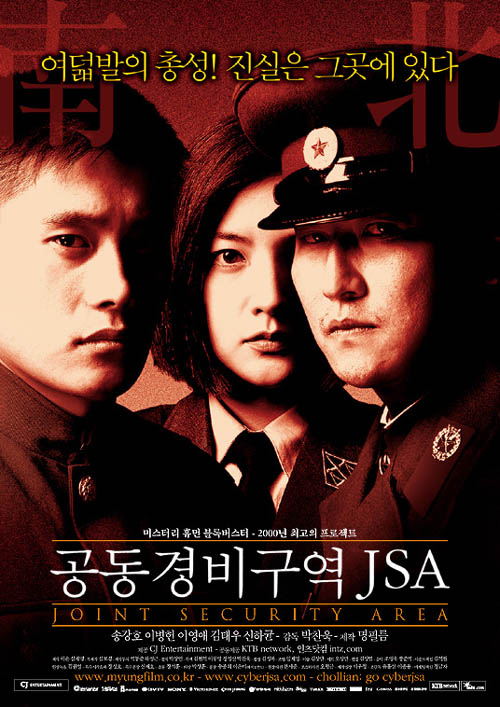
Oh Gyeong-pil is the most fully realized expression of the film's central thesis: that human bonds — built in ordinary moments, through food and laughter and the exchange of notes — can be stronger than the ideological systems that are supposed to keep people apart. His final act in the confrontation scene is the most dramatic proof of this: he sacrifices his own safety and ideological standing to protect Soo-hyeok. That sacrifice is also a kind of tragedy — because it can only be performed through the very language of ideology and violence. Song Kang-ho's portrayal of this contradiction is what makes the character, and the film, unforgettable.
Other Character dives3
- arrow_outward
Senior Lieutenant Choi Man-su
Senior Lieutenant Choi Man-su functions in the film not as the direct instigator of the incident but as a dramatic device that detonates the 'temporary peace' formed between soldiers of the two Koreas. He arrives in the final confrontation scene and in a single gesture converts the emotional current of 'human friendship' back into 'military confrontation.' His appearance symbolizes how easily — and how violently — ideological boundaries can be reasserted, maximizing the film's thematic intent.
- arrow_outward
Sophie (Major Sophie Jean)
Major Sophie Jean bears the narrative axis of this film. She is a Swiss Army major serving with the Neutral Nations Supervisory Commission, with the background of being Korean-mixed — a complex identity that places her as an 'outsider' belonging to neither camp, providing the legal and psychological foundation to pursue only the objective truth of the incident.
- arrow_outward
Lee Soo-hyeok
Lee Soo-hyeok symbolizes the point where personal friendship and human desire collide with a towering ideological wall inside the extreme tension of the Joint Security Area. Through the everyday private emotions he experiences at the inter-Korean border, he speaks for the anguish and vulnerability of the individual caught inside the structural violence of division — posing deep questions to the audience.
Back to the title
Joint Security Area
12 deep dives in total