Love Built on Wit and Humor
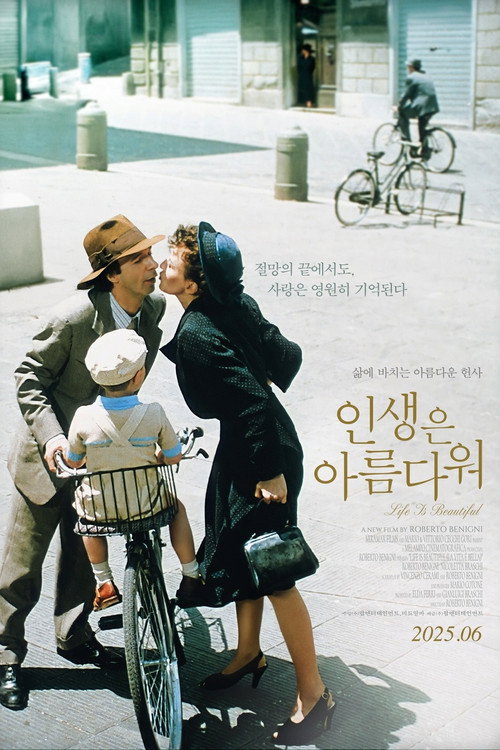
In Life Is Beautiful, Guido's humor transcends a simple comedic device to become the most powerful survival weapon of the human spirit. He uses wit to win love in romance, and to protect his son's innocence in the concentration camp. His humor is the greatest survival strategy, packaged under the name of 'optimism.'
Wit and Humor: The Most Sublime Performance for Survival
Guido Orefice's humor is the core driving force running through the film's narrative. It is not simply entertainment that amuses those around him — it is how he relates to the world, wins love, and ultimately overcomes the fear of death. His humor is the greatest survival strategy, wrapped in the name of 'optimism.'
1. Humor in Romance: The Wit That Breaks Down Barriers
Early in the film, Guido blossoms his wit and eloquence through his work as a hotel waiter. His humor breaks down the barriers of those around him and serves as the decisive tool for winning Dora's heart.
- Turning Chance into Destiny: Guido was an ordinary young man who moved to the city with a dream of opening a bookshop, but his natural joyfulness drew people to him. Through chance meetings and reunions, he turns coincidences into inevitable destiny — his wit shining especially in his playful responses to Dora. (F3)
- Intellectual Exchange: He brings daily joy to regular guest Dr. Lessing by solving riddles, and in the process wants to create more chance encounters with Dora. (F8) This was a way of building emotional connections through intellectual play, beyond simple meetings.
- Philosophical Foundation: His attitude toward life is even grounded in philosophical thinking — listening to his uncle explain Schopenhauer's theory that 'with enough will, you can do anything.' (F2)
2. Humor in the Camp: A Performance for Survival
When war breaks out and the family is imprisoned in the camp, Guido's humor completely transforms its meaning. From romantic wit, it evolves into 'a father's performance' to protect his son.
- The 'Game' Lie: After arriving at the camp, Guido explains the entire wretched situation to his son Giosué as 'a game where you win a tank if you score 1,000 points.' (F11) This lie is the father's desperate effort to protect his son's innocence, bringing even the people of the camp to join in this performance.
- Maintaining Hope: Even in the extreme circumstances of the camp, Guido endeavors not to lose his wit and humor. He conveys hope to those around him and shows his human side by helping others. (F6) He is even recommended as a waiter at the officers' club, continually deflecting situations and maintaining hope for survival. (F12)
- The Critical Moment of Performance: Even when death looms directly before him, Guido deliberately marches forward with jolly playfulness and a comic gait, concerned that Giosué will be disturbed. This performance delivers laughter rather than fear to his son, becoming the decisive moment that preserves the child's survival.
3. The Duality of Humor: The Connecting Thread of Love and Survival
Guido's humor always performs a dual function. For Dora, it operates as 'the charm that conveys sincerity,' completing their fateful love (F9). In the camp, it serves as 'an anesthetic to temporarily forget despair.' In this way, his humor is not merely something that gives pleasure — it is the core device that makes possible the psychological survival of the characters.
Why It Matters
Guido's humor is the film's most important thematic pillar. This film deals with the historical tragedy of the Holocaust, but does not dismiss that tragedy as simple sadness or anger. Instead, it illuminates the instinctive mode of survival — 'optimism' and 'humor' — that humans cannot give up even in the most desperate situations. Guido poses a question to the audience through this humor: 'How can humans emit light even in the darkest moments?' His humor transcends simple comedy to function as an example of artistic sublimation that symbolizes the nobility and resilience of the human spirit, and is the core element that determines the film's artistic depth.
Other 기타 dives3
- arrow_outward
Jewish Discrimination and the Road to the Concentration Camp
The backdrop of Jewish discrimination and concentration camp life in Life Is Beautiful is not merely a tragic piece of history — it is the stage for exploring the most sublime mode of human spiritual survival. The tension between the oppressive system of 1930s Italy and the father's 'game' is what makes this film's unique aesthetic both possible and necessary.
- arrow_outward
The 'Game' Rules of the Concentration Camp
The concentration camp's 'game' rules — the central metaphor running through Life Is Beautiful — are the father Guido's greatest act of love and the most powerful mode of survival in the face of extreme tragedy, protecting his son Giosué's innocence and humanity. This 'game' transcends a simple lie to become the philosophical core of the entire film.
- arrow_outward
Dr. Lessing's Role and Sacrifice
Dr. Lessing is a complex figure who symbolizes 'help that cannot help' in the film. He provides Guido with intellectual intimacy and temporary hope, but that help is always neutralized by the enormous wall of reality. His narrative poses questions about what 'true help' is — and where hope should be found.
Back to the title
Life Is Beautiful
12 deep dives in total