The Truth About the Sammy Jankis Couple
The story of the Sammy Jankis couple is far more than an episode; it is the enormous fiction that protagonist Leonard Shelby constructs in order to rationalize his own guilt and trauma. The story is the most decisive evidence that Leonard is not 'remembering truth' but 'continuously reconstructing the story he wants to believe,' and the device that drives through the film's central theme of the 'reliability of memory.'
Sammy Jankis: The Perfect Fiction for Guilt
The tragedy of Sammy Jankis (Sammy Jankis) appears in the early part of the film as an important device revealing Leonard Shelby's past actions. On the surface it unfolds as the story of Sammy, a real patient who was once Leonard's insurance case, and his wife—but this narrative is very likely an 'imagined tragedy' that Leonard has deliberately constructed in order to avoid his own guilt over his wife's death and rationalize himself.
1. The Setup of the Sammy Jankis Case
Sammy is an accountant who, like Leonard, suffers from anterograde amnesia. At first Leonard suspects Sammy may be faking illness to collect insurance money and conducts various tests. In this process Leonard tries to judge Sammy's condition objectively, yet ultimately the story involving Sammy's wife is deeply connected to Leonard's own psychological defense mechanism.
- Similarity of the Illness: Both Sammy and Leonard share the commonality of losing memory in ten-minute intervals. This reflects Leonard's psychology of projecting his own condition onto another person and trying to frame his own suffering in the objective frame of 'illness.'
- The Insurance Adjuster's Perspective: Leonard tries to judge Sammy's condition in connection with whether to approve insurance payment. This overlaps with the image of Leonard himself—trapped in the framework of 'legal, objective evidence'—distorting truth when dealing with his own wife's case.
2. Narrative Function: The Transfer and Rationalization of Guilt
The most important reason the story of the Jankis couple matters is that its content serves as a 'substitute narrative' filling Leonard's psychological deficit. Leonard is afraid to confront the fact that his wife met a tragic death following the assault. To cover this enormous guilt, he manufactures an imagined tragedy he can control—'the Jankis tragedy'—and transfers his own guilt there.
- The Insulin Injection Detail: The detail that Sammy's wife died while taking a gamble with an insulin injection is deeply suspicious. This reflects Leonard's psychology of wanting to define his own wife's death as 'an accident' or 'an act of external violence.' If his wife's death was the result of Leonard's inattention or passive complicity, that guilt is too heavy—making him flee into the safe story of 'the Sammy couple.'
- The Absence of 'Truth': The interpretation that the very existence of Sammy's wife may be a product of Leonard's memory distortion shows that Leonard is more skilled at 'making stories' than at excavating truth.
3. Foreshadowing and the Problem of Credibility: The Meaning of Italics
When the story of the Jankis couple unfolds, certain clues are used repeatedly as devices implying 'low credibility.' The most representative of these is italics. Italics function beyond a mere design element—serving the role of a warning signal the film sends to the audience meaning 'this information has low credibility.'
- Tattoos and Photographs: In handling Sammy's case, italics function as the symbol for 'low credibility.' This visually emphasizes how blurred the boundary is between the information Leonard wants to believe and the information actually close to truth.
- Teddy's Role: Teddy tells Leonard Sammy's story and induces Leonard to become deeply immersed in this narrative. Teddy has a dual face—simultaneously a helper who helps Leonard find truth on his own and a corrupt figure who exploits Leonard. The story of Sammy may have been one of Teddy's means of controlling Leonard.
Why This Item Connects to the Work's Identity
The story of the Sammy Jankis couple connects directly to the most fundamental question Memento poses—'Is the memory we believe actually true?' This narrative exposes the fact that Leonard's journey is not really about chasing a killer but about reconstructing his own trauma. Leonard is not seeking an external criminal but trying to confront the 'truth' buried deep within himself. Sammy's story is the most perfect and dangerous product of the self-deception he has constructed, and the collapse of this fiction is both Leonard Shelby's psychological liberation and the engine driving the film toward its climax.
Why It Matters
The Sammy Jankis story is the 'psychological trick' that drives through Memento's narrative core. This entry proves that although Leonard appears to be chasing an external killer, he is in reality constructing a 'story' himself in order to evade the enormous trauma of his guilt—his wife's death. The film asks the audience 'who is telling the truth?' but Sammy's story poses the deeper question 'who wants to believe the truth?'—completing the film's identity as an inquiry into the subjectivity and reliability of memory.
Other 떡밥 dives4
- arrow_outward
Non-Linear Time Structure and Editing
The non-linear time structure that is Memento's central device lets the audience experience the fragmentation of memory that protagonist Leonard Shelby undergoes. The dual timeline—color sequences in reverse, black-and-white sequences in forward order—gives viewers not merely the passive experience of following a story but the active intellectual puzzle of reassembling shards of time into a reconstructed truth. This is the film's greatest intellectual pleasure, and the device that poses fundamental questions about the reliability of memory.
- arrow_outward
Teddy's Role and Motives
Teddy is not merely a helper to the protagonist Leonard Shelby; he is the supreme manipulator who exploits Leonard's hunger for revenge and his memory distortion. Using his authority as a police officer, he feeds Leonard fragments of 'truth' that appear real but exist only to allow Teddy to observe and exploit the very process of Leonard's search for truth—maximizing the film's central theme of the 'reliability of memory.'
- arrow_outward
Records Kept in Photographs and Tattoos
The photographs, notes, and tattoos that serve as Leonard Shelby's central tools in Memento are his only means of survival—the sole way to sustain himself without reliable memory. Although these physical records appear to be 'evidence of truth,' they are simultaneously 'substitutes for memory' that prop up Leonard's own distorted recollections. That contrast keeps the audience endlessly asking: what is truth, and what is fabricated memory?
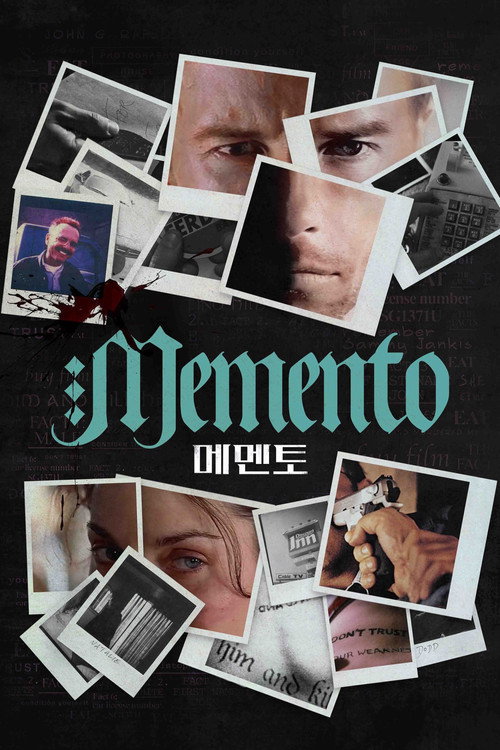
Back to the title
Memento
12 deep dives in total