Teddy's Role and Motives
Teddy is not merely a helper to the protagonist Leonard Shelby; he is the supreme manipulator who exploits Leonard's hunger for revenge and his memory distortion. Using his authority as a police officer, he feeds Leonard fragments of 'truth' that appear real but exist only to allow Teddy to observe and exploit the very process of Leonard's search for truth—maximizing the film's central theme of the 'reliability of memory.'
Teddy: The Most Cunning Manipulator Who Packages Truth
Teddy is the most ambiguous and dangerous character in the film. He appears to provide Leonard with the information he needs—but his purpose is not dependent on whether Leonard succeeds in his revenge. It lies in observing and exploiting the very process of Leonard's search for 'truth.' Teddy perfectly understands Leonard's psychological vulnerabilities and is the architect who designs Leonard's self-entrapment in the labyrinth.
Setting the Scene: The Role of the Corrupt Police Officer
Teddy takes on the role of the police officer who assists Leonard after he survives the assault that killed his wife. His professional background is the greatest device that grants authority and credibility to the information he provides. Yet this authority soon combines with corruption, and he is portrayed not as an agent of justice but as a figure who uses events to sustain his own career and extort wealth.
Every clue he hands Leonard—the existence of John G, the story of the Sammy Jankis couple, even advice about the full story of the case—serves to burn the fuel of Leonard's thirst for revenge.
How It Works: Assembling the Memory Puzzle
Teddy engineers puzzles that Leonard cannot solve on his own, and observes the very process of Leonard's search for 'truth.' This process is made up of several layers of deception.
- Using the Sammy Jankis Story: Teddy induces Leonard to become familiar with the concept of 'memory distortion' through Sammy's case. Sammy's story serves as the perfect psychological mirror—allowing Leonard to rationalize and look away from the memory connected to his own wife's death. Through this story Teddy confirms that Leonard has lost the ability to judge 'truth' objectively.
- Continuous Intervention in the Revenge Process: Even after Leonard kills Teddy and succeeds in his revenge, the fragments of information Teddy supplied (such as the killer's license plate number and the full story of the case) subtly stimulate Leonard to set a new target and plan yet another murder. Teddy performs the role of a 'catalyst' that makes Leonard unable to stop himself.
A List of Red Flags: Untrustworthy Evidence
All of Teddy's statements and actions are open to question. Details that deserve fans' attention include the following.
- The Source of Information: All the information Teddy provides to Leonard is always packaged in the name of the authority called 'the police.' Yet his actions are focused not on realizing public justice but on personal gain—sustaining his career, extorting wealth.
- Leonard's Forgetting: The fact that Leonard forgets even the truth that Teddy played a decisive role in helping him find and catch John G means that Teddy succeeded in manipulating Leonard's memory. Teddy succeeded in making Leonard dependent on him.
- The Final Gaze: In the film's last scene, Teddy exposes all the 'truth' to Leonard, leaving Leonard in a state where he cannot trust his own memory. This is the decisive moment showing that Teddy most perfectly observed and exploited Leonard's psychological collapse.
Why Teddy's Existence Is Core to the Work's Identity
Teddy transcends simple villainy to become a living metaphor embodying the film's central theme—the 'relativity of truth.' Nolan uses this film to ask the audience: 'Is what you believe actually true?'—and Teddy presents the most powerful and seductive wrong answer to that question. Teddy's existence forces both audience and Leonard into the endless suspicion of 'who is telling the truth?'—the dynamo that drives the audience's immersion into an extreme intellectual thriller.
Why It Matters
Teddy is the most important link connecting Memento's plot structure and thematic consciousness. If Teddy were simply a villain, the film would have remained a simple revenge thriller. But Teddy combines the 'individual defect' of Leonard's amnesia with the 'corruption of the social system,' showing how truth itself can be distorted and commodified by power and self-interest. Teddy symbolizes 'the system that manipulates truth'—far more dangerous than the burglar or 'John G' who destroyed Leonard's life. As a result, the film rises beyond a simple mystery to become a work that poses philosophical questions about the nature of human psychology and memory.
Other 떡밥 dives4
- arrow_outward
Non-Linear Time Structure and Editing
The non-linear time structure that is Memento's central device lets the audience experience the fragmentation of memory that protagonist Leonard Shelby undergoes. The dual timeline—color sequences in reverse, black-and-white sequences in forward order—gives viewers not merely the passive experience of following a story but the active intellectual puzzle of reassembling shards of time into a reconstructed truth. This is the film's greatest intellectual pleasure, and the device that poses fundamental questions about the reliability of memory.
- arrow_outward
The Truth About the Sammy Jankis Couple
The story of the Sammy Jankis couple is far more than an episode; it is the enormous fiction that protagonist Leonard Shelby constructs in order to rationalize his own guilt and trauma. The story is the most decisive evidence that Leonard is not 'remembering truth' but 'continuously reconstructing the story he wants to believe,' and the device that drives through the film's central theme of the 'reliability of memory.'
- arrow_outward
Records Kept in Photographs and Tattoos
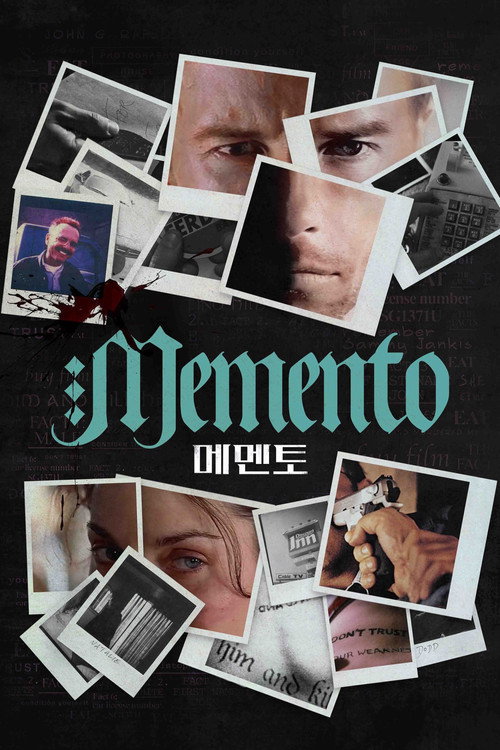
The photographs, notes, and tattoos that serve as Leonard Shelby's central tools in Memento are his only means of survival—the sole way to sustain himself without reliable memory. Although these physical records appear to be 'evidence of truth,' they are simultaneously 'substitutes for memory' that prop up Leonard's own distorted recollections. That contrast keeps the audience endlessly asking: what is truth, and what is fabricated memory?
Back to the title
Memento
12 deep dives in total