It's not the coin that decides. You do.
Carla Jean Moss's line 'It's not the coin that decides. You do.' goes beyond a simple warning — it is the central philosophical question the film poses. It carries a powerful message that human life and fate should not be entrusted to chance or probability but determined by one's own will and choice, symbolizing the debate between 'free will and fate' that runs through the entire work.
"It's Not the Coin That Decides. You Do.": Humanity's Defiance Against Fate
The line Carla Jean Moss throws at Anton Chigurh is the clearest philosophical manifesto that cuts through all the film's violence and chaos. It is not simply a desperate cry to protect her husband but a fierce assertion that the agency of human life must not be determined by external, random forces.
1. Context: Agency Amid Desperation
This line bursts out at a moment of absolute crisis — after Llewelyn Moss's discovery of the money bag has made everything spiral into disorder and violence. Carla is in danger because of her husband, and her actions are already being pulled along by the vast tide called 'fate.' What she says to Chigurh is the final form of human resistance — refusing to allow their lives to be governed by the cartel's greed or Chigurh's unpredictable violence.
2. Chigurh's Rebuttal: Everything Is a Combination of Chance and Choice
Chigurh rebuffs Carla's claim as if it were absurd, declaring: "I came here like the coin — everything is nothing but chance and choice." To Chigurh, 'choice' and 'chance' are one inseparable mechanism. He interprets human life as a grand game of probabilities and argues that human will or moral judgment is ultimately no more than a random outcome — like a coin flip.
This logic is the world-view the film itself presents. The Texas desert, where law and order have collapsed, is portrayed as a space governed only by random and cruel 'fate' — beyond the control of human will or effort.
3. Philosophical Collision: Free Will vs. Determinism
- Carla's argument (Free Will): Humans can forge their own destiny through their choices. Moral judgment and will exist.
- Chigurh's argument (Determinism): Everything is merely the result of already-determined probability and chance. Human will is ultimately meaningless.
The film does not clearly answer which view is true. Instead, it throws the collision itself at the audience, compelling them to ponder: 'What meaning does human will hold in this age?'
4. Extra-Textual Impact: Reflecting Modern Society's Anxiety
This exchange reflects a fundamental anxiety felt by modern society. We often feel that our lives are governed by vast forces called 'fate' or 'the system.' This dialogue is a metaphor for the lonely, desperate struggle of the modern individual who strains to hold on to their own will before that colossal system.
Why It Matters
This line is more than a climactic piece of dialogue — it is the film's very reason for being, its philosophical backbone. The film refuses to define who is good and who is evil, insisting that only the cold mechanics of 'rules' and 'fate' exist. Carla's line is a human attempt to uphold 'will' — the most human of values — against those random mechanics. When Chigurh dismisses even this will as mere probability, the film poses to the audience: 'Is the justice you believe in based on probability, or on will?' — and in doing so, completes the work's depth.
Other Quote dives1
Back to the title
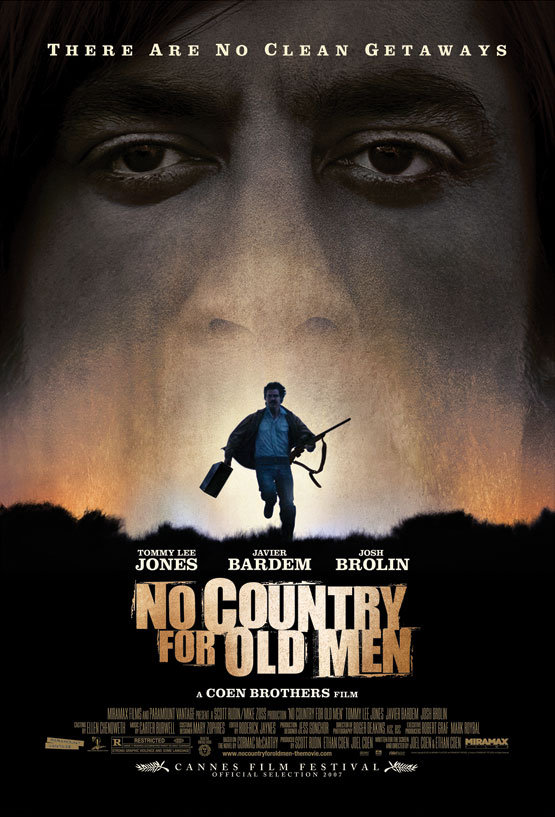
No Country for Old Men
16 deep dives in total