Minimalism and the Use of Sound
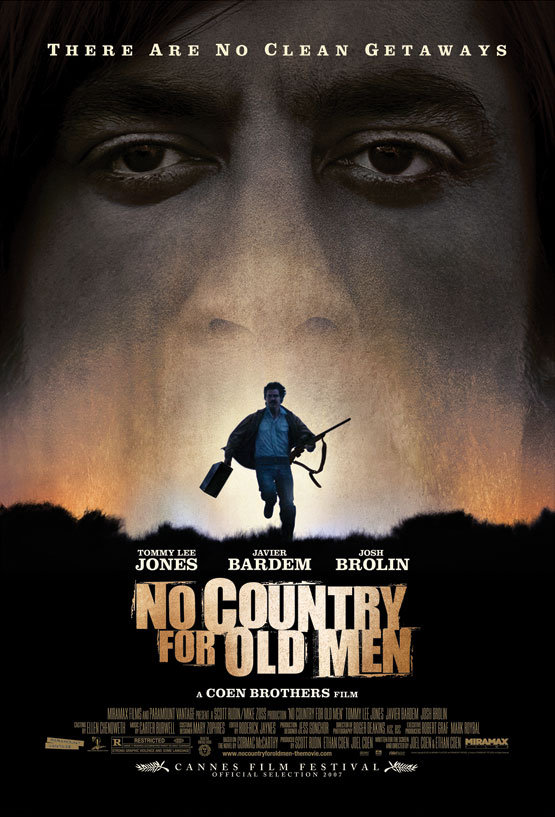
The minimalism of No Country for Old Men goes beyond a mere style — it is a device that embodies the film's core theme of 'collapsed order' and 'the desolate spirit of the age.' The Coen Brothers restrain the use of music to an extreme, combining sound design with the sweeping Texas desert landscape to deliver suffocating dryness and overwhelming tension. This focuses attention not on violence itself but on the 'space' and 'silence' in which that violence occurs.
The Minimalism of Sound and Vision: An Aesthetic of Dryness
No Country for Old Men most extremely reflects the Coen Brothers' intent to minimize music. By using almost no background music (BGM), the film maximizes the audience's auditory focus and creates the arid, dry atmosphere of the Texas desert. This makes the silence of the desert itself feel like a character.
This sonic minimalism goes beyond simply being 'quiet' to make us concentrate on 'what is not heard.' Extremely realistic sound effects — the vibration of air as a gunshot rings out, footsteps, wind — act as the core elements building tension. Even unconventional instruments like Tibetan singing bowls used in Buddhist meditation are deployed as ambient sound or effects, laying a subtly meditative and surreal atmosphere in the gaps between violent events.
The Use of Sweeping Landscape and Lens: The Overwhelm of Space
Cinematographer Roger Deakins played a decisive role in laying the film's aesthetic foundation. He actively employs anamorphic and wide-angle lenses to simultaneously express the enormity of the characters' environment and their sense of isolation. The sweeping Texas desert landscape functions not merely as background but as a colossal presence that overwhelms the characters and symbolizes their helplessness.
- Visualization of isolation: When characters stand before the desert's endless horizon, their existence is visually emphasized as how small and insignificant it truly is. This constructs a spatial background — cut off from civilization — where law and order are difficult to operate.
- Distortion of relationality: The wide-angle lens sometimes exaggerates the distance between characters or shows the surrounding environment too broadly, amplifying the psychological pressure and solitude the characters experience.
Contrast of Silence and Violence: The Maximization of Tension
The film's greatest virtue lies in the extreme contrast between 'silence' and 'violence.' Scenes just before violent killings often occur in extreme stillness. This silence maximizes the audience's anxiety about 'what is about to happen,' and doubles the shockwave when violence erupts.
This stylistic choice perfectly aligns with the film's theme — giving form, through sonic and visual minimalism, to the landscape of an era where modern society's law and order no longer function, where 'rules' themselves have collapsed. Everything is dry, everything is unpredictable, everything is indifferent.
Why It Matters
This minimalist direction proves that *No Country for Old Men* is not a simple hardboiled crime thriller but a 'portrait of an era.' Rather than spectacular action or emotional outbursts, the Coen Brothers concretize the abstract concept of 'disorder' through the dryness of sound and space. The endless wasteland of the desert, and the minimal sounds that echo within it, are a metaphor for the moral and legal vacuum that modern American society is experiencing. Through these stylistic devices, the audience confronts not 'who is good and who is evil' but a fundamental question: 'What is justice in this age?'
Other 기타 dives4
- arrow_outward
The Source Novel and Production Secrets
No Country for Old Men is itself important as the Coen Brothers' first attempt to adapt a Cormac McCarthy novel. This piece examines the subtle differences between the source novel and the film, the actors' intense preparation process, and other production secrets — the depth of the adaptation. It shows a successful case of translating a literary text into the language of cinema.
- arrow_outward
The Whereabouts of the $2 Million Bag
The $2 million money bag is the essential catalyst that triggers all the tragedy in No Country for Old Men. This bag is not simple cash but symbolizes 'excessive desire' itself — an abrupt intrusion into the dry order of the Texas desert. The moment Llewelyn Moss picks it up, he transforms from an ordinary hunter into a being placed at the center of great violence, and the bag's whereabouts expand into a question about the collapsing law and order of modern American society.
- arrow_outward
Anton Chigurh's Inhuman Code
Anton Chigurh's inhuman code goes beyond a mere pattern of violence — it is the philosophical question of 'fate' and 'rules' itself that this film poses. He is a psychopath who moves solely by the cold principle of what benefits himself, not by emotion or anger. His actions — coin flips, his extreme aversion to blood — ruthlessly prove that in a modern society where human will and moral judgment have been rendered powerless, only 'rules' are the sole order.
Back to the title
No Country for Old Men
16 deep dives in total