K
Ki-taek (Kim Ki-taek)
Father and head of the family · Song Kang-ho
Bears the burden of providing for the family but reacts most strongly to class friction and humiliation. His actions blend survival instinct with class-borne rage.
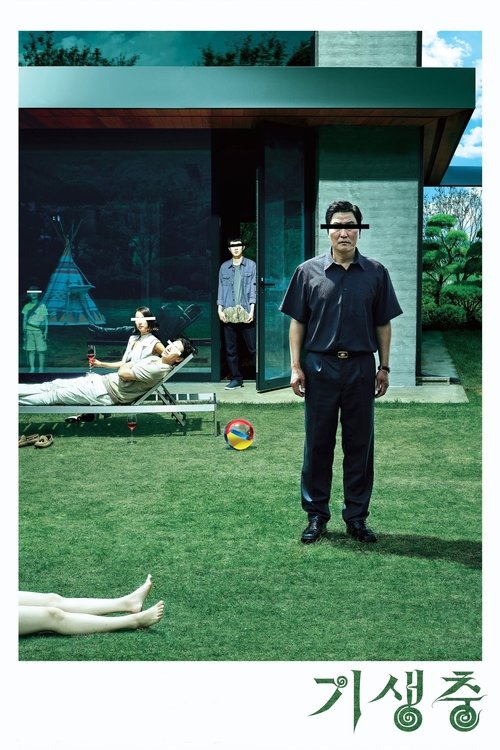
Parasite
Directed by Bong Joon-ho · 2019-05-30 · 131 min · Barunson E&A
A poor semi-basement family infiltrates the lives of the wealthy Park household — a meticulous con game and a black comedy that probes the boundaries of class. The film goes beyond a simple contrast of poverty and wealth, visualizing the wall of class through the vertical structure of space (semi-basement vs. mansion) and the most primal of human senses: smell. It delivers a giddy thrill to its audience while painfully asking about the unconscious humiliation of hierarchy and the structural contradictions of capitalism.
With the entire Kim family unemployed, the eldest son Ki-woo's lead lands them a high-paying tutoring gig. Disguising themselves as art therapists, they infiltrate the mansion of the wealthy Park family, savoring its abundance and pleasure. But their flawless plan collides with a secret hidden beneath the mansion, spiraling into an unstoppable chain of events. The meeting of the two families becomes more than a con — it transforms into an explosive tragedy born of survival and class friction.
Father and head of the family · Song Kang-ho
Bears the burden of providing for the family but reacts most strongly to class friction and humiliation. His actions blend survival instinct with class-borne rage.
Eldest son who steps into a provider's role and drives the family's plan · Choi Woo-shik
Most actively engaged in the family's plan; intelligent and proactive. In the film's final beats, he resolves to become self-reliant by his own efforts.
Mr. Park's young and elegant wife · Cho Yeo-jeong
Outwardly flawless and refined, yet carries the subtle tension and secrets that her class background creates. For the Kim family she functions as a kind of 'access point'.
Daughter who infiltrates the wealthy household through art therapy · Park So-dam
One of the most cunning and calculating figures in the family. Uses her professional expertise in art therapy to penetrate deep into the private domain of the upper class.
Former housekeeper of the Park family mansion · Lee Jung-eun
A pivotal figure who knows the family's secret. Her presence introduces unforeseen variables and threats into the Kim family's plan.
CEO of a global IT company and wealthy patriarch · Lee Sun-kyun
Symbolizes the perfectly controlled life of the upper class. His mansion is the front line of class boundaries — the moment his 'line' is crossed, everything collapses.
Mr. Park is more than a wealthy patriarch — he embodies the perfectly controlled life of the upper class and the boundary of class itself. His mansion is the stage of class friction, and his offhand remark about 'smell' explodes the structural and instinctive wall of class that the poor can never cross, driving the film toward its tragic climax.
The Kim family's 'plan' is more than a survival strategy — it is the meticulous core axis of a con that maximizes class contradiction. They infiltrate the wealthy Park family's life under the disguised pretext of 'art therapy', savoring abundance. But the discovery of the secret basement drags their plan into the realm of crime, completing a tragic narrative in which the vertical structure of space collides with human desire.
Ki-jung wears the professional mask of art therapy to infiltrate the private domain of the wealthy Park family. She is more than a daughter playing rich — she symbolizes the refinement and intellectual sophistication of class, and provides the most 'legitimate' channel for the Kim family to penetrate deepest. Her presence is the decisive device that intensifies the film's black-comedy tension.
In Parasite, vertical space is not a mere backdrop — it is the most powerful device that visualizes class structure and social hierarchy. The layers of space — semi-basement, ground, mansion, and basement — determine the economic positions and psychological states of the characters. Every movement up and down the stairs symbolizes class ascent and descent, and the spatial contrast delivers a class humiliation that is at once giddy and painful.
Moon-gwang, the Park family's former housekeeper, is the pivotal figure who brings unforeseen variables and explosive threats to the Kim family's perfect con. Her existence shows how fragile class boundaries really are and embodies the most primal, raw energy that lights the film's climax.
Parasite's greatest appeal lies in its supple blend of genre. The film goes beyond mere black comedy — it starts with the cheer of an everyday con and mutates into suspense, thriller, and finally explosive tragic drama. This shift in genre pleasure creates a 'tonal turn' that has audiences laughing one moment and recoiling the next, becoming the core device that delivers the heavy message of class contradiction in the most effective and entertaining way.
In Parasite, 'smell' is more than body odor — it is the core device that embodies the boundary of class in the most violent and sensory way. This smell is the residue of poverty, and the unconscious rejection of being itself, sensed by the upper class. Through this sensory barrier the film shows that the gap between classes cannot be measured in economic figures alone, leaving the audience with an uncomfortable and painful social question.
In Parasite, space is not a mere backdrop but the most powerful and meticulous device determining class hierarchy. The damp of the semi-basement is set against the light of the mansion, and movement up and down the stairs visualizes the boundary between classes. Even a tiny detail like the toilet installed above the residential level exposes the contradictions and precarity of upper-class life — making space itself the core engine of a black comedy that triggers class humiliation.
In Parasite, 'smell' is more than a hygiene issue — it is the deadliest and hardest-to-perceive device symbolizing the boundary of class. The smell is the residue of poverty: a 'class brand' that cannot be erased no matter how perfectly one disguises or imitates a wealthy life, and the decisive contradiction that drives the film's tragic conclusion.
The metaphor of the scholar's stone and flowing water is the core device that symbolizes the nature of class structure in Parasite. The stone signifies the 'plan' and 'desire to possess' — humanity's effort to give order and a name to disorderly nature (the flow of capitalism), while water symbolizes the rupture between classes and the colossal, ceaseless flow of capitalism. The metaphor ultimately shows how fragile individual effort and planning are before vast structural currents.
The paradox of 'plan vs. no plan' — one of the central themes of Parasite — examines where the human will to survive collides with the colossal structural contradictions of capitalism. Every plan the Kim family devises is ultimately frustrated or reset by outside forces, and the film reveals, with brutal clarity, that only true self-sufficient subjectivity can serve as an exit.
Ki-taek's line — 'You know what kind of plan never fails? No plan. No plan at all.' — is more than life philosophy. It is a black-comedy declaration that pierces the core theme of Parasite: class disguise and the holes in any plan. The line carries the irony that the family's meticulously crafted 'plan' is itself fragile, and that true survival becomes possible only in unpredictable chaos — deepening the film's resonance.
Yeon-kyo is more than a wealthy madam — she is the 'access point' that lets the Kim family infiltrate the Park mansion, and a figure who embodies class friction. Outwardly the very image of a perfect, elegant upper class, beneath the surface she carries subtle tension and secrets — efforts to keep class boundaries intact. Her presence renders the wall between classes both most alluring and most dangerous.
Ki-woo is the figure who plants the illusions of 'plan' and 'success' in the poor semi-basement family. He is the most active agent in the family's survival and plays the most intellectual role. Throughout the film he represents the desire for upward mobility, and at the end, by showing the will to become self-reliant by his own power, he realizes — most painfully — the class contradictions and the futility of dreams that this work treats.
Yeon-kyo's 'belt of faith' line is more than casual social advice — it is a verbal code shared by the upper class and a symbol of class privilege. The line treats the abstract value of 'trust' as a tradable resource, fundamentally distinct from the 'desperate deception' the Kim family relies on for survival. It embodies the most solid, hardest-to-cross wall between classes that the film explores.
The film displays class structure visually through the stark contrast between the elevated mansion and the low semi-basement dwelling. The staircase-descent scenes in particular have become so iconic they read as photo spots in their own right.
Layers of space are not mere backdrops. Every passage — through the semi-basement window or the mansion gate — is a device that reveals the boundary of class. The irony of a toilet installed above the residential level further symbolizes the cruel paradox of communication itself.
The Kim family enters the wealthy household disguised as art tutors; their lives become abundant and pleasurable in the process. They revise their plan upon discovering the previous housekeeper Moon-gwang and the secret underground space.
Exploiting the fact that Geun-se is hiding in a sealed room, the family schemes — ultimately committing crimes that even confine Ki-taek to the hidden room himself. The whole process looks like a perfectly drafted 'plan', yet the process itself exposes the contradictions of class.
The decisive trigger for Ki-taek's humiliation by Mr. Park is 'smell'. This smell goes beyond personal hygiene — it functions as a device symbolizing class separation itself.
Through this smell, the film shows that society is already divided along class lines. The smell is the residue of poverty, serving as evidence of someone crossing the 'line' the upper class can sense.
The scholar's stone goes beyond a charm for wealth — it signifies humanity's effort to control disorderly nature by naming and owning it. The flow of water connects to the flow of information and communication, symbolizing the rupture between classes.
Through the ending — Ki-woo starts in the semi-basement and returns to the semi-basement — the film mirrors the way the stone returns to nature's waters, ultimately revealing the cyclical structure of class. It hints at how fragile individual effort is within the colossal flow of capitalism.
The film deftly weaves comedy, suspense, human drama, action, and social commentary. It delivers uncontrollable twists, with unpredictable developments as a signature.
Bong Joon-ho's films often begin by borrowing a genre but end by betraying it. This work crushes the heart with its message in proportion to its genre pleasure — the tonal shift from laughter to shock is the core source of its appeal.
You know what kind of plan never fails? No plan. No plan at all.
I'm deadly serious. Trusted-person connections, chain by chain — that's the best, I think. A kind of, you know, belt of faith?
A flagship work representing Bong Joon-ho's filmography, decisive in establishing 'socially critical black comedy' as a genre niche in Korean cinema. Its directorial approach — visualizing structural social contradictions through spatial backdrops — has shaped subsequent directors and is credited with setting a new global benchmark for 'class narrative'.