The Interrogation Scene Where Faith and Violence Collide
The scene in which Jules Winnfield interrogates the small-time hoods as a gang enforcer goes far beyond mere violence—it is an iconic set piece in which scripture is used to display moral superiority and deeply held conviction. It captures the collision between the gangster world's violence and the religious authority used to justify it, and serves as the key narrative device that brings about Jules's fundamental shift in conviction.
The Crossroads of Faith and Violence: Analysis of Jules's Interrogation Scene
The scene in which Jules Winnfield, as a gang enforcer, interrogates his enemies is one of the film's most iconic set pieces. It functions as a complex psychological drama—going beyond the simple process of eliminating an enemy to combine religious authority and a sense of moral superiority into a violent situation.
1. The Setup: Psychological Pressure and Biblical Authority
The interrogation targets individuals connected to one of Marsellus Wallace's business partners, and a tense atmosphere dominates. In this process, the characters probe and mock their adversaries' knowledge or physical characteristics, applying psychological pressure. The interrogation was a psychological process seeking to control relationships and secrets—going beyond physical threat.
The core point of faith-collision in this scene is the recitation of scripture. One character shouts from a verse like Ezekiel 25:17, conveying a message of 'vengeance' and 'judgment.' This passage—promising to visit 'great vengeance and furious anger' upon those who 'poison and destroy my brothers'—shows a shocking piece of direction: combining religious authority with a violent situation.
2. Development and Climax: The Threat of Medieval Torment
The interrogation proceeds without restraint, staging extreme tension with threats like 'I will make you experience medieval pain.' This threat goes beyond inflicting bodily pain—it is an act of negating the adversary's very existence and declaring the termination of the relationship.
At the interrogation's climax, the characters mention the dangerous situation (a figure hiding in the bathroom, a large firearm) and are shown paralyzed with fear. All of this applies intense pressure for the adversary to maintain silence, emphasizing that everything is solely a matter between oneself, the adversary, and 'a third party who will shortly live a very painful life.'
3. The Resolution: Divine Revelation and an Ironic Catastrophe
Through this dramatic interrogation process, Jules comes to believe his survival was 'divine grace' and 'divine revelation.' This shift in conviction becomes the decisive catalyst for him to step off the gangster path and choose a new life of 'redemption.'
But this moment of redemption concludes in an extremely ironic fashion. Jules witnesses Vincent's gun—belonging to someone who fundamentally denied the 'divine grace' Jules believed in—firing out of nowhere, accidentally killing informant Marvin. This event delivers a great shock to Jules, yet paradoxically becomes the force driving his resolution to completely leave the gang life. The subsequent scene at the 'Hawthorne Grill'—where he subdues the robbers and shows them mercy—symbolically shows that he has chosen not the path of a simple gangster but of a 'redeemer.'
4. Foreshadowing: The Contrast Between Violence and Redemption
The most noteworthy detail in this scene is the coexistence of the 'language of violence' and the 'language of conviction.'
- The Misuse of Scripture: The passage from Ezekiel is originally a message of sacred judgment, but used as a 'cool-sounding line' in a gangster context, its meaning is subverted. This captures the moment when violence invades the most sacred of realms.
- The 'You and I' Relationship: In the interrogation process, everything implies that something greater has intervened beyond the merely personal relationship, and the way the termination of the relationship is declared turns it into a fateful event transcending simple crime resolution.
- The Rule of the Bathroom: In the process of Jules resolving to leave the gang, Pumpkin and Honey Bunny stage a robbery while Vincent is in the bathroom—and throughout this film, the 'bathroom' is repeatedly deployed as a device that always becomes the center of events or creates a decisive moment in which someone is absent.
Why It Matters
This interrogation scene is the point most dramatically showing Pulp Fiction's core identity: 'black-comedy violence' and 'postmodern narrative deconstruction.' In the most secular and violent of backdrops—the gangster setting—Jules produces the most sacred code: scripture. This is interpreted as an attempt to sublimate the act of violence into a kind of 'conviction' or 'mission.' This scene, in which faith and violence are mingled, connects directly to the fundamental question the film poses: 'What is the basis of the violence we commit?'—elevating the work from a simple crime film to a black comedy with literary depth.
Other 명장면 dives4
- arrow_outward
The Title's Meaning and Structural Characteristics
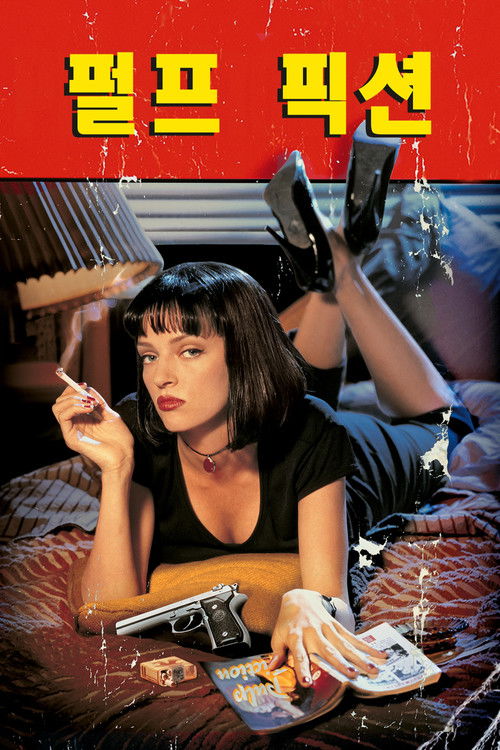
The film's title and core structure—'Pulp Fiction'—refers to the serialized fiction in cheap pulp magazines of the early 20th century, a metaphor that extends beyond a simple genre backdrop to signify the film's entire narrative structure. The film adopts a non-linear anthology format, deliberately deconstructing chronological order, focusing not on the causes and effects of incidents but on the trivial conversations and chance encounters of its characters. This fragmented structure completes a black-comedy game posing fundamental questions about 'the order of stories' and 'the true protagonist.'
- arrow_outward
Items That Symbolize Power and Pride
The two key symbolic items—the 'gold briefcase' and the 'gold watch'—go beyond mere props to form the fundamental axis of conflict in the gangster world. The briefcase signifies the overwhelming 'power' and 'domination' of gang boss Marsellus Wallace, while the watch represents the 'personal pride' and 'past glory' of failed boxer Butch Coolidge. The process of these two symbols colliding shows that the violent lives of the gangsters ultimately reduce to the all-too-human question of pride.
- arrow_outward
The Fictional Brand That Unites a Shared Universe
The 'Red Apple' cigarettes in the film are more than a prop—they are a core fictional brand running through the cinematic universe of director Quentin Tarantino. This brand recurs across numerous Tarantino works—'Pulp Fiction,' 'Kill Bill,' 'Inglourious Basterds,' and more—implying that all his films share one vast, stylish universe. This offers audiences the pleasure of discovering a 'hidden code,' while reminding them that the world in which the characters exist is itself one great pop-cultural stage.
Back to the title
Pulp Fiction
14 deep dives in total