The Awakening of Conscience: A Turning Point
Oskar Schindler's moral awakening is not a simple emotional change but a complex process of moral transformation occurring as capitalist logic and the survival instinct collide. The film deeply explores how he began as a businessman focused entirely on profit, but after directly witnessing the horrific massacres in the Kraków Ghetto and the systematic evil of the Nazis, deploys all his assets and acumen to 'businesslike' rescue the Jews.
💰 Initial Phase: Businessman Oskar Schindler Consumed by Profit
In the film's first act, Oskar Schindler is a typical corrupt, dissolute ethnic German businessman. He seizes Nazi Germany's occupation as opportunity, acquiring factories previously run by Jews and maximizing profit. In this phase, Schindler has no hesitation in utilizing Jews as labor — his actions are driven entirely by the logic of "business acumen" and "bribery."
- Factory acquisition: He acquires Jewish-owned factories cheaply, hiring Jewish workers as low-cost labor. In this process, he treats Jewish assets and labor like commodities.
- Relationship with Stern: He meets Jewish accountant Itzhak Stern and learns the practical aspects of factory operation, but even this relationship is closer to the process of securing "necessary personnel" for Schindler.
At this point, Jews are merely "resources" to Schindler — his behavior is thoroughly opportunistic, far from humanitarian.
💔 The Decisive Shock: Forced into the Awakening of Conscience
The decisive catalyst that turned Schindler's life 180 degrees was the shock that came as he directly witnessed the horrific massacres and extermination in the Nazi ghetto. Having been initially consumed with protecting himself by cultivating ties with the Nazi SS, he undergoes a change of heart as he faces the tragic reality of the ghetto.
This shock transforms him from a mere businessman into "an existence who must save lives." In particular, his direct witness of the Nazi liquidation of the Kraków Ghetto becomes the moral boundary that makes it impossible for him to pursue only his own interests any longer.
💼 Turning Point: The Rescue Operation Using 'Business Acumen'
Schindler's rescue process cannot be packaged with the sentimental word "good deeds" alone. As the materials show, his actions are still based on "business acumen" and "the logic of capital." He deploys all his assets and social networks to conduct a vast "survival operation" rescuing Jews.
- Securing factory workers: To recover factory workers who have been dragged to camps, he stuffs trunks with cash for Amon Goeth and "wins him over" through bribes and favors. This is a continuation of "transactions" paying consideration to the powerful — not pure appeals.
- The birth of the list: The act of compiling a list of prisoners to rescue — the birth of "Schindler's List" — is the product of the process by which he uses his financial resources and social status to legally spirit Jews away under the pretext of "factory employees."
- The final defense line: He secures the authority to prevent the factory from being searched without permission, and the authority to exempt from summary execution — making the factory a "sanctuary" protecting Jews. All this process proceeds under the guise of legal and economic logic.
Ultimately, Schindler's moral awakening is an extremely complex and contradictory process of purchasing and protecting the non-material value of "human conscience" with the most realistic tools of "capital and power."
Why It Matters
Schindler's moral transformation is the film's most essential theme and appeal. If he had been a pure hero from the start, the film would have collapsed into a simple 'good versus evil' conflict. But Spielberg shows Schindler risking his survival and fortune — even using the capitalist logic of 'bribery' — to save Jews, demonstrating how complex and contradictory an act rescue can be. This poses to audiences the question 'What is true good deeds?' — becoming the driving force that delivers a powerful moral message transcending simple historical recreation.
Other 명장면 dives5
- arrow_outward
The Symbolism of Black-and-White Cinematography
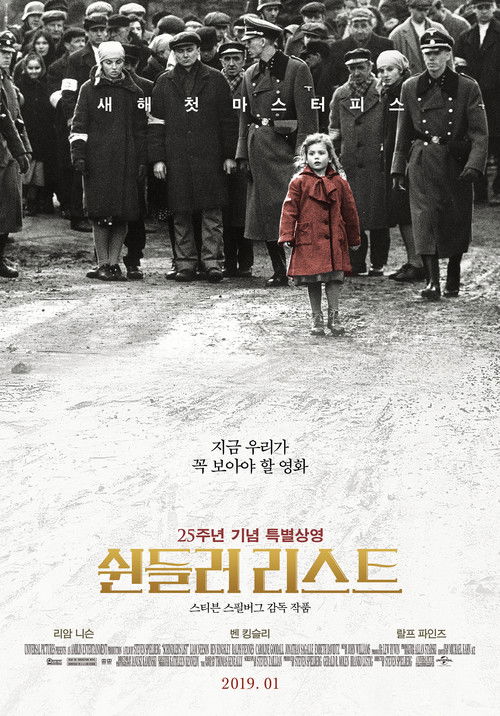
The black-and-white cinematography of Schindler's List transcends a mere aesthetic choice to serve as the core device symbolizing the weight of historical tragedy and the complex moral gray zone of human conscience. It focuses the viewer's gaze on the essence of the horrors without dramatic embellishment, substituting 'losing color' for 'losing life' to express the silenced laments of the vanished Jewish people.
- arrow_outward
Real Figures and Historical Context
Schindler's List transcends a simple survival story to explore the moral gray zone where capitalist logic and human conscience collide. Noting that protagonist Oskar Schindler's process of helping Jews is achieved not through pure good deeds but through 'business acumen' and 'bribery,' it explores this complex human psychology in addressing the vast tragedy of the Holocaust.
- arrow_outward
Survivors' Memorial and Legacy
The final scene in which survivors place memorial stones on Oskar Schindler's grave symbolizes the process by which he is remembered not merely as a businessman but as an 'agent' and 'angel of Mercy.' This scene shows that Schindler's rescue was achieved not through pure good deeds but upon a complex moral gray zone and the logic of survival — completing the film's deep thematic consciousness.
Back to the title
Schindler's List
12 deep dives in total