Business Acumen and Opportunism
Oskar Schindler's 'business acumen and opportunism' is the film's most complex and compelling core. Schindler began as a corrupt businessman focused solely on profit, but as he witnesses the horrors of Nazism his actions gradually evolve into a form where 'business survival strategy' and 'conscience' are intermingled. His rescue acts are not simple good deeds — they explore the moral gray zone achieved through bribery, lobbying, and the logic of capital.
Business Acumen: Schindler's Initial Driving Force
In the film's first act, Oskar Schindler is portrayed as a figure who most effectively deploys the capitalist logic of treating Jews as "assets." A former German military intelligence agent, he was a businessman of exceptional salesmanship and social skill — and his initial actions are focused entirely on profit-seeking.
- Seizing opportunity: Taking advantage of the chaos of the 1939 occupation of Poland, Schindler succeeds in acquiring factories previously run by Jews. He treats the Jews as a "resource" in this process, using them to acquire the factory as labor that would work without wages.
- Delegation of operations: The practical operations needed to run the factory are entrusted to Jewish accountant Itzhak Stern, but Schindler himself handles the external flow of capital — the "bribery" and "purchase" that are the core of factory operation. This shows that he was skilled at exploiting the cracks in the system rather than humanitarian concern.
The Awakening of Conscience and Strategic Transformation
Schindler's inner transformation begins as he directly witnesses the horrific massacres and extermination in the Nazi ghetto. What initially appeared to be using Jews out of material greed begins to experience serious fractures after witnessing Jews dying in the camps. This change is not a pure emotional explosion but occurs at the point where "his own business interests" and "the survival of human beings" as two logics collide.
- Protecting factory workers: When factory workers are dragged away to camps, Schindler attempts to recover them to maintain the factory. In this process, the act of paying a great price to Goeth to purchase lives shows that his actions had not yet escaped the logic of "transaction."
- The meaning of the list: The "Schindler's List" he compiles to rescue Jews is not a simple life-saving list. It has the character of an "asset list" and "investment roster" aimed at achieving the most business-like goal of survival by deploying all his financial resources and capital.
Salvation Completed by the Logic of Capital
Schindler's rescue process refuses the typical heroic narrative. He acts not out of love for Jews or moral duty, but to uphold the minimum conscience of: "the workers at my factory are about to die, and I cannot simply sit with folded hands and watch." This shows the most realistic, capitalist form of resistance against the vast evil system of Nazism.
- Lobbying and bribery: He stuffs trunks with cash for Goeth, offers diamonds as bribes to the suspicious Scherner, and rescues prisoners. All this process is achieved through the capitalist logic of "money" and "power" — making even the depletion of Schindler's own fortune feel like a kind of "business loss."
- The guilt of the ending: At the film's close, weeping as all the Jews weep, he weeps with guilt and shame — "If only I had earned a little more, sold a little more of what I had, perhaps I could have saved even one more." This guilt is connected to the capitalist sense of failure that he could not save more lives because of the limits of the "capital" he had.
Why It Matters
The keyword 'business acumen' explains why Schindler's List transcends a simple Holocaust survival story. Steven Spielberg, by not portraying his protagonist as a conventional moral hero, compels audiences to reject the binary thinking of 'good' and 'evil.' Schindler's actions are grounded in the most realistic question of 'how to survive,' causing audiences to reflect on the complex gap between moral responsibility and the survival instinct. In other words, this film shows that human conscience does not come from pure emotion but is the result of a realistic struggle over 'what logic to choose' and 'what resources to mobilize' in extreme situations.
Other 떡밥 dives5
- arrow_outward
The Symbolism of Black-and-White Cinematography
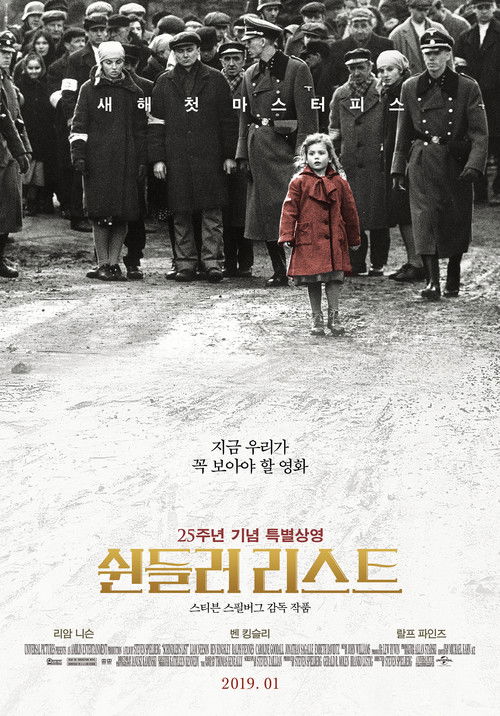
The black-and-white cinematography of Schindler's List transcends a mere aesthetic choice to serve as the core device symbolizing the weight of historical tragedy and the complex moral gray zone of human conscience. It focuses the viewer's gaze on the essence of the horrors without dramatic embellishment, substituting 'losing color' for 'losing life' to express the silenced laments of the vanished Jewish people.
- arrow_outward
Real Figures and Historical Context
Schindler's List transcends a simple survival story to explore the moral gray zone where capitalist logic and human conscience collide. Noting that protagonist Oskar Schindler's process of helping Jews is achieved not through pure good deeds but through 'business acumen' and 'bribery,' it explores this complex human psychology in addressing the vast tragedy of the Holocaust.
- arrow_outward
Survivors' Memorial and Legacy
The final scene in which survivors place memorial stones on Oskar Schindler's grave symbolizes the process by which he is remembered not merely as a businessman but as an 'agent' and 'angel of Mercy.' This scene shows that Schindler's rescue was achieved not through pure good deeds but upon a complex moral gray zone and the logic of survival — completing the film's deep thematic consciousness.
Back to the title
Schindler's List
12 deep dives in total