C
Protagonist, a girl in the middle of moving · Rumi Hiiragi
Timid and fearful at first, she discovers remarkable resilience and courage in crisis, gradually growing into a strong young woman. She works at the bathhouse under the alias 'Sen.'
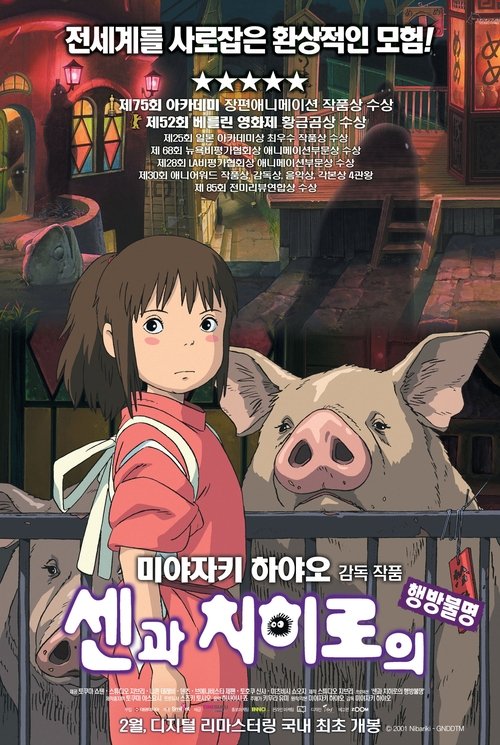
千と千尋の神隠し
Directed by Hayao Miyazaki · 2001-07-20 · 124 min · Studio Ghibli
Far more layered than a simple coming-of-age fairy tale, Spirited Away carries a weight of symbolism that demands deeper engagement. The moment ten-year-old Chihiro steps into the spirit bathhouse, she is not merely looking for a job—she must recover the most fundamental things of all: her name and her identity. From the shocking moment her parents are transformed into pigs, to the way the bathhouse itself operates as a vast symbol of capitalism and human greed, this film casts a sharp light on the dark underside of modern society through the guise of fantastical storytelling. Can Chihiro hold onto her own light within this enormous system?
On their way to a new home, Chihiro's family passes through a tunnel that leads them into the world of spirits. Her parents are lured by the food of an abandoned stall and are turned into pigs. To survive in this uncanny bathhouse, Chihiro strikes a deal with the ruling witch Yubaba—and in doing so receives the name 'Sen,' losing her true identity. Working among gods and spirits of every kind, she learns survival skills and courage while setting out on a journey to rescue her family and reclaim her real self. Along the way she confronts the great themes of human desire, the advance of civilization, and the cycles of nature.
Protagonist, a girl in the middle of moving · Rumi Hiiragi
Timid and fearful at first, she discovers remarkable resilience and courage in crisis, gradually growing into a strong young woman. She works at the bathhouse under the alias 'Sen.'
A boy at the bathhouse, a river spirit · Miyu Irino
A mysterious boy who aids Chihiro. He was once the spirit of a river, and through his encounters with Chihiro he recovers his long-forgotten identity.
The witch who rules the bathhouse · Mari Natsuki
The owner of the bathhouse. Armed with powerful magic and commanding charisma, she binds Chihiro in a contract to control her name and life. She is the symbolic embodiment of the bathhouse system.
Chihiro's father · Takashi Naito
A man who enters the spirit world with his family and is transformed into a pig. He symbolizes the tragedy brought about by parental greed and ignorance.
Chihiro's mother · Yasuko Sawaguchi
She enters the spirit world alongside her husband and is also turned into a pig. She embodies the family's unconscious desires.
A faceless spirit
A being that hovers around Chihiro. Initially destructive, he gradually discovers his own reason for existence and identity through his interactions with her.
In Spirited Away, Chihiro's growth comes not from magic or external help but from the 'labor' she performs directly within the vast system of the spirit bathhouse. She attends the Stink Spirit, cleans, and fulfills the role of a contract worker, acquiring survival skills and a sense of responsibility along the way. This process carries a deep message—set within a fantastical backdrop—that an individual performing their role and bearing responsibility in modern society is a prerequisite for self-realization.
Haku is more than a mere helper—he is the symbol of lost identity and memory. Originally a spirit guarding a river, he wanders the bathhouse having forgotten his name, and through his encounters with Chihiro he recovers his true name and reason for existence. Haku's journey illustrates the universal process of every being searching for forgotten memories and a true self.
Spirited Away is not a simple fantasy coming-of-age story—it is a complex work that passed through multiple genre experiments and planning failures before completion. Early stages included various genre experiments such as 'A Strange Town in the Mist' and a noir-genre story featuring an 18-year-old art student. These backgrounds provided the foundation for the film to carry both its fantastical depth and a sharp critical consciousness of contemporary reality.
No-Face is not a simple spirit—he is a character symbolizing the collective desires and emptiness of modern society. Initially destructive through gold dust and material temptation, he goes through his interactions with Chihiro to demonstrate a process of discovering his own reason for existence and identity. This character is a core device that maximizes the tension between the capitalist desires and the essential purity of human nature that the work throws into relief.
Yubaba is not merely the witch who rules the bathhouse 'Aburaya'—she is the personification of the capitalist system and the will to control. She strips the protagonist Chihiro's name and identity through a contract, but also shows responsible leadership in staff management and crisis situations (F2, F3), revealing a complex face that transcends a simple villain.
'Don't worry, I'll definitely save you…' is the line Haku delivers to Chihiro when she is in despair after seeing her parents turned into pigs. Far more than simple comfort, it is the decisive catalyst that starts Chihiro's survival journey. This single sentence is the first hope she finds amid her greatest sense of loss and fear, and the turning point that makes her realize she must grow through her own power.
In Spirited Away, 'name' goes beyond a mere label—it is the vessel that holds a person's history, memories, and very existence. The process through which Chihiro works at the bathhouse under the alias 'Sen' symbolically shows how, within modern society's capitalist labor and desire, an individual loses their essential self. Ultimately, Chihiro's journey of reclaiming her true identity through courage and labor provides a deep interpretation of establishing a sense of self through inner—rather than external—power.
Chihiro is a character whose journey goes beyond mere survival—she is a story of reclaiming a lost identity and courage. Initially a timid and fearful girl, she gradually transforms into a resilient survivor through labor and crises within the vast system of the spirit bathhouse. Her growth is the core axis running through the great themes of modern society's capitalist desires and the cycles of nature.
The process of washing the Stink Spirit is more than labor—it symbolizes that Chihiro is the agent who restores essential purity within the corrupted civilization and desire system. This scene demonstrates that all the trials Chihiro faces are ultimately the process of 'purification,' and that her growth is deeply connected to physical cleaning and the rediscovery of sacred essence. It is a key iconic scene.
The mother in the film is more than a family member—she is a character symbolizing past loss and unresolved emotional burdens. Her coldness toward Chihiro is interpreted not as a lack of affection but as the projection of unconscious grief, and this maximizes the weight of the film's core themes of 'loss' and 'memory.'
In the film Spirited Away, 'name' is more than a mere label—it is a key keyword symbolizing the fundamental identity of existence. The process through which protagonist Chihiro obtains the alias 'Sen' at the bathhouse from Yubaba, and Haku's journey to recover his true name 'Nigihayami Kohaku Nushi,' symbolically show the process of recovering a lost self and discovering one's true identity.
The spirit bathhouse 'Yubaba' (Aburaya) in the film is more than a mere backdrop—it is a vast symbolic space where the spirit world, human desire, and capitalism intermingle. The name itself derives from a wordplay on 'oil shop,' and as a space commercialized for the gods' fatigue, it functions as a device that sharply satirizes the consumerism and desires of modern society.
The spirit bathhouse 'Aburaya' in the film is more than a mere backdrop—it is a vast stage symbolizing modern capitalism and humanity's endless material desires. This space weaves a sharp critique of 'economic survival' into the fairy-tale narrative of 'growth,' and functions as the place where protagonist Chihiro must fight against a great system to preserve her individual identity.
Spirited Away uses the fantastical spirit bathhouse to deliver a sharp critique of modern capitalism and humanity's endless material desires. In this space every being is treated as a kind of commodity, and every hardship Chihiro faces is a metaphor for the erosion of essential values by the logic of money and desire in modern society.
Chihiro's father is more than a family member—he is a character symbolizing modern capitalism and reckless greed. His act of freely devouring delicacies in the spirit world without permission represents the complacency and ignorance of someone who relies on economic prosperity without questioning it. His transformation into a pig visualizes the tragic process by which greed collapses like a bubble and everything returns to its original state.
The bathhouse owner's name 'Yubaba' derives from 'Aburaya' in Japanese, meaning 'oil shop.' This interpretation is traced back to an idea by Isao Takahata. The gods depicted in the film are grounded in Japan's indigenous Shinto religion and the animistic belief that spirits inhabit all things.
The bathhouse is more than a mere setting; it is a vast system where gods dwell—a symbolic space where human desire and capitalism intermingle. Yubaba's establishment is portrayed as a commercial facility where the gods come to relieve their 'fatigue.'
Working at the bathhouse, Chihiro has her name stolen and is given the alias 'Sen.' One of the work's core themes is the process of reclaiming one's self through recovering one's name and discovering one's true identity. Haku's true name is 'Nigihayami Kohaku Nushi,' the spirit of a small neighborhood river.
In this film, a name is not a mere label—it is the very foundation of a person's identity. The journey of Chihiro reclaiming the name 'Chihiro,' and of Haku remembering his true name, is a symbolic quest to recover a lost sense of self.
The bathhouse carries a critique of civilizational development, the destruction of nature, and the rapacity of capitalism. It is interpreted as the symbolic space representing the commercial establishments of the economic bubble era. The transformation of the parents into pigs symbolizes the collapse of the legal and economic bubble—all greed reduced to nothing.
Through the bathhouse as a commercial facility, the film critically satirizes humanity's endless material desires and the logic of capital that flows from them. This is not merely a story about gods, but a message directed at all of us living in modern society.
Chihiro is tasked with attending an enormous Stink Spirit that reeks with foul odors. In the process she discovers a bicycle handle embedded in the spirit's body, growing through these events. The Stink Spirit is in fact the true form of a famous river god.
The act of washing the Stink Spirit demonstrates that Chihiro is not merely a worker but the agent restoring a divine being's purity. This symbolizes Chihiro's ability to find essential value even within a polluted civilization.
The film originally emerged after a failed attempt to adapt 'A Strange Town in the Mist,' passing through concept stages involving a 'chimney' and a character named 'Rin.' Early on, a noir-genre story was conceived in which an 18-year-old art student is confined in the bathhouse setting.
Having passed through multiple genre experiments, the resulting setting provided the foundation for the film to carry both its fantastical depth and a sharp critical consciousness of contemporary reality.
Don't worry, I'll definitely save you…
This work is celebrated as a masterpiece of film history transcending the animation genre, elevating the artistic prestige of Studio Ghibli to a new level. Its record as the only Japanese animation to win the Academy Award for Best Animated Feature was a decisive moment that impressed upon the world the artistic depth of Japanese animation. It subsequently played a decisive role in raising director Hayao Miyazaki's works to high esteem in film circles worldwide.