A Critical Satire of Capitalism and Desire
Spirited Away uses the fantastical spirit bathhouse to deliver a sharp critique of modern capitalism and humanity's endless material desires. In this space every being is treated as a kind of commodity, and every hardship Chihiro faces is a metaphor for the erosion of essential values by the logic of money and desire in modern society.
The Spirit Bathhouse: A Vast Symbol of Desire and Capital
The spirit bathhouse at the center of Spirited Away is no mere spa. It is a vast commercial facility where gods come to relieve their "fatigue"—and the system itself, governed by the logic of human desire and capital. Through this bathhouse, the film critically satirizes modern society's dependence on material prosperity and the economic bubble.
1. The Commodification of All Beings: Gods and Humans
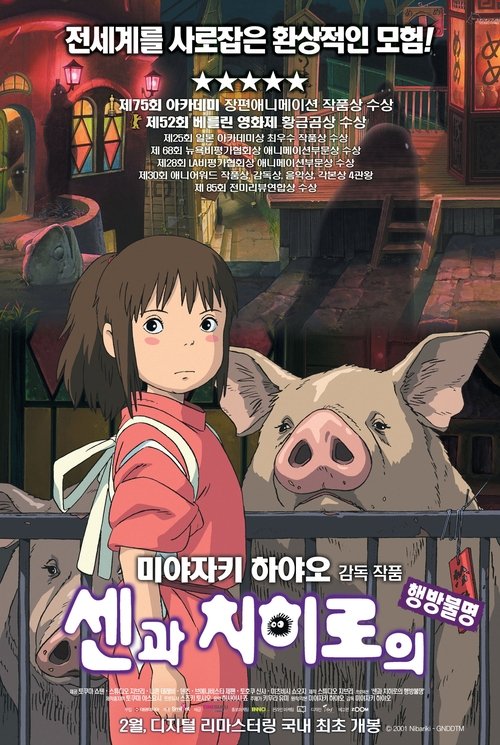
Every being in the bathhouse is treated as a kind of "commodity." The most glaring example is Chihiro's parents. The event of the parents freely devouring food from an unattended stall and being turned into pigs symbolizes the process of losing essential values—family time, health—to the lure of material prosperity and the economic bubble. Their transformation shows the moment desire overwhelms nature.
Yubaba imposes the rules of a great system—"this is a bathhouse where eight million gods of Japan come to rest"—and strips Chihiro's name, "Ogino Chihiro," replacing it with the commodified name "Sen." This is a metaphor for the reality in modern society where individuals sell their identity or labor to the capitalist system in order to survive.
2. The Cycle of Desire and the Critical Gaze
- Gold Dust and No-Face: No-Face offers gold dust to win Chihiro's favor, but Chihiro, thinking only of Haku, refuses. This refusal is a rejection of material value, and the chaos No-Face subsequently brings to the bathhouse demonstrates that endless desire ultimately produces destructive consequences.
- The Stink Spirit and the River Spirit: The enormous Stink Spirit symbolizes environmental pollution—the "filth" that modern society ignores. The process of Chihiro enduring hardship in tending it, and ultimately the River Spirit appearing to offer aid, means that no matter how enormous a system, it is eventually purified and restored by the cycles of nature and essential power.
- The Breaking of the Contract: The moment Chihiro tells Yubaba "my mother and father are not here," pointing out the loophole in the contract, the bathhouse system temporarily collapses. This shows that "true value" cannot be captured by money or a contract.
3. The Recovery of Essence: Names and Memory
Every hardship's conclusion is "the recovery of essence." The process of Chihiro recovering her parents, of Haku recovering his true name "Nigihayami Kohaku Nushi," and of Chihiro remembering her own true name "Ogino Chihiro"—all are journeys to reclaim the most fundamental thing: "the self," temporarily forgotten under external systems. This is not merely returning to where one came from, but an active act of re-establishing the meaning of one's existence through one's own power.
Why It Matters
The single greatest reason this film cannot be understood as a simple fantasy fairy tale is precisely this gaze of 'capitalist critique.' The bathhouse setting expands the familiar systems of the everyday world into a vast metaphor. Chihiro's hardships are not merely the process of learning survival skills, but a journey of finding the answer to the philosophical question: 'What is truly valuable?' Thanks to this thematic consciousness, the film speaks across generations, delivering deep empathy and reflective messages to all modern people wandering amid material prosperity.
Other Reading dives2
- arrow_outward
The Value of Labor and Growth
In Spirited Away, Chihiro's growth comes not from magic or external help but from the 'labor' she performs directly within the vast system of the spirit bathhouse. She attends the Stink Spirit, cleans, and fulfills the role of a contract worker, acquiring survival skills and a sense of responsibility along the way. This process carries a deep message—set within a fantastical backdrop—that an individual performing their role and bearing responsibility in modern society is a prerequisite for self-realization.
- arrow_outward
Identity and the Power of the Name
In Spirited Away, 'name' goes beyond a mere label—it is the vessel that holds a person's history, memories, and very existence. The process through which Chihiro works at the bathhouse under the alias 'Sen' symbolically shows how, within modern society's capitalist labor and desire, an individual loses their essential self. Ultimately, Chihiro's journey of reclaiming her true identity through courage and labor provides a deep interpretation of establishing a sense of self through inner—rather than external—power.
Back to the title
Spirited Away
15 deep dives in total