Mother
The mother in the film is more than a family member—she is a character symbolizing past loss and unresolved emotional burdens. Her coldness toward Chihiro is interpreted not as a lack of affection but as the projection of unconscious grief, and this maximizes the weight of the film's core themes of 'loss' and 'memory.'
The Mother: An Incarnation of Loss and Unconscious Grief
In the film, Chihiro's mother is the closest person to her, yet she simultaneously shows an emotional distance that is difficult to understand. Her behavior addresses issues deep in the human psyche—of a different dimension from the external threats Chihiro faces, such as Yubaba or the Stink Spirit.
1. The Character Arc: The Shadow Called "Loss"
The mother's character arc is drawn less as a clear change and more as a form of "enduring pain." Her cold treatment of Chihiro is not simply a failure to perform her role as a parent. Rather, it is interpreted as the result of the deep grief of loss she unconsciously carries being projected onto her daughter.
- Surface Behavior: She keeps her distance from Chihiro and shows a cold attitude.
- Inner Truth: She consciously cherishes her daughter and knows that certain past events were not her daughter's fault.
- Consequence: Nonetheless, past trauma and grief act as her emotional defense mechanism, manifesting as behavior that wounds Chihiro.
This psychological depiction shows the mother as a figure "trapped in the past," unable to fully accept the present Chihiro.
2. Key Scene Cluster: Transformation into Pigs and Parting
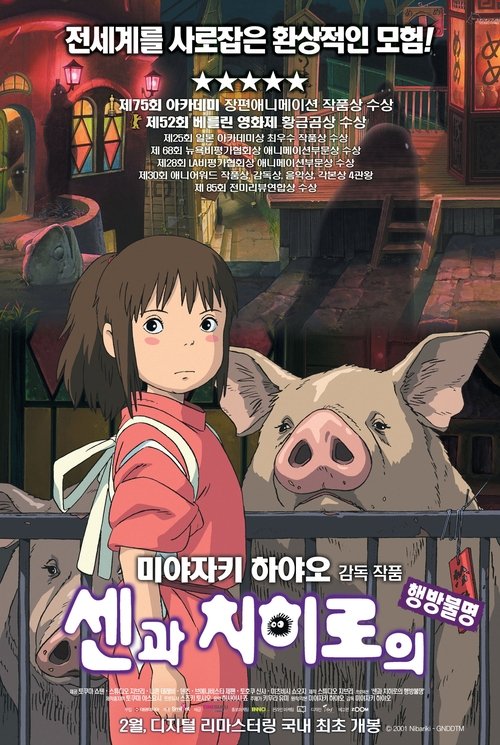
The moment the mother's presence is most dramatically revealed is when the family enters the spirit world and is transformed into pigs. This event symbolizes not merely a physical transformation, but the entire family being swept away by "real-world desires" and "unconscious laziness."
- The Manifestation of Desire: The parents lose their guard, succumb to the delicious food, and are turned into pigs—visually demonstrating that the family has lost its "original sense of responsibility" and "real-world boundaries."
- Emotional Disconnection: When Chihiro begins her journey to save her parents, the mother's cold gaze shows her as trapped within her own emotional domain rather than empathizing with Chihiro's hardships.
3. Interpretation: The Weight of "Loss" and the Process of Healing
The mother character is the device that most emotionally conveys the film's core themes of "loss" and "memory" to the audience.
- Audience Reception: Rather than interpreting the mother's cold attitude simply as "a bad parent," audiences come to empathize from the perspective of "a human experiencing the pain of loss."
- The Film's Message: In the end, when Chihiro looks back as she leaves the bathhouse, the mother's call serves as the final link confirming that Chihiro has found "her own light." This offers the hope that even after experiencing loss, one can be healed through love and memory.
Why It Matters
The mother character is both the emotional backdrop supporting Chihiro's journey and a mirror deepening the film's thematic consciousness. If Chihiro's process of acquiring a new identity 'Sen' is learning external survival skills, the mother's narrative is about learning to 'acknowledge and accept loss.' Her unconscious grief reminds audiences of the universal themes of 'family' and 'memory,' and is the reason the film achieves a deep psychological resonance that transcends simple fantasy.
Other Character dives5
- arrow_outward
Haku
Haku is more than a mere helper—he is the symbol of lost identity and memory. Originally a spirit guarding a river, he wanders the bathhouse having forgotten his name, and through his encounters with Chihiro he recovers his true name and reason for existence. Haku's journey illustrates the universal process of every being searching for forgotten memories and a true self.
- arrow_outward
No-Face
No-Face is not a simple spirit—he is a character symbolizing the collective desires and emptiness of modern society. Initially destructive through gold dust and material temptation, he goes through his interactions with Chihiro to demonstrate a process of discovering his own reason for existence and identity. This character is a core device that maximizes the tension between the capitalist desires and the essential purity of human nature that the work throws into relief.
- arrow_outward
Yubaba
Yubaba is not merely the witch who rules the bathhouse 'Aburaya'—she is the personification of the capitalist system and the will to control. She strips the protagonist Chihiro's name and identity through a contract, but also shows responsible leadership in staff management and crisis situations (F2, F3), revealing a complex face that transcends a simple villain.
Back to the title
Spirited Away
15 deep dives in total