The Symbolic Space of Capitalism and Desire
The spirit bathhouse 'Aburaya' in the film is more than a mere backdrop—it is a vast stage symbolizing modern capitalism and humanity's endless material desires. This space weaves a sharp critique of 'economic survival' into the fairy-tale narrative of 'growth,' and functions as the place where protagonist Chihiro must fight against a great system to preserve her individual identity.
The Spirit Bathhouse: A Vast Symbolic Space of Desire and Capital
On the surface, the spirit bathhouse setting of Spirited Away appears to be a sacred and peaceful place where gods come to relieve their fatigue. But through this bathhouse as a commercial facility, the film critically satirizes humanity's uncontrolled material desires and the logic of capital. This is not merely a story about gods—it carries a vast message directed at all of us living in modern society.
1. The Runaway of Uncontrolled Consumption and Desire
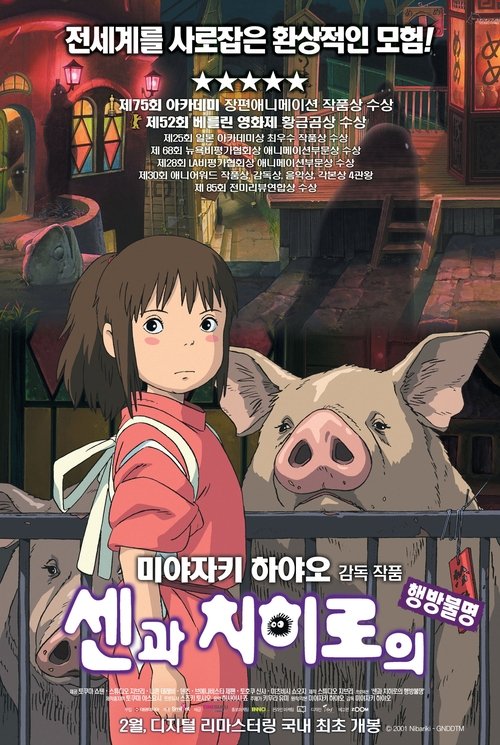
The event of Chihiro's parents being turned into pigs is the most central point of critique symbolized by the bathhouse. The parents immediately eat their fill at an unattended food stand without seeking permission—representing the flow of reckless capital consumed in modern society without limits or a sense of ethical responsibility. Their transformation into pigs is a symbolic warning that when the law and the economic bubble burst, all greed ultimately returns to nothing.
2. The Contract and the Commodification of Labor
Yubaba, the owner, is the most powerful administrator of this system. The contract she imposes on Chihiro shows the typical structure of "commodification of labor." She forces on Chihiro the rules of a great system and strips Chihiro's name and identity, replacing them with the commodified name "Sen." The process of Chihiro going to work at the bathhouse is a metaphor for modern people who must sell their identity or labor to survive within the logic of capitalism.
3. The Stink Spirit and the Cycle of Purification
The "Stink Spirit" that appears deep in the bathhouse symbolizes the garbage that modern civilization has piled up—material waste and social pollution. The process Chihiro undergoes in attending it means not simply cleaning but the painful labor of purifying all the filth accumulated by the bathhouse system. The process of the Stink Spirit recovering its true form as the River Spirit conveys the message that no matter how polluted, the cycles of nature and essential power will eventually purify and restore.
4. The Recovery of Names and Essence
The bathhouse tests whether Chihiro can preserve "her own light." The moment she realizes through Haku that her true name is more important than any system name, and through No-Face that "real relationships" and "her own values" are more important than "material value," she transcends the system's logic. The bathhouse is not merely a place where Chihiro finds work—it is the stage of a journey to reclaim her fundamental identity.
Why It Matters
The bathhouse setting is the core device that runs through this film's thematic consciousness. If this space had remained a simple fantasy backdrop, the film would have remained nothing more than a 'coming-of-age fairy tale.' But by interpreting the bathhouse as a capitalist commercial facility, Hayao Miyazaki borrows the genre framework of fantasy to critically illuminate the structural problems of modern society—reckless consumption, exploitation of labor, and the loss of identity. Every hardship Chihiro faces is the process of proving her own value within this great 'system,' and this symbolism of the space is the most important element determining the artistic depth of the work.
Other 설정 dives4
- arrow_outward
Early Concepts and Genre Experimentation
Spirited Away is not a simple fantasy coming-of-age story—it is a complex work that passed through multiple genre experiments and planning failures before completion. Early stages included various genre experiments such as 'A Strange Town in the Mist' and a noir-genre story featuring an 18-year-old art student. These backgrounds provided the foundation for the film to carry both its fantastical depth and a sharp critical consciousness of contemporary reality.
- arrow_outward
The Stink Spirit and the Discovery of the Bicycle Handle
The process of washing the Stink Spirit is more than labor—it symbolizes that Chihiro is the agent who restores essential purity within the corrupted civilization and desire system. This scene demonstrates that all the trials Chihiro faces are ultimately the process of 'purification,' and that her growth is deeply connected to physical cleaning and the rediscovery of sacred essence. It is a key iconic scene.
- arrow_outward
Name = Identity: The Importance of Reclaiming One's True Name
In the film Spirited Away, 'name' is more than a mere label—it is a key keyword symbolizing the fundamental identity of existence. The process through which protagonist Chihiro obtains the alias 'Sen' at the bathhouse from Yubaba, and Haku's journey to recover his true name 'Nigihayami Kohaku Nushi,' symbolically show the process of recovering a lost self and discovering one's true identity.
Back to the title
Spirited Away
15 deep dives in total