This flower… I give to you. For a comrade has her enemy to face…
Go Seon-suk's line to Geum-ja — 'This flower… I give to you. For a comrade has her enemy to face…' — is not a simple word of comfort. This exchange in the closed space of prison symbolizes the transmission of a survival strategy and a tool of revenge meticulously hidden within the wrapping of 'kindness.' This line captures the decisive moment in which Geum-ja builds her revenge network, and serves as a key device hinting that all her actions were calculated 'kindness.'
"This Flower… I Give to You. For a Comrade Has Her Enemy to Face…": A Weapon Wrapped in Kindness
This line is one of the scenes that most clearly embodies the 'duality' running through the film's atmosphere. The prison setting, cut off from the outside world, means all exchanges take place in an extremely private and covert manner. This conversation therefore carries not the nature of simple dialogue, but of an 'information exchange' for survival and revenge.
1. Context of the Line: The Boundary Between Comfort and Concealment
The scene where Go Seon-suk passes the Dhammapada to Geum-ja appears on the surface to be an exchange of religious comfort and compassion. Go Seon-suk hands Geum-ja the copy and says: "This flower… I give to you. For a comrade has her enemy to face…" This sentence itself seems to deliver a warning by directly mentioning the word 'enemy.' But the true context of this exchange lies in the Dhammapada itself.
This copy is no mere Buddhist scripture. According to the film's narrative, it concealed the blueprint for a gun — a lethal weapon Geum-ja needed to execute her revenge. Go Seon-suk, while appearing to offer comfort, was in fact performing the role of an accomplice delivering the core tool and information Geum-ja required. This demonstrates how meticulously Geum-ja had built her network inside the prison.
2. Position in the Narrative: Securing 'Material Evidence' for the Revenge Plan
This scene is important because it visually proves that Geum-ja's process of revenge is conducted not on the basis of abstract emotion, but on concrete 'material evidence' and 'tools.' Geum-ja does not act on anger alone to take revenge on Mr. Baek. She systematically collects weapons, information, and the help of allies.
- Securing the Tool: The Dhammapada (blueprint) provides Geum-ja with the physical means to execute her revenge. This means her plan is not merely theoretical — it is ready to translate into actual violent action.
- Strengthening the Network: The exchange with Go Seon-suk shows that Geum-ja has secured 'trustworthy' allies within the prison. They serve to provide the human resources needed for her revenge drama.
At this point, Geum-ja has already built a perfect disguise under the nickname 'Kind-hearted Geum-ja,' and this Dhammapada is the symbol of the 'real weapon' operating behind that disguise.
3. Interpretation: Redefining 'Kindness'
This exchange fundamentally redefines the concept of 'kindness.' The audience tries to interpret all of Geum-ja's actions as 'good intentions,' but this scene exposes that those very good intentions are driven by the cold calculation of 'achieving a goal.' The act of passing the Dhammapada takes the form of a 'gift,' but its contents are a 'threat' and a 'directive.'
For Geum-ja, kindness is precisely 'a medium for the exchange of information.' She demonstrates the ability to acquire the weaknesses and information of others through the process of giving and receiving help, and to convert that information into weapons. The warning "For a comrade has her enemy to face…" suggests that all these kindly exchanges were part of a process ultimately aimed at eliminating an 'enemy.'
4. Subsequent Impact: Completion of the Revenge
The information and tools secured through this Dhammapada (blueprint) play a decisive role in the film's climax — the final confrontation with Mr. Baek. Geum-ja uses these weapons to subdue Mr. Baek and retaliates for all the pain and betrayal she endured. The 'planned violence' symbolized by the Dhammapada was the most lethal 'knowledge' and 'skill' Geum-ja acquired through 13 years of imprisonment. This scene is a critical turning point confirming that Geum-ja was not a mere victim, but an active 'architect of revenge' who manufactures and wields her own weapons.
Why It Matters
This line captures the defining moment that completes Lee Geum-ja's identity as a character. Geum-ja wore a perfect mask of 'model prisoner' through 13 years of imprisonment. This exchange shows that mask at its thickest and most impenetrable. The process by which a religious symbol — the Dhammapada — transforms into a 'material weapon' in the form of a gun blueprint imprints on the audience that Geum-ja's revenge is not an emotional outburst, but a thoroughly calculated 'technical act.' In short, this line is the decisive piece of evidence proving that Geum-ja's 'kindness' was itself the most lethal 'intelligence' and 'weapon.'
Other Quote dives1
Back to the title
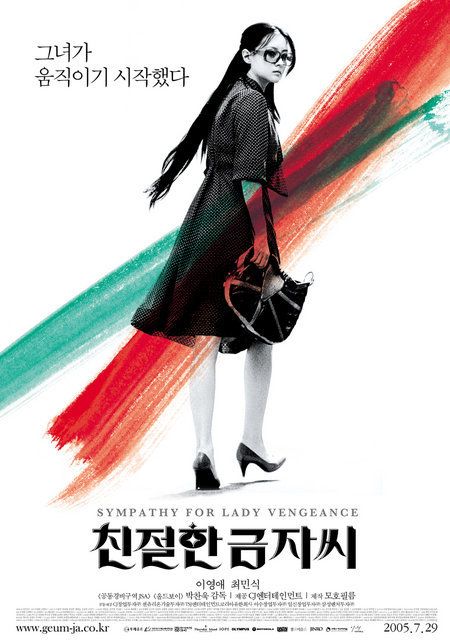
Sympathy for Lady Vengeance
15 deep dives in total