arrow_back
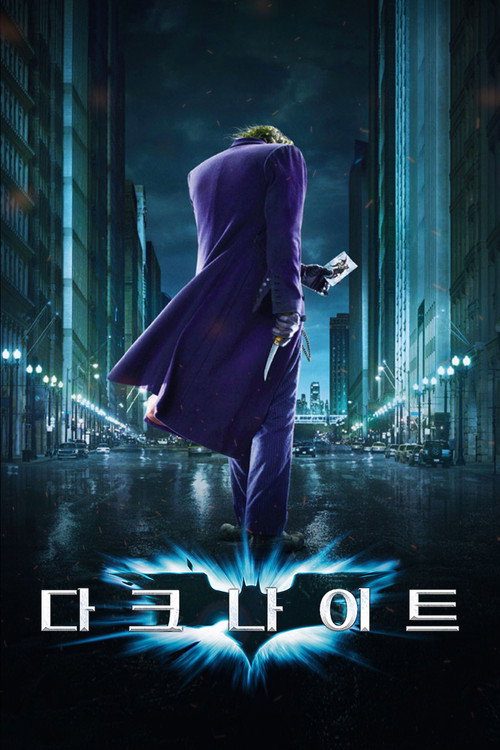
The Dark Knight
The Dark Knight
Film

The Dark Knight

The Dark Knight

Directed by Christopher Nolan · 2008-07-16 · 152 min · Warner Bros. Pictures

This is not simply a superhero film — it begins with the premise that justice itself has collapsed in Gotham City. The film dismantles the very concepts of 'law' and 'justice.' Batman engages in illegal activities in the name of maintaining order, while District Attorney Harvey Dent seeks to realize justice within the confines of the law. Witnessing how these two pillars crumble and are redefined before their most perfect adversary — the Joker, an embodiment of madness — is a revelatory experience. The Joker is not merely a villain but a philosophical force that poses the sharpest possible questions about every moral norm and rule society has constructed.

Synopsis

Gotham City seethes with organized crime and corruption, while Batman works to maintain order. As he plots to save the city alongside Detective Jim Gordon and District Attorney Harvey Dent, an unpredictable villain known as the Joker emerges. The Joker vows to kill Batman and destroy Gotham, unleashing madness and chaos everywhere he goes, forcing Batman to stake everything on stopping him. In the process, Batman discovers in Harvey Dent's efforts — to save the city through law — the true meaning of a hero. The fate of Gotham hangs on an ethical showdown between the most powerful villain and its champions.

Cast6

B

Billionaire chairman and guardian of the night · Christian Bale

Outwardly a wealthy and sociable businessman, but by night he employs illegal means to maintain order in Gotham. The crucial point is that his very existence lies outside the realm of 'law.'

J

A nihilistic clown who revels in murder, bound by no rules or purpose · Heath Ledger

Far more than a mere villain, he is a philosophical entity who mocks society's hypocrisy and moral norms themselves. His madness advances the argument that a state without rules is the most rational way to live.

H

The bold and ambitious District Attorney of Gotham City · Aaron Eckhart

Portrayed as the 'white knight' who seeks to save Gotham through law and order. But under the Joker's relentless pressure, his convictions and moral code are put to the ultimate test.

J

Detective of the Gotham City Police Department · Gary Oldman

Watching Batman and Harvey Dent at work, Gordon experiences firsthand the difficulty of law enforcement. He represents the perspective of a police officer in pursuit of justice.

R

Bruce Wayne's childhood friend · Maggie Gyllenhaal

She serves as the emotional bridge between Bruce and Harvey Dent, standing at the fateful crossroads between the destinies of two men.

A

Bruce Wayne's butler · Michael Caine

Representing the moral compass of family, Alfred provides Bruce Wayne with practical counsel and human support. He is the indispensable ally who keeps Bruce grounded in his humanity.

Credits

Screenplay
Jonathan Nolan · Christopher Nolan
Music
Hans Zimmer · James Newton Howard
Production
Warner Bros. Pictures · Legendary Pictures · Syncopy · DC
Chapter 02

Dig Deeper

Dig Deeper
Cardarrow_outward

The Blurred Line Between Good and Evil

The Dark Knight is a philosophical thriller that goes beyond a simple battle between good and evil to explore the very ambiguity of the concepts of 'justice' and 'law.' Batman's extralegal activities, the 'purification' effect within the chaos the Joker creates, and the figure of Harvey Dent crumbling within the law constantly pose to audiences the question 'what is true justice?'

Characterarrow_outward

Bruce Wayne / Batman

Bruce Wayne / Batman is not a simple hero, but the very entity that deconstructs the concepts of law and justice in Gotham. Hiding behind the mask of a wealthy businessman, he employs illegal means to maintain order, but confronts the limits of his own existence and methodology before the absolute evil that is the Joker. This character poses the philosophical question of whether 'realizing justice outside the law' is truly right, and profoundly explores the ethical price a hero must pay.

Cardarrow_outward

The Technical Evolution of the Batsuit

Batman's suit in The Dark Knight is a live-action suit of armor concentrating advanced technology, far beyond a simple costume. The suit employs eleven protective plates combined with various special materials — Kevlar, Nomex, Boron Carbide — achieving bulletproofing, fire resistance, and shock absorption. In particular, the technological breakthrough of allowing the actor to turn his neck maximizes Batman's range of action and the realism of his fight scenes, serving as a key device that heightens the film's immersion.

Characterarrow_outward

Rachel Dawes

Rachel Dawes is far more than a romantic supporting character — she is a pivotal figure who symbolizes the fateful crossroads between Bruce Wayne and Harvey Dent. Her presence poses to Bruce the fundamental question of what he must choose between 'personal happiness' and 'justice for Gotham,' and provides the catalyst for Batman to become a true hero within the law.

Cardarrow_outward

The Significance of the Mob Bank Heist

The mob bank heist is more than a simple criminal incident — it is the core device that exposes the structural flaws of the corrupt capitalism and criminal system sustaining Gotham. Through this incident, Batman attempts not merely to punish individual criminals but to dig into the fundamental system of law and order that has rotted in Gotham itself, posing the question 'what is the definition of justice?' — the film's philosophical theme.

Characterarrow_outward

Alfred Pennyworth

Alfred Pennyworth is far more than a butler — he is Bruce Wayne's moral anchor and his most profound psychological supporter. He is the sole witness who has watched closest as Bruce experienced his traumas and hidden truths, and he symbolizes the human connection that allows Bruce to remain 'Bruce Wayne.' His presence is the core device that communicates to the audience the essence of one suffering human being, hidden beneath the mask of Batman.

Characterarrow_outward

James Gordon

James Gordon is a member of the Gotham City Police Department who symbolizes institutional justice — law and order. He experiences firsthand the limits of 'law' before the Joker's madness and Gotham's pervasive corruption, and ultimately voices 'true justice' by abandoning the false myth (Harvey Dent) and demanding truth from its citizens.

Cardarrow_outward

The Joker's Psychological Provocation

The Joker's method of psychological provocation goes beyond simple terror — it is a philosophical device that dismantles the fundamental norms of 'law' and 'morality' that Gotham society believes in. He forces his targets to choose between their most cherished relationships (friend vs. fiancee), mocks Batman's 'rules' as a 'ridiculous joke,' and poses to both audience and characters the question of how easily human nature crumbles in the face of crisis.

Readingarrow_outward

The Limits of Rule of Law and the Redefinition of Justice

The Dark Knight questions the perfection of the system called rule of law itself, arguing that true justice must arise not from legal statutes or institutional authority, but from human will and ethical choice. The Joker's madness maximizes the cracks in this system, justifying Batman's extralegal activities as a 'necessary evil,' and profoundly addresses the ethical dilemmas of modern society.

Characterarrow_outward

Joker

The Joker is not a simple criminal, but a philosophical entity who mocks every moral norm, law, and order that human society has constructed. He advances the logic that 'a state without rules' is the most essential and rational way to live, probing the weaknesses of the 'order' that Batman and Harvey Dent sought to uphold. His madness is the catalyst that poses the sharpest questions to Gotham's heroes.

Readingarrow_outward

The Coexistence of Chaos and Order

The central theme of The Dark Knight is not a simple battle between good and evil, but the philosophical collision of two fundamental forces: 'chaos' and 'order.' The Joker symbolizes chaos, arguing for the futility of all moral norms and rules, while Batman represents extreme control and order. The film shows, through the clash of these two extremes, not the triumph of one side, but the necessity of both forces coexisting to sustain the 'balance' that is Gotham City.

Characterarrow_outward

Harvey Dent

Harvey Dent is the 'white knight' of Gotham — the perfect hero and embodiment of law and order. Yet under the Joker's relentless psychological pressure, his convictions and moral code are put to the ultimate test, making him a tragic figure who shows how fragile and susceptible to human failing even the 'law' system can be.

Cardarrow_outward

Nolan's Directorial Precision and Filming Approach

The defining technical characteristic of The Dark Knight is the extreme realism that Director Christopher Nolan pursued. The film minimizes large-scale CGI and instead delivers audiences an overwhelming sense of immersion through real physical stunts — vehicle flips, building explosions. In particular, the hospital explosion scene is not improvisation, but the result of meticulous directorial calculation involving more than ten rehearsals and an actual detonation.
Things worth knowing5

Foreshadowingarrow_outward
The Blurred Line Between Good and Evil

The film frames the conflict as good versus evil, but as it unfolds the boundary between the two grows hazy or disappears altogether. Batman employs illegal methods in the name of maintaining order, while the Joker's actions admit an interpretation as a kind of positive contribution to society.

The Joker's disposal of mob figures and delivery of messages to the public can be read as a form of 'purification' even amid the chaos he sows. This presents a critical perspective: his actions are not fundamentally different from Batman's maintenance of order through illegal means that lie outside the law.

The Joker's Psychological Provocation

The Joker wages psychological warfare by forcing his targets to choose between a friend and a fiancee. He argues that the moral norms (morals, code) of the police and society are nothing more than a 'bad joke' that collapses when crisis arrives.

The Joker tells the story of his scars, revealing that he once went to extreme lengths — wounding himself — to restore his wife's smile. His madness is expressed through the keywords of 'smile' and 'scar,' serving as the central device conveying his sense of loss and insanity.

Key Scenearrow_outward
The Significance of the Mob Bank Heist

The film's backdrop is shaped by a bank heist targeting mob funds, giving rise to Gotham's investigations and courtroom battles. Batman is drawn into the case while tracking the money Lau has smuggled abroad.

This incident exposes the enormous structure in which Gotham's corrupt capital and organized crime are intertwined. It reveals that Batman's mission extends beyond simply apprehending criminals — he is delving into the rotten core of the system itself.

The Technical Evolution of the Batsuit

Batman's suit is a live-action suit of armor, not a leather costume. It features eleven protective plates laid over flexible fabric, and is designed to allow movement such as turning the neck.

This suit represented the greatest technological advance of any live-action film up to that point. The ability to turn the neck in particular is regarded as a key element that maximized Batman's range of action and the realism of his fight scenes.

Behind the Scenesarrow_outward
Nolan's Directorial Precision and Filming Approach

The hospital explosion scene in the latter half is rumored to be Heath Ledger's improvisation, but it was in fact filmed under Nolan's meticulous directorial calculation following more than ten rehearsals. It was a one-shot event — the real building was blown up and could not be filmed twice.

Nolan is known for minimizing CGI and pursuing real physical stunts such as flipping cars and detonating actual buildings. This commitment to extreme realism gave audiences an overwhelming sense of immersion.

Chapter 03

Aftermath

Aftermath

Legacy

The Dark Knight is regarded as the work that elevated the superhero genre from a simple action blockbuster to a 'socially critical thriller.' In particular, by establishing the Joker not as a mere villain but as a three-dimensional entity that poses philosophical questions, it had an immense influence on the villain design and narrative of countless hero films that followed. Moreover, the film's realistic direction and large-scale action sequences raised the production standards for subsequent blockbusters.

Trivia3