The Significance of the Mob Bank Heist
The mob bank heist is more than a simple criminal incident — it is the core device that exposes the structural flaws of the corrupt capitalism and criminal system sustaining Gotham. Through this incident, Batman attempts not merely to punish individual criminals but to dig into the fundamental system of law and order that has rotted in Gotham itself, posing the question 'what is the definition of justice?' — the film's philosophical theme.
The Intersection of Corrupt Capital and Crime in Gotham City
The mob bank heist that runs through the film's opening visually proves that the crisis Gotham faces does not originate simply from 'the emergence of a villain.' This incident is an enormous theatrical device exposing how deeply Gotham's underground economy and its surface law enforcement system are entangled with corruption.
1. The Structural Significance of the Incident: The Marriage of Money and Power
The key to this incident is that what the robbers targeted was not simply cash or gold. The very setting of a bank where mob funds are held suggests that crime in Gotham is already connected to a vast capital system. Criminal organizations have gone beyond stealing money to survive — they are now shaking the economic foundations of the city.
The process by which Batman becomes entangled in this incident shows that he is not a mere criminal tracker, but performing the role of an investigator seeking to expose the rotten core of 'the system itself' in Gotham. This means the crime is a structural disease that can never be resolved by the conventional law enforcement approach of treating crime as individual deviance.
2. The Point of Collision Between Law and Justice
The investigation that unfolds against the backdrop of the bank heist maximizes the methodological clash between Batman (unofficial justice) and Harvey Dent / Jim Gordon (official law).
- Batman's approach: He operates outside the law, tracking the vast flow of funds and corrupt networks behind the crime. His actions are a primal yet powerful way of realizing justice through 'results.'
- Harvey Dent's approach: Dent seeks to realize justice through law, evidence, and official procedure. He believes in the system and shows the will to restore it to working order.
This incident shows that neither approach is perfect. Batman's method is prone to losing legal legitimacy, while Dent's method risks running into the wall of an already corrupt system and ending in frustration.
3. The Question the Incident Poses: Who Will Save Gotham?
Ultimately, the mob bank heist poses this fundamental question to the audience: 'Can justice in Gotham truly only be realized within the boundaries of the law?'
In searching for an answer, Batman discovers in Harvey Dent's example the 'true meaning of a hero.' That is, it is in the 'will to maintain the system' — however imperfect — that the greatest value is found in Dent's efforts to save the city through law. This incident becomes the decisive foundation leading into the latter part of the film, when the Joker appears as an absolute evil intent on dismantling all these 'rules' and 'systems' with madness.
Why It Matters
This bank heist is not simply a plot backdrop — it is the philosophical skeleton of the film. It shows why Batman's pursuit of 'justice' cannot but remain 'vigilantism' that bypasses legal procedure, and that this vigilantism can ultimately bring about the worst possible outcome: 'the collapse of the system.' Through this incident, audiences acquire a dual perspective on Batman's actions — 'moral support' and 'legal criticism' — which is the core driving force that forms the ethical tension running through the entire film.
Other 명장면 dives4
- arrow_outward
The Blurred Line Between Good and Evil
The Dark Knight is a philosophical thriller that goes beyond a simple battle between good and evil to explore the very ambiguity of the concepts of 'justice' and 'law.' Batman's extralegal activities, the 'purification' effect within the chaos the Joker creates, and the figure of Harvey Dent crumbling within the law constantly pose to audiences the question 'what is true justice?'
- arrow_outward
The Technical Evolution of the Batsuit
Batman's suit in The Dark Knight is a live-action suit of armor concentrating advanced technology, far beyond a simple costume. The suit employs eleven protective plates combined with various special materials — Kevlar, Nomex, Boron Carbide — achieving bulletproofing, fire resistance, and shock absorption. In particular, the technological breakthrough of allowing the actor to turn his neck maximizes Batman's range of action and the realism of his fight scenes, serving as a key device that heightens the film's immersion.
- arrow_outward
The Joker's Psychological Provocation
The Joker's method of psychological provocation goes beyond simple terror — it is a philosophical device that dismantles the fundamental norms of 'law' and 'morality' that Gotham society believes in. He forces his targets to choose between their most cherished relationships (friend vs. fiancee), mocks Batman's 'rules' as a 'ridiculous joke,' and poses to both audience and characters the question of how easily human nature crumbles in the face of crisis.
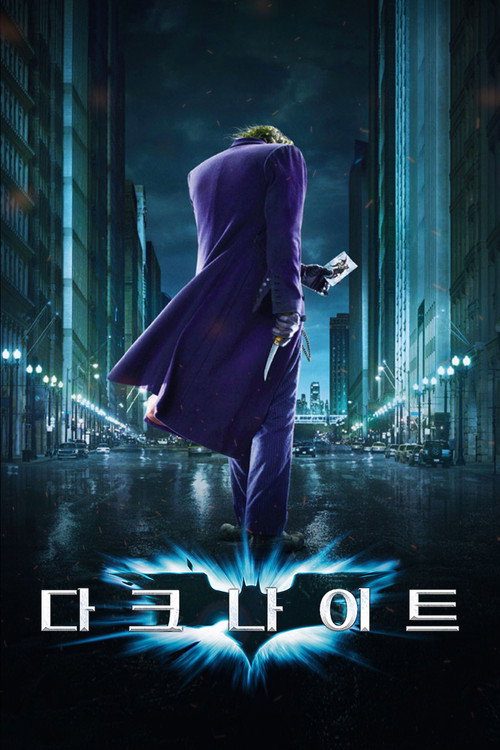
Back to the title
The Dark Knight
13 deep dives in total