arrow_back
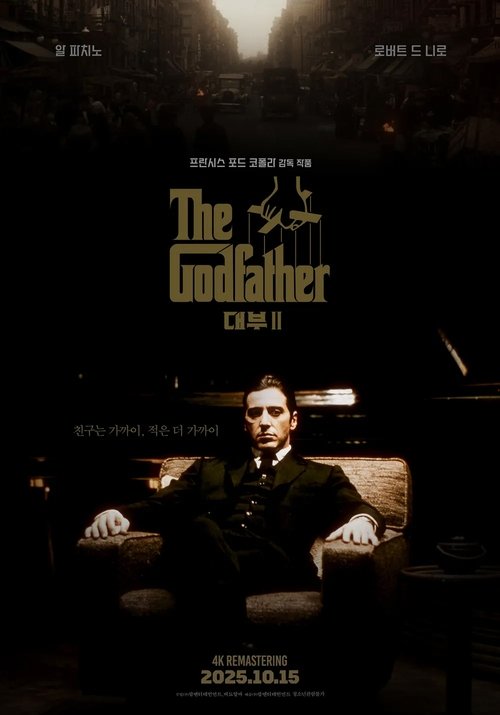
The Godfather Part II
Film

The Godfather Part II

Directed by Francis Ford Coppola · 1974-12-20 · 202 min · Paramount Pictures

A masterpiece that delves into the dark underbelly of the Mafia world and the anguish of the human condition. Contrasting the two fathers of the Corleone family—Vito and Michael—it lays bare the true nature of power enacted beneath the name of family. Through Vito's rise and Michael's cold-blooded metamorphosis, this towering historical epic shows that the price of success is the loss of one's humanity.

Synopsis

The Corleone family runs its Mafia operations out of New York. The film traces Vito Corleone's ascent from Sicily into the leader of a vast criminal empire, while simultaneously following Michael Corleone as he inherits his father's legacy and expands the family's business. Michael reclaims supremacy in New York's underworld and decides to shift the center of operations to Las Vegas, where gambling has been legalized. In this process the Mafia must resort to sophisticated financial maneuvers to disguise illegal funds within the legitimate financial system—an evolution that upgrades the family's business domain to the level of a nationwide syndicate. But the apex of power inevitably brings betrayal and loss, and the Corleone family is crushed under its immense weight.

Cast4

V

Founder and boss of the Corleone family · Robert De Niro

A man who rises from a small Sicilian village to become a great Mafia boss. His life illustrates a process of gradual accumulation of violence and power, and he simultaneously possesses the most human and the most brutal aspects of his character.

M

Heir to the family and master strategist · Al Pacino

A figure who inherits his father's legacy and expands the family's business. He reclaims supremacy in New York's underworld, shifts the center of operations to Las Vegas, and transforms into a ruthless businessman. His transformation symbolizes the weight of power.

T

Legal counsel for the Corleone family · Robert Duvall

A figure who handles the family's legal and social dimensions, playing a crucial role in expanding the Mafia's business into the legitimate sphere.

K

Michael's wife · Diane Keaton

A figure who represents the values of the 'normal' world in Michael's life. She stands in contrast to Michael's violent world, serving as a reminder of his human side.

Credits

Screenplay
Mario Puzo · Francis Ford Coppola
Music
Nino Rota
Production
Paramount Pictures · The Coppola Company
Chapter 02

Dig Deeper

Dig Deeper
Cardarrow_outward

Laundering the Mob's Money

The process by which the Mafia's illegal funds, passing through sophisticated financial techniques such as straw men and shell corporations, are transformed into legitimate businesses—this goes beyond simply hiding crime to become the decisive juncture at which the organization penetrated the core of the capitalist system and evolved into a nationwide syndicate.

Quotearrow_outward

It wasn't a miscarriage, Michael! It was an abortion!

Kay's confession—'It wasn't a miscarriage, Michael! It was an abortion!'—goes beyond a line from a marital quarrel to symbolize the most lethal loss Michael Corleone's soul has suffered. This single sentence declares that the violent success of the Mafia world has finally invaded even the most private realm of human moral choice and responsibility—the decisive moment that detonates the film's thematic consciousness.

Cardarrow_outward

The Corleone Syndicate

The process by which the Corleone family, stepping beyond a simple violent organization, leveraged the legitimate front of 'Genco Pura' to seize political and financial networks—evolving into a nationwide syndicate worth a billion dollars—is the core narrative device showing how the Mafia survived by absorbing the corporate structure of modern capitalism.

Cardarrow_outward

Restructuring the Business Around Las Vegas

The process by which Michael Corleone moves the family's base from New York to Nevada and restructures the business around the legitimate casino industry is the Mafia's evolutionary turning point—penetrating the core of the modern capitalist system to pursue survival—and simultaneously foreshadows the family's tragic downfall.

Characterarrow_outward

Vito Corleone

The life story of Vito Corleone goes beyond a simple tale of a criminal's success to become a meticulous record of a strategy that built 'reputation' and 'business standing' for the purpose of survival and revenge. Coming as an American immigrant from a small Sicilian village, he used 'rispetto (respect)' and 'ragione (reason)' as weapons rather than relying on violence, expanding the Mafia's domain and reaching the apex of vast power.

Cardarrow_outward

Hyman Roth: The Financial Architect

Hyman Roth is the core 'financial architect' who evolved the organization into a vast capitalist enterprise and expanded the domain of power from physical violence to financial structures—by designing a systematic financial plan to channel Mafia funds into legitimate businesses.

Cardarrow_outward

Vito's Origins and Early Growth

Vito Corleone's early growth is not the birth of a simple criminal but a process of growing from one who overcame Sicily's tragedy in New York's Hell's Kitchen—through 'rispetto (respect)' and 'ragione (reason)'—into a community mediator. He used intelligence and reputation, rather than fear, as his weapons to construct an order of his own.

Cardarrow_outward

Michael's Transformation and Guilt

A look at the arc of internal collapse and guilt that Michael Corleone experiences—from a young man who dreamed of legitimizing the family to a ruthless boss who alienates even his own brother and wife.

Characterarrow_outward

Tom Hagen

Tom Hagen is the Corleone family's legal counsel and Michael Corleone's most deeply trusted advisor. He serves beyond a simple attorney as the moral and intellectual pillar of the family, symbolizing the process by which the Mafia's business domain expands beyond the criminal into the legitimate financial system. His existence simultaneously embodies the weight of power and the human bonds that must be preserved within it.

Cardarrow_outward

Sicily's 2,000-Year Historical Background

The '2,000-year history of Sicily' referenced in The Godfather Part II is the essential historical backdrop that elevates the Corleone family beyond a simple criminal organization to the status of a vast, fated epic governed by the unique cultural codes of omertà and vengeance.

Characterarrow_outward

Michael Corleone

Michael Corleone is a figure who, bearing the weight of his family and the experience of war, shows the process of transformation from an innocent heir into a ruthless and perfect strategist. He upgrades the Mafia's business domain from simple violence to sophisticated financial maneuvers at the nationwide syndicate level, proving that the apex of power means the loss of one's humanity. His transformation is more than a simple story of a criminal's success—it is a vast epic that symbolizes the dark underbelly of American capitalism.

Readingarrow_outward

Power and the Loss of Humanity

The Godfather Part II is a tragic epic where reaching the pinnacle of power means the destruction of one's humanity. Through the two fathers of the Corleone family—Vito and Michael—the film shows how the struggle to survive and protect family becomes enslaved to a violent and ruthless system. In this process, love, morality, and even familial bonds are meticulously depicted being crushed under the immense weight of power.

Characterarrow_outward

Kay Corleone

Kay Corleone represents the values of a 'normal' world in Michael Corleone's life, symbolizing a purity in contrast to the violence and crime that dominate the Corleone household. Her existence serves as a mirror that constantly reminds the audience of the process by which Michael loses his humanity, and the controversy surrounding the miscarriage and abortion functions as a pivotal device—beyond mere personal tragedy—that symbolizes the moral losses paid as the price of power.

Readingarrow_outward

The Mafia's Alliance with Capitalism

The Godfather Part II interprets the Mafia not as a mere criminal gang but as a vast capitalist enterprise that evolves with the times. It meticulously depicts the evolution from Vito Corleone's traditional regional dominance to Michael Corleone's modern methods—leveraging the legal financial system, information warfare, and legal frameworks—arguing that the essence of power has shifted from violence to the logic of capital accumulation.

Quotearrow_outward

Keep your friends close, but your enemies closer.

Michael Corleone's 'Keep your friends close, but your enemies closer' is more than simple advice—it is a distillation of the ruthless survival philosophy needed to thrive at the apex of power. This line shows Michael completely setting aside emotional ties and treating all relationships as calculated leverage, serving as the ideological pillar running through the film's core theme of 'the price of success.'

Cardarrow_outward

The Corleone Family's Olive Oil Monopoly

Vito Corleone's process of securing the olive oil monopoly in Sicily is a core early success story showing that the Mafia's business domain evolved beyond simple criminal acts to encompass the acquisition of sophisticated economic monopolies and political power-building. This defines the fundamental operating principle of the Corleone family—where violence and capitalist logic are inseparably combined.
Things worth knowing8

Laundering the Mob's Money

Mafia illegal funds posed a serious risk if poured directly into legitimate businesses reported to the government. So the Mafia had to use complex financial maneuvers—straw men, shell corporations, and secret accounts in Switzerland or the Bahamas—to disguise funds and siphon off investment profits.

This process signifies that Mafia business had evolved beyond simple violent crime into a nationwide syndicate-level operation requiring highly specialized financial and legal skills. One of the pioneers of this shift was Meyer Lansky, who laundered Mafia funds and reinvested them into legitimate casino and hotel businesses, maximizing the organization's survivability.

Foreshadowingarrow_outward
Restructuring the Business Around Las Vegas

Michael decided to restructure the Corleone family's operations around Las Vegas, where gambling is legal. He put Clemenza in charge of New York business and relocated the Corleone base to Lake Tahoe, Nevada—where Las Vegas is located.

Nevada had a low population density and was poor in the early twentieth century, but from 1931 it began implementing gambling legalization, becoming the center of the casino industry. Mafia bosses from major cities across the country invested there, forming the backdrop for the Las Vegas Strip, and Michael harbors a grand ambition to use this to fully transfer the family's business into the legitimate sphere.

Foreshadowingarrow_outward
Hyman Roth: The Financial Architect

Hyman Roth, a character modeled on Meyer Lansky, played the role of 'architect'—designing systematic financial and business plans to pool Mafia funds from across the country and invest them in hotels. If Moe Greene led the physical construction, Hyman was responsible for the flow of capital.

Hyman Roth used professional financial and legal skills to open new business channels for the Mafia. Their cooperation shows that the Mafia had evolved beyond a simple violent organization into a vast corporation merged with the capitalist system. Roth in particular, through his tension-filled psychological battle with Michael, symbolically demonstrates the ruthlessness of the business world—where the coldness of power and betrayal run rampant.

Vito's Origins and Early Growth

Around the age of ten, Vito Corleone grew up meeting the Abbandando family in Sicily. He worked in their grocery store and became close friends with Genco Abbandando, who would later become a core member of the Corleone family.

The turning point in Vito's life came when he encountered a figure named Fanucci on the way to see a play with Genco. When confronted with a demand for tribute, Vito showed the family's innate refusal to submit to the strong, and thereafter was recognized as someone possessing 'rispetto (respect)' and 'ragione (reason)'—taking his first steps toward becoming a Don. He grew not as a violent thug who inspired fear, but as a mediator who maintained order in the local community.

Key Scenearrow_outward
Michael's Transformation and Guilt

Michael purges his brothers and associates to protect the family's business, remaking himself as a ruthless boss. But in this process his relationship with his wife Kay deteriorates beyond repair, and she tries to leave him, exposing just how evil his world has become.

This conversation deals with the losses and guilt Michael experiences, carrying a critical gaze: his entire course of action and marriage has ended in what is 'not sacred but evil.' Kay's revelation starkly exposes that the empire Michael built is nothing but a sandcastle—and that the justification of protecting the family led to the very destruction of the family. It is one of the most shocking scenes in cinema history.

Behind the Scenesarrow_outward
Sicily's 2,000-Year Historical Background

In a conversation, 'the Sicilian problem' is referenced as something that has gone on for 2,000 years. This implies that there are deep, ancient historical roots behind the family or events connected to Michael.

Such references suggest that the Corleone family is not simply a New York crime organization but a vast family bearing deep history and destiny spanning thousands of years, adding narrative depth to the work. Sicily's unique omertà (code of silence) and culture of vengeance subtly overlap with the legal and political conflicts Michael faces in American society, evoking a fatalistic tragic atmosphere.

The Corleone Family's Olive Oil Monopoly

Vito teamed up with Don Tommasino to secure an exclusive supply of Italian olive oil from his homeland Sicily. In this process, Vito helped drive out Don Ciccio—the enemy who had slaughtered his family.

This is an early success story showing that Vito from the beginning expanded the family's power by combining business monopoly with violence. It demonstrates how the Mafia's business domain gradually expanded toward securing regional monopolies. Vito—in avenging Don Ciccio who had massacred his family—simultaneously settles a personal score and demonstrates the political acumen to solidify his influence within Sicily.

Foreshadowingarrow_outward
The Corleone Syndicate

Vito, Genco, Clemenza, Tessio, and the Jewish Hyman Roth together founded the Genco Pura Olive Oil Import Company. This is a case where the Mafia's unique monopoly power was used to grow the business—inspired by real-life New York Mafia boss Giuseppe Profaci.

This shows that Mafia organizations functioned not as simple violent gangs but as vast enterprises equipped with professional business structures and financial systems. It symbolizes the evolved form of the Mafia depicted in the film, and realistically portrays how the Mafia in actual history deeply penetrated the underbelly of the American economy—blurring the line between legal and illegal while accumulating enormous wealth.

Memorable lines2

Keep your friends close, but your enemies closer.

Michael Corleone · A cold maxim of survival, spoken by Michael as he maintains relationships with enemies in order to read their movements and keep them under control.

It wasn't a miscarriage, Michael! It was an abortion!

Kay Corleone · A scene where Kay, disillusioned by Michael's violent world, confesses a shocking truth in order to completely sever her relationship with him.
Chapter 03

Aftermath

Aftermath

Legacy

A Textbook for the Mafia Genre: The Godfather Part II transcended the clichés of Mafia films, establishing a narrative structure that combines psychological depth of character with historical context. It has had a defining influence on countless crime films and dramas since, planting the themes of 'family honor' and 'business ambition.'

The Structure of Two Contrasting Fathers: The contrast between two giants—Vito (ascent) and Michael (culmination)—represents a pinnacle of narrative technique that, while covering a single individual's life story, three-dimensionally portrays the transformation and decline of human beings over the passage of time.

Trivia2