D
Boss of the Corleone family · Marlon Brando
The patriarch of the traditional Mafia — a man who places family honour and welfare above all else. His methods are violent, yet at their root lies a profound love for his family.
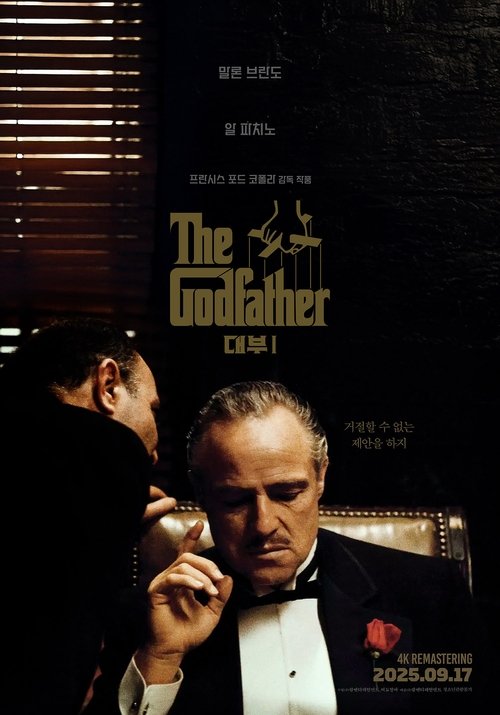
Directed by Francis Ford Coppola · 1972-03-14 · 175 min · Paramount Pictures
An epic saga that shows how 'justice' — wielded as private revenge in the space where American law and police cannot reach — transforms into a vast, ruthless business. The film counterpoints the sunlit spectacle of a lavish wedding against the shadow-world of back-room dealings, using that contrast as a metaphor for America's double face. Far more than a gangster picture, it is a work that dismantles genre boundaries and demands we interrogate family obligation, the flow of capital, and the very concept of 'legitimacy.'
New York, 1945. Vito Corleone, the powerful head of a Mafia family, receives petitioners on his daughter's wedding day, dispensing justice the courts cannot. But when he refuses drug lord Sollozzo's proposal, the family is plunged into crisis: Vito is gunned down in the street and left near death. Michael — a decorated war hero who had always kept his distance from the family business — steps up to protect his father and, in a Bronx restaurant, kills Sollozzo and a corrupt police captain. Fleeing to Sicily, he marries Apollonia, only to lose her to a car-bomb meant for him. As his brother Sonny is ambushed and killed and the war between the Five Families intensifies, Michael returns to New York. In the film's sublime baptism sequence, he stands as godfather to his nephew while, simultaneously, his lieutenants execute the rival family bosses one by one. From his father's death he inherits the throne, and the new Don Corleone — cold, calculating, absolute — is born.
Boss of the Corleone family · Marlon Brando
The patriarch of the traditional Mafia — a man who places family honour and welfare above all else. His methods are violent, yet at their root lies a profound love for his family.
Vito's son and heir to the family · Al Pacino
Initially dreaming of a legitimate life, Michael is forced to confront the family's crisis and is transformed into a ruthless businessman and violent 'Godfather.' His psychological metamorphosis is the engine of the film.
Vito's eldest son · James Caan
The most passionate and impulsive member of the family, deeply enmeshed in the family business and acutely aware of the Mafia world's dangers. His desire to protect his sister Connie leads him straight into an enemy trap.
Lawyer and consigliere to the Corleone family · Robert Duvall
The man who manages the family's legal affairs and overall business operations. An invaluable advisor who counsels the protagonist Michael at every critical turn.
Michael's love interest · Diane Keaton
The embodiment of the legitimate American life Michael once dreamed of. Her relationship with him symbolises his inner conflict throughout the film.
This entry focuses on the decisive psychological turning point at which Michael Corleone, after witnessing the family's vulnerability at the hospital following his father's attack, abandons his ordinary civilian life and awakens as a cold heir by personally shooting Sollozzo and McCluskey at Louis Restaurant.
Michael Corleone transforms from a decorated war hero dreaming of a legitimate life into a ruthless powerbroker, his family's crisis the catalyst. He ultimately destroys his own soul to protect the family and ascends to the absolute seat of 'the Godfather' — a tragic figure.
Michael Corleone's transformation goes beyond a simple revenge story to depict a man's tragic awakening between 'family' as obligation and the cold reality of 'power.' His process of initially trying to distance himself from the world of violence, only to ultimately become the most efficient and ruthless 'Godfather' in his father's footsteps, symbolises the dual nature of American society and the fateful weight of the family.
Johnny Fontane's appearance symbolises the Corleone family's reach extending from New York's underworld to the glittering heights of Hollywood — a narrative device that shows how the Mafia controls the domains of art and capital through its own brutal rules.
In *The Godfather*, 'family' operates beyond mere blood ties as a vast system in which survival and obligation are entangled — and as the heavy shackle that leads Michael into a world of violence. Through the tragic collision between individual desire and family destiny, the film functions as a key device that sharply allegorises the dual nature of American society.
The Corleone family's 'family business,' far beyond simple crime, is the core operating principle of the family's permanence — a vast social system in which family obligation and the survival instinct are fused, maintained outside the law through the discipline of honour and fear known as 'an offer you can't refuse' — and a device symbolising America's duality.
Don Vito Corleone built an empire defending the primal value of 'family' in the margins of the law — yet he harboured the contradiction and tragedy of wanting his youngest son Michael, above all others, to remain a man of the legitimate world.
Kay Adams is both the symbol of the 'legitimate American life' Michael Corleone once craved and the tragic witness who is progressively marginalised, deceived, and finally shut out behind a closing door as Michael sinks deeper into the heart of power.
The Godfather, far beyond a simple Mafia film, is a philosophical epic exploring the dual nature of American society. The film counterpoints scenes where private revenge masquerades as 'justice' in the space where law and police cannot reach against scenes of bright legitimacy — posing fundamental questions about 'justice' itself and the boundary between America's public face and its dark interior.
Tom Hagen, the Corleone family's adopted son and lawyer, serves as the intellectual bridge linking the ruthless Mafia world with legitimate society — the essential consigliere who underpins the family's survival and strategic expansion.
The Mafia's business structure, far beyond simple violence, takes the form of a complex 'corporation' equipped with a sophisticated financial system for disguising illicit funds as legitimate capital. This construct is a core narrative device showing how the Corleone family exploited cracks in the social system to grow into a vast capitalist enterprise.
The Godfather is an epic that deconstructs the very concept of 'legitimacy' in American society through the activities of the Mafia. The film shows how the space that law and police cannot fill is privately occupied by money and power, and sharply critiques America's dual nature through Michael Corleone's construction of a 'new form of legitimacy' by fusing violence with capital.
Don Vito Corleone's 'offer he can't refuse' symbolises overwhelming violence and the family's absolute power concealed behind elegant language — a defining line that encodes the ruthless business philosophy running through the entire film.
Sonny Corleone, the family's eldest son, is a figure of uncontrollable impulse and fierce attachment to family whose explosive drive is simultaneously the force that breaks through the organisation's crises and the tragic fuse that drives both himself and the family toward ruin.
The Sicilian exile is the decisive spatial backdrop and spiritual baptismal site where Michael Corleone confronts the family's violent roots, loses the last remnant of hope for an ordinary life, and awakens as a cold heir.
The Godfather cross-cuts the bright outdoor wedding and the dark scenes of private revenge, simultaneously showing the violent, dark survival history hidden behind the rule of law and peaceful daily life that America professes — while questioning how 'justice' operates in the private domain. It is a genre masterwork.
The war of the Five Families running through *The Godfather* symbolises, beyond a simple territorial dispute, the collision between a traditionalist old guard and a capital-sensitive new generation. This conflict becomes the decisive catalyst for Michael Corleone's establishment of the Corleone family's absolute power through a sweeping purge of all enemies.
The film cross-cuts the sunlit happiness of Connie's outdoor wedding with the dark private-justice scenes unfolding inside Vito's study. The juxtaposition shows how America resolves problems its law and police cannot touch — through revenge dressed up as 'justice' — and serves as a visual metaphor for the nation's dual nature.
The opening sequence's intercut of Vito Corleone receiving petitioners in his dim study and the bright outdoor wedding of his daughter Connie is deeply symbolic. It is a device that visually and starkly contrasts the rule of law and peaceful daily life that America professes with the violent, shadowy history of survival hidden behind that facade.
After his father is shot, Michael senses the family's existential crisis, abandons his plan for an ordinary civilian life, and steps into the world of violence to protect those he loves.
Michael's early image — in uniform, outdoors in the sun, drawing a line: 'That's my family, not me' — shows how hard he tried to separate himself from the violent family enterprise. But when he resolves to protect his father in the hospital and to personally eliminate Sollozzo, he accepts his tragic destiny: to become an even more ruthless and thorough 'Godfather' than his father ever was.
For the Corleone family, 'family business' is an essential activity that does not stop even on a wedding day. Vito believes the essence of the family is to build a vast network of people who respect him and can help each other when the need arises.
This is not mere criminal activity but a vast social system born of the fierce sense of obligation among family members intertwined with the survival instinct. The famous line 'I'm gonna make him an offer he can't refuse' simultaneously symbolises the inescapable duty that binds family and business together, and the harsh price of defying that offer — and it becomes the core principle that maintains the organisation's order.
The power struggle and conflict among the five Mafia families that rule New York is the central conflict structure running through the entire film.
When Vito Corleone refuses to enter the drug trade, the Tattaglia family and their allies move to assassinate him. This goes beyond a simple gang war — it symbolises a paradigm shift between an old guard that clings to traditional values and a new generation of Mafia that chases narcotics as a fresh revenue stream. The war ultimately concludes in a Corleone victory as Michael purges all his enemies in a sweeping execution.
After hearing of his father's shooting and coming face to face with Sollozzo and a corrupt police captain at the hospital, Michael reaches the decisive moment when he determines that he himself must kill them.
This scene is the psychological turning point at which Michael abandons ordinary life and fully transforms into the ruthless 'Godfather' of the family's violent, dark world. The moment he retrieves the hidden gun from the restaurant bathroom and shoots both men, he can no longer pretend to be 'not that person' — and he takes the family's fate onto his own shoulders. The camera's close-ups and the taut sound design convey his inner resolve with devastating force.
Johnny Fontane — Vito Corleone's godson — plays an important role in extending the family's influence all the way to Hollywood.
Johnny Fontane appears as a slumping pop singer who implores Vito to help him land a film role. The 'horse-head' incident that follows is one of the most iconic scenes in the film, showing just how brutal the Corleone family's methods are when they need to enforce their will. The character is widely believed to be modelled on the real Frank Sinatra, and the depiction of the collusion between the Mafia and the entertainment industry remains a fascinating piece of the film's mythology.
Sicily — where Michael flees after killing Sollozzo — is both the ancestral home of the Corleone family and the place where Michael accepts his cold, inescapable destiny.
Sicily's beautiful but harsh landscape stands in sharp contrast to the dark, claustrophobic atmosphere of New York. Here Michael suffers the tragedy of losing his first wife Apollonia, forcing him to recognise that he can never return to a normal life. The Sicily sequence is an important device that visually depicts Michael's inward transformation: his absorption of the family's history and cycle of violence, and his awakening as the true heir to the Mafia legacy.
The film shows how America resolves problems its law and police cannot address — through private revenge in the name of 'justice' — staging America's double nature through deliberate contrast.
This contrast poses the fundamental question 'What is true justice?' and demands deep reflection on the boundary between the legal system and private violence. Director Francis Ford Coppola used the story of a Mafia family to sharply dissect the ruthless logic of capitalist society and the nature of power, giving the film a philosophical depth that transcends simple genre filmmaking.
Because Mafia money was illegally accumulated black money, routing it into legitimate enterprises required various financial manoeuvres to disguise illicit funds as clean capital.
This is a crucial detail showing that Mafia organisations were not mere violent gangs but sophisticated 'corporations' equipped with advanced financial knowledge and business acumen. The way the Corleone family extends its influence through gambling, union control, and political corruption realistically depicts how a criminal organisation exploits cracks in the social system to ally with legitimate power and grow into a vast capital enterprise.
I'm gonna make him an offer he can't refuse.
It established the grammar of the Mafia genre and elevated crime film from simple action fare to a vehicle for psychological and social narrative. It bequeathed to countless subsequent crime films and organised-crime dramas the storytelling framework of 'family obligation' and 'the succession of power.'
The film's epic scale and tragic atmosphere became a benchmark for subsequent period dramas and family sagas. In particular, the way violent acts are gradually reframed as 'business decisions' is sometimes interpreted as the archetype for contemporary critiques of corporate ethics.