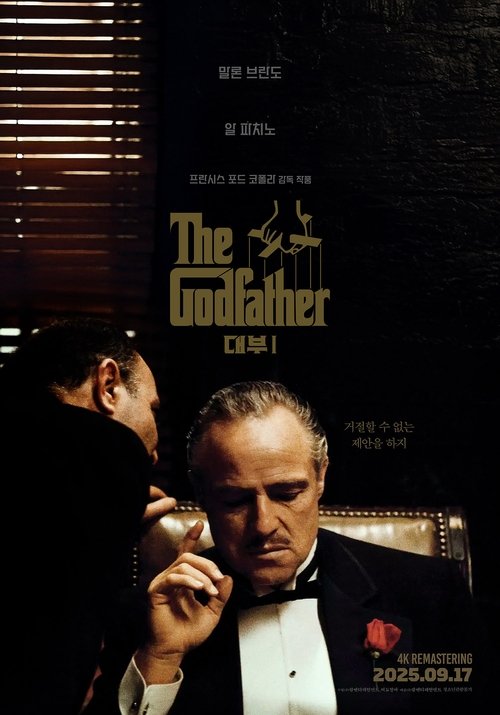
Don Vito Corleone
Don Vito Corleone built an empire defending the primal value of 'family' in the margins of the law — yet he harboured the contradiction and tragedy of wanting his youngest son Michael, above all others, to remain a man of the legitimate world.
1. From the Pinnacle of Power to Decline: The Arc of a Solitary Giant
The film's opening — Vito Corleone in a darkened study, stroking a cat, murmuring "Someday, and that day may never come, I will call upon you to do a service for me" — symbolises a 'Godfather' whose authority transcends mere crime boss. In this dark space, contrasting with the bright world of daughter Connie's lavish wedding, he serves as a private judiciary resolving the grievances of immigrants whom the law has abandoned. Yet his refusal of Sollozzo's drug-trade proposal — "My friends don't want to get involved in narcotics" — triggers an assassination attempt signalling not merely his physical decline but the beginning of the end for the 'old-fashioned honour' he championed against the logic of capital. After recovering in hospital, he steps back from the front, remaining as an adviser behind his youngest son Michael, transforming into a tragic observer who watches the empire he built consume his son's soul. His arc begins with the dignity of a splendid boss and closes with the solitary silhouette of an old man worried for his child.
2. The Decisive Scene: The Confession in the Garden — "I Never Wanted This for You"
The scene that most completely defines Vito's character is the garden conversation with Michael shortly before his death. Here he reveals deep regret that Michael ended up taking over the family business. "I never wanted this for you. I worked my whole life — I don't apologise — to take care of my family, and I refused to be a fool, dancing on the string held by all those big shots. I thought that when it was your time, that you would be the one to hold the strings. Senator Corleone. Governor Corleone. Something." These words show that Vito was not simply a crime boss but a plain and desperate father who longed for his son to escape the dark world he had been forced to inhabit and stand at the apex of legitimate power. His final moments — playing with his grandson in the garden, wearing an orange-peel smile, then suddenly collapsing — paint not the protagonist of a blood-soaked Mafia war but the peaceful, bittersweet end of a single old man, leaving the audience with a deep afterglow.
3. Interpretation: Private Justice in the Void of Law — and Its Price
Vito Corleone is a man who privately redefined the 'protection' and 'justice' that the vast American system failed to provide to immigrants. The scene in which Amerigo Bonasera, despairing of the American judicial system, comes to Vito and pleads "I believe in America... I want justice" (F6) proves that Vito's power was born not of simple violence but of social need. Though he tried to maintain order through a network built on respect and courtesy (F8, F10), the 'family empire' he erected could only be sustained, in the end, through exactly the kind of violence and betrayal he most wanted to avoid. Vito warns Michael — "Whoever comes to you with this Barzini meeting, he's the traitor" — still trying to protect the family to the last; yet this simultaneously means Michael must shed his innocence and become a cold, ruthless monster. In the end, Vito's death is both the close of an era and the tragic turning point at which the transition to Michael's 'new age' — where honour has vanished and only efficiency and survival remain — is complete.
Why It Matters
Vito Corleone is an archetype who, by placing the universal value of 'patriarch' beneath the outer skin of 'criminal,' draws from the audience a strange sympathy. He shows what the most powerful order an individual can build looks like where state power is absent, and proves simultaneously that the price of maintaining that order is the corruption of what is most precious. His existence is assessed as the decisive case in modern film history that elevated the definition of 'villain' from simple criminal to tragic hero.
Other Character dives4
- arrow_outward
Michael Corleone
Michael Corleone transforms from a decorated war hero dreaming of a legitimate life into a ruthless powerbroker, his family's crisis the catalyst. He ultimately destroys his own soul to protect the family and ascends to the absolute seat of 'the Godfather' — a tragic figure.
- arrow_outward
Kay Adams
Kay Adams is both the symbol of the 'legitimate American life' Michael Corleone once craved and the tragic witness who is progressively marginalised, deceived, and finally shut out behind a closing door as Michael sinks deeper into the heart of power.
- arrow_outward
Tom Hagen
Tom Hagen, the Corleone family's adopted son and lawyer, serves as the intellectual bridge linking the ruthless Mafia world with legitimate society — the essential consigliere who underpins the family's survival and strategic expansion.
Back to the title
The Godfather
17 deep dives in total