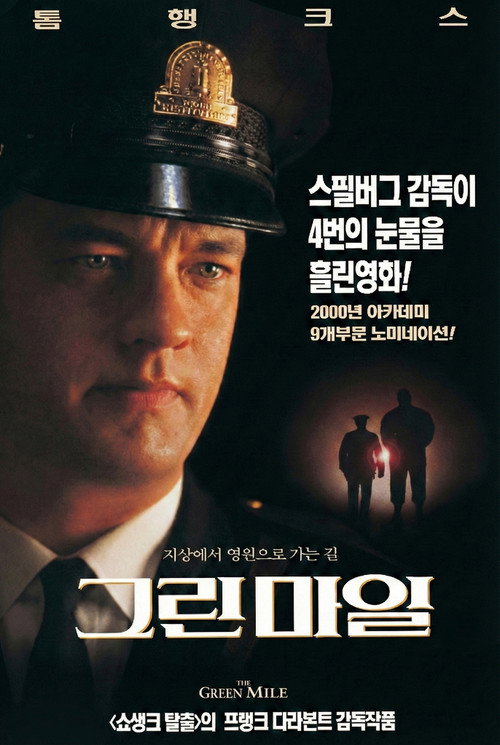
Paul Edgecomb
Paul Edgecomb is haunted by past trauma and professional guilt, and through his encounter with death-row inmate John Coffey faces fundamental questions about his own life and justice. He endures severe conflict between the system's absurdity and human compassion, and comes to bear the heavy burden of lifelong guilt — the price of witnessing a miracle.
Between Guilt and Professional Limits: Paul Edgecomb's Psychological Journey
Paul Edgecomb is no simple guard. He is a figure haunted by guilt he buried for sixty years while confronting his professional limits. The film begins with him telling the story of the past to his nursing home friend Elaine in his old age, but the content unfolds around events that took place in 1935 in Louisiana's E Block.
1. Before Encountering the Miracle: An Observer Within the System
As E Block's senior guard, Paul stands in a space where the deep-rooted racial prejudice and systemic bias of 1930s American society operate. Before meeting John Coffey he functions as part of this system. Yet inside him an unease had already taken root — 'something is wrong.'
John Coffey approaches Paul, suffering from a urinary infection, shows him miraculous healing ability, and becomes the decisive catalyst that cracks Paul's life. This miracle grants Paul significance beyond simple treatment. It was the opportunity that revived the sense of 'human conscience' he had been suppressing his entire life.
2. The Deepening of Doubt: Questions Posed to the System
Having experienced John's healing ability and miraculous existence, Paul cannot shake his doubts about the case file branding John a murderer. He works with colleagues to prove John's innocence, yet what blocks them is not simply the absence of evidence — it is the racial prejudice and systemic indifference permeating all of 1930s Louisiana society.
- Pieces of Truth: After coming to know John's ability, Paul acts on his convictions without hesitation — passing the injured mouse Mr. Jingles to John in the scene where Percy Wetmore steps on it. This shows he is no longer simply a person confined within the system's rules.
- Utilizing the Ability: Paul goes further and actively uses John's ability to have him cure Warden Hal Moores's wife Melinda Moores's brain tumor — an attempt to realize 'justice' through John's ability.
3. The Clash of Professional Role and Human Conscience
Paul's anguish reaches its peak. Through John's ability he comes to know the truth, and realizes that his own profession (guard) is the greatest obstacle to proving John's innocence. He wants to save John, yet feels helplessness before the temporal backdrop of an era that normalized racial discrimination and the systemic barrier of execution.
This conflict explodes in the confessional scene where Paul opens up to John on the day of execution. This dialogue is the core that runs through Paul's inner life:
Paul: When I die and I stand before God and He asks me why I killed one of His true miracles, what am I gonna say? That it was my job?
John: Tell God the Father it was a kindness done.
This dialogue most clearly reveals the guilt Paul bears between his professional role and human compassion. He is gripped by the fear that his profession may have contributed to the act of 'killing a miracle.'
4. The Burden of the Survivor: Eternal Guilt
After John's execution, Paul carries the burden of the survivor. He has lost all his loved ones including his wife Jan and their children, yet feels that his very survival is the price for having killed innocent John's miracle.
In the final scenes, Paul believes that his extreme longevity is a kind of 'divine punishment' for having killed God's miracle. Even a mouse whose natural lifespan is only three years could live long — he wonders whether he himself will be able to die naturally, and lives carrying the weight of guilt that will continue forever. Paul's journey ultimately resolves into a philosophical question about what justice is and what value human life holds.
Why It Matters
Paul Edgecomb's character arc is a device that explores the boundary of this film's core theme: 'justice and mercy.' He is not simply an observer of events — he is an agent struggling to uphold his own conscience against the system's absurdity. His guilt poses a question to audiences: can law and the system realize justice? And what price must a human being pay to keep their conscience before vast social prejudice? Paul's anguish presents a personal answer to the most warm and dangerous question the film poses — 'Can a miracle wash away sin?'
Other Character dives5
- arrow_outward
John Coffey
John Coffey is a miraculous being cast into the brutal execution system of 1930s Louisiana. Behind his enormous frame and slow, gentle speech, his healing ability symbolizes the collision between human goodness and the absurdity of the system. He is not a simple prisoner — he is the warmest and most dangerous question about justice and human dignity itself.
- arrow_outward
James Cromwell
James Cromwell — as warden — transcends a simple administrator's role; he symbolizes the conflict between the cruel execution system of 1930s Louisiana and the fundamental human conscience. He initially places discipline and procedure above all else, but after witnessing John Coffey's miracle he gradually struggles between the system's absurdity and human compassion, shouldering the weight between justice and mercy.
- arrow_outward
Jan Edgecomb
Jan Edgecomb, played by Bonnie Hunt, is not merely a wife — she is the moral conscience of protagonist Paul Edgecomb and the origin of his guilt. Through the existence of innocent John Coffey, she intensifies the conflict Paul experiences between professional duty and human compassion, acting as a catalyst that constantly poses questions to the audience about what justice means.
Back to the title
The Green Mile
15 deep dives in total