arrow_back
The Pianist
The Pianist
Film

The Pianist

The Pianist

Directed by Roman Polanski · 2002-09-17 · 150 min · R.P. Productions

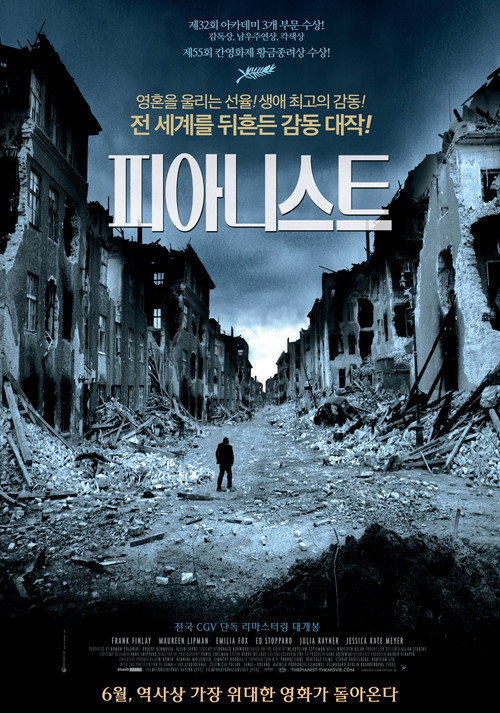
How can art become a means of survival amid the horrors of war? Roman Polanski's film The Pianist depicts the harrowing survival story of a Jewish pianist against the backdrop of six years of Polish reality from 1939 to 1945. Beyond a mere record of massacre, the film probes with depth the dignity of a human being and the anguish of an artist. In particular, the ambiguous 'humanity' embodied by German officer Wilhelm Hosenfeld poses the greatest question to audiences, demanding profound reflection on the boundary between survival and moral choice.

Synopsis

The film begins as Polish pianist Wladyslaw Szpilman loses his home and is trapped in the ghetto following the Nazi German invasion. He struggles to maintain his life as a pianist, but is gradually forced into a desperate fight for survival amid extreme fear and starvation. Szpilman navigates countless dangers as he continues to flee, and in the process encounters German officer Hosenfeld, who helps him. Hosenfeld provides Szpilman with the supplies and safe shelter necessary for survival, and through him Szpilman confronts the complex and ambiguous emotional spectrum of humanity. The film vividly portrays Szpilman's solitary struggle between life and death and the anguish of his identity as an artist.

Cast6

S

Pianist and survivor · Adrien Brody

Based on the real-life Wladyslaw Szpilman, a figure who strives to preserve his identity as an artist even amid the horrors of war. Adrien Brody won the Academy Award for Best Actor at just 29 years old for this role.

H
Hosenfeld (Wilhelm Hosenfeld)

German Army Captain · Thomas Kretschmann

Though a German officer, he is depicted in the film as someone who rescued Jews and Poles, upholding his human conscience. His actions transcend simple good-vs-evil distinctions, revealing the complex boundary between survival and moral responsibility.

H

Szpilman's younger brother · Ed Stoppard

Somewhat boastful but outspoken in his advocacy for armed Jewish resistance. His tragic fate symbolizes the violent reality of life in the ghetto.

D

Cellist, Szpilman's love interest · Emilia Fox

Drawn to Szpilman after hearing him play, she becomes a figure of complex emotions when confronted by the real barriers of the ghetto and her marriage to another man.

S

Szpilman's father · Frank Finlay

The head of the family who sustains the Szpilman household, placed in the tragic position of witnessing the family's downfall.

Credits

Screenplay
Ronald Harwood
Music
Wojciech Kilar
Production
R.P. Productions · Heritage Films · Studio Babelsberg · Runteam
Chapter 02

Dig Deeper

Dig Deeper
Cardarrow_outward

Szpilman's Survival and the Anguish of an Artist

In The Pianist, Szpilman's survival story depicts the most desperate and solitary struggle an artist endures, set against six years of Polish reality from 1939 to 1945. His life was not merely physical survival enduring starvation and cold, but a mental struggle to preserve the 'artistic self' of a pianist.

Cardarrow_outward

Youngest Academy Award for Best Actor

Adrien Brody's Academy Award for Best Actor for The Pianist is regarded as an artistic achievement — the combined weight of the film's historical tragedy and the actor's extreme immersion — that transcends the simple success of an individual. This record proves that Brody conveyed to the audience, through Szpilman, the most primal human anguish of survival.

Cardarrow_outward

Chopin's Nocturnes and the Power of Art

In The Pianist, Chopin's Nocturnes No. 20 and No. 21 function beyond mere background music as Szpilman's reason to survive and his last bastion for preserving human dignity. Nocturne No. 21 — known as a hidden masterpiece Chopin never published in his lifetime — conveys the quiet yet weighty emotion of a foggy night road, functioning as a device of artistic sublimation contrasting with brutal reality.

Characterarrow_outward

Dorota

Dorota is a figure who provides artistic inspiration and human warmth to Wladyslaw Szpilman. Beyond a mere lover, she symbolizes the value of ordinary life and love that one sought to preserve amid the extreme circumstances of war. Her complex emotional spectrum deeply conveys the conflict between the desperation of survival and the bond of humanity.

Characterarrow_outward

Szpilman's Mother

Szpilman's mother is a character who symbolizes the destroyed home and ordinary daily life in the work. Her existence conveys to the audience the weight of the 'lost life' forming the background of Szpilman's survival struggle, showing that war destroyed even the most private domain of an individual's life.

Characterarrow_outward

Szpilman's Father

The character of Szpilman's father symbolizes the pillar of the Jewish middle-class family struggling to survive as it collapses. Amid the Nazi invasion and the ghetto, he is a tragic figure who witnesses the family's downfall at closest range. His existence carries the tragic weight of showing how war destroys an individual's life and home — beyond a mere survival story.

Readingarrow_outward

The Relationship Between Art and Survival: The Sublimation of Suffering

In The Pianist, piano performance is not merely a professional talent but the spiritual lifeline that preserves Szpilman's humanity — an artistic act that sublimates suffering. When Nazism seeks to strip away everything human, music becomes Szpilman's only channel for proving he is still a 'living human being,' acting as the driving force of survival and its most powerful message.

Readingarrow_outward

Moral Ambiguity: Humans Standing on the Edge of Evil

The deepest thematic consciousness of The Pianist lies in its refusal of a clear binary division of good and evil. Set against the extreme backdrop of the Holocaust, the film illuminates in three dimensions the ambiguous conflict humans experience between survival instinct and moral duty. From 'conscientious villains' like Hosenfeld, to Jewish policemen who collaborate to survive, to betraying neighbors — no character is simply defined as victim or perpetrator.

Characterarrow_outward

Henryk Szpilman

Henryk Szpilman, as the protagonist's younger brother, advocates for armed resistance within the ghetto, representing the will to resist of the Jewish community. Though somewhat boastful, through his direct nature as an intellectual and his tragic end, he symbolizes the idealistic resistance of the Jewish community frustrated by the violent reality of the ghetto.

Characterarrow_outward

Szpilman (Wladyslaw 'Wladek' Szpilman)

Szpilman is a survivor who struggles to preserve his identity as an artist throughout the harrowing history of war. Beyond a simple victim of massacre, he is a figure who proves through piano performance, even amid extreme fear and starvation, human dignity and hope. His journey shows that art can become both a means of survival and the last bastion for preserving humanity.

Cardarrow_outward

Hosenfeld's Ambiguous Conscience

Captain Wilhelm Hosenfeld is a character symbolizing the 'ambiguous conscience' operating within the extreme evil system of Nazi Germany. He shows not a simple villain or savior but complex humanity acting according to personal moral choices, posing to the audience a fundamental question about the boundary between good and evil.

Cardarrow_outward

Hosenfeld's Discovery and the Demand to Play

In The Pianist, the scene in which Captain Hosenfeld discovers Szpilman and demands a performance is the decisive moment proving that Szpilman possesses value not merely as a survivor but as an 'artist.' This encounter becomes a pivotal turning point for Szpilman's survival and shows how art preserves human dignity in extreme fear.
Things worth knowing5

Key Scenearrow_outward
Hosenfeld's Discovery and the Demand to Play

Immediately after the 1944 Warsaw Uprising, Szpilman — hiding in a ruined building — is detected by a rolling tin can. Hosenfeld demands he play the piano, and Szpilman begins playing as if giving his final performance. Hosenfeld listens to the end and, rather than taking him away, asks to be shown to Szpilman's hiding place.

This is the decisive moment when Hosenfeld recognizes that Szpilman possesses value not merely as a survivor but as an 'artist.' He hands Szpilman a bag of jam and bread and tends to him rather than arresting him, showing human compassion. This encounter becomes a pivotal turning point in Szpilman's survival.

Chopin's Nocturnes and the Power of Art

Chopin's Nocturnes No. 20 and No. 21 in the film go beyond mere background music, evoking deep resonance and a contemplative atmosphere. Nocturne No. 21 in particular is a hidden masterpiece that Chopin never published in his lifetime, conveying the quiet yet weighty emotion of a foggy night road.

Music becomes both Szpilman's reason to survive and his last bulwark for preserving human dignity. Piano performance, set in stark contrast to the horrors he endures, functions as the core device through which suffering is sublimated into art and one person's humanity moves another.

Foreshadowingarrow_outward
Hosenfeld's Ambiguous Conscience

Though a German officer, Hosenfeld has a documented history of secretly rescuing not only Szpilman but numerous Poles and Jews. He is depicted as someone who maintained his human conscience within the Nazi system, helping victims even in POW camps. His actions blur the line between good and evil.

According to actual historical records, Hosenfeld learned Polish and even went to confession at a Polish church — acts unthinkable for a German officer. This shows he was not a simple villain but a complex human being who acted according to his personal moral choices.

Szpilman's Survival and the Anguish of an Artist

In the early days of the ghetto, Szpilman was still active as a pianist, but after Jews were transported to the camps he was forced to survive as a common laborer. Even amid extreme fear and starvation he strives to preserve his existence as an artist through piano performance.

His survival story was not merely physical flight but a mental struggle to preserve his artistic self. The film underscores the fundamental power that art gives to human beings by depicting the solitude and despair he experiences.

Behind the Scenesarrow_outward
Youngest Academy Award for Best Actor

Adrien Brody, who played the lead Szpilman, earned the honor of becoming the youngest Best Actor winner in Academy Awards history at just 29. This is regarded as the combined result of the film's artistic depth and the actor's outstanding immersion in the role.

Brody expressed Szpilman's unstable and desperate survival with his entire being, making audiences deeply empathize with his pain. His performance is regarded not merely as acting but as an artistic act bearing witness to the tragedy of an entire era.

Chapter 03

Aftermath

Aftermath

Legacy

The Pianist is regarded as closer to a 'human drama' than almost any other Holocaust film and has had a significant influence on the war film genre. In particular, by spotlighting figures like Hosenfeld who preserve individual conscience within an evil system, it provided an opportunity to focus on 'human resilience' beyond a simple victim narrative. This remains a testament to film as an artistic medium that can explore universal human psychology beyond historical record.

Trivia1