Szpilman's Survival and the Anguish of an Artist
In The Pianist, Szpilman's survival story depicts the most desperate and solitary struggle an artist endures, set against six years of Polish reality from 1939 to 1945. His life was not merely physical survival enduring starvation and cold, but a mental struggle to preserve the 'artistic self' of a pianist.
Defending the Artistic Self: The Struggle Between Survival and Performance
Szpilman's survival story, set against six years of Polish reality from 1939 to 1945, contains the most desperate and solitary struggle an artist endures. His life went beyond merely physical survival — enduring starvation and cold — to a mental struggle to preserve the 'artistic self' of a pianist.
🎹 Planting: The Collapse of Artistic Life
The film begins with Szpilman, initially active as a pianist, losing his home in the face of Nazi Germany's discriminatory policies and forced relocation. The scene in which he — recording an album in Warsaw in 1939 — hears the thunder of German bombardment and rushes outside announces the prologue of tragedy. Subsequently, Jews were made to wear armbands bearing a Star of David, and underwent the horrific relocation policy of herding 400,000 people into a single district. In this process, Szpilman witnesses the crumbling of human dignity and, while striving to maintain his life as a pianist, is gradually forced to survive as a common laborer.
🕯️ Retrieval: The Discovery of Artistic Talent and Salvation
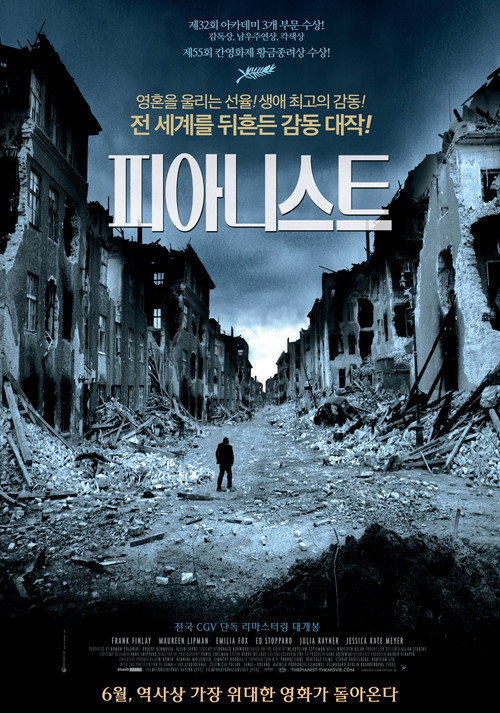
Szpilman's survival continues through numerous brushes with death. In particular, the scene in which he plays piano in a ruined building is the core climax of this film. At the crossroads between life and death, Szpilman reveals his identity as an artist — placing his hands on piano keys in the rubble of Warsaw. The German officer who witnesses this is transfixed and moved, deciding to save him and provide continuing help. His performance becomes not a mere hobby but an 'existential proof' that keeps him alive.
✨ Motif List: What Performance Symbolizes
Szpilman's performance appears repeatedly throughout the film, reinforcing its symbolic significance. His performance moves people's hearts regardless of his Jewish identity, proving amid the unreality of war that he was a great artist. The human exchange in which Captain Hosenfeld visits him and shows care demonstrates that Szpilman's artistic talent played a role in saving him on a human dimension.
🕊️ Why This Is Core to the Work's Identity
Szpilman's survival story transcends the category of simply 'a Holocaust survival story.' The film vividly depicts his crossroads between life and death and his solitary struggle as an artist, emphasizing the mental struggle not to lose human dignity in extreme circumstances. In this process, Szpilman's performance paradoxically shows that when humans are stripped of everything by violence and despair, only art remains as the last human value.
Why It Matters
Szpilman's survival and artistic anguish is the philosophical core of this film. This work is both a historical record of Nazi Germany's atrocities and an artistic drama posing the question 'What is a human being?' Szpilman, initially a pianist in the ghetto, is placed in the extreme situation of having to survive as a common laborer after others are taken to the camps. In this process, his piano performance is not a mere skill but a 'mental shield' — proving that he is alive and maintaining human dignity. The scene in which Captain Hosenfeld demands a performance shows how artistic talent can become the decisive opportunity for survival, leaving deep resonance and questions throughout the entire work.
Other 기타 dives4
- arrow_outward
Youngest Academy Award for Best Actor
Adrien Brody's Academy Award for Best Actor for The Pianist is regarded as an artistic achievement — the combined weight of the film's historical tragedy and the actor's extreme immersion — that transcends the simple success of an individual. This record proves that Brody conveyed to the audience, through Szpilman, the most primal human anguish of survival.
- arrow_outward
Chopin's Nocturnes and the Power of Art
In The Pianist, Chopin's Nocturnes No. 20 and No. 21 function beyond mere background music as Szpilman's reason to survive and his last bastion for preserving human dignity. Nocturne No. 21 — known as a hidden masterpiece Chopin never published in his lifetime — conveys the quiet yet weighty emotion of a foggy night road, functioning as a device of artistic sublimation contrasting with brutal reality.
- arrow_outward
Hosenfeld's Ambiguous Conscience
Captain Wilhelm Hosenfeld is a character symbolizing the 'ambiguous conscience' operating within the extreme evil system of Nazi Germany. He shows not a simple villain or savior but complex humanity acting according to personal moral choices, posing to the audience a fundamental question about the boundary between good and evil.
Back to the title
The Pianist
12 deep dives in total