arrow_back
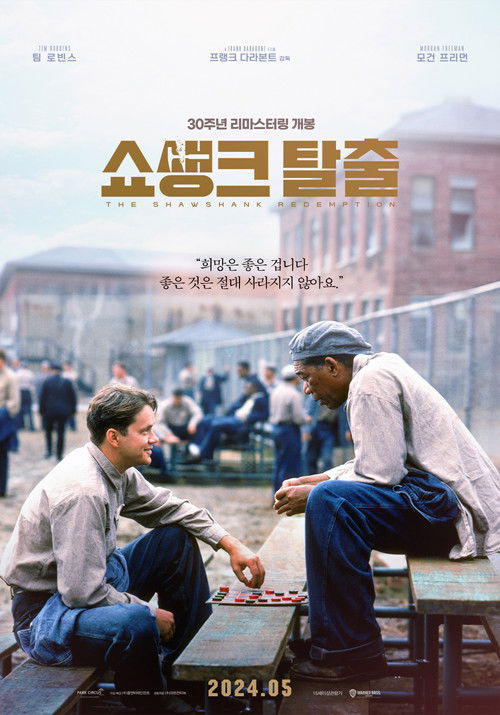
The Shawshank Redemption
Film

The Shawshank Redemption

The Shawshank Redemption

Directed by Frank Darabont · 1994-09-23 · 142 min · Castle Rock Entertainment

Set in Shawshank State Penitentiary in the 1930s, this masterpiece portrays the human spirit's struggle to pursue hope and freedom within an oppressive system. Andy Dufresne's twenty-year effort to bore through a wall symbolizes not merely a prison break, but the greatness of a man who overcomes despair through intellect and sheer will.

Synopsis

In the 1930s, Andy Dufresne is imprisoned at Shawshank State Penitentiary on charges of murdering his wife and her lover. Initially overwhelmed by shock and despair, he adapts to the prison system with remarkable composure and intelligence, gradually building influence. He befriends a fellow inmate named Red, a narrator and confidant, and learns to sustain hope within a closed and crushing environment. Andy manages the prison's financial system, forging a connection to the outside world, and ultimately carries out an escape two decades in the making by tunneling through the wall. The journey is no mere flight — it is a grand epic of delivering true freedom to himself and everyone around him.

Cast5

A

Protagonist and intellectually gifted inmate · Tim Robbins

A man wrongfully convicted of murdering his wife and her lover. Inside Shawshank he spearheads financial management and library expansion, gradually amassing power. His composure and geological knowledge become the driving force behind his escape.

R

Inmate who observes and supports Andy · Morgan Freeman

A 20-year veteran of prison life — observer and storyteller. Through his relationship with Andy he slowly recovers his sense of hope, and it is through his eyes that the audience vicariously experiences the oppressive atmosphere of Shawshank.

W

Supreme authority figure at Shawshank · Bob Gunton

A figure who embodies the prison's discipline and order. Initially hypocritical and authoritarian, he meets a tragic end as Andy's intellect systematically dismantles his power.

C

Chief guard · Clancy Brown

A character who embodies the prison's violent and repressive side. His brutality toward new inmates amplifies the dehumanizing atmosphere of Shawshank to its extreme.

H

Inmate · William Sadler

A friend to both Andy and Red, and a supporting witness to events unfolding inside the prison. He plays an important role in Andy's plans.

Credits

Screenplay
Frank Darabont
Music
Thomas Newman
Chapter 02

Dig Deeper

Dig Deeper
Cardarrow_outward

Andy's Intellectual Seizure of Power

The process by which Andy Dufresne transforms from a simple inmate into a financial and cultural 'manager' of the system at Shawshank Prison proves that intellect is power. By exploiting the prison's economic vulnerabilities through his accounting skills and injecting the culture of the outside world into the closed space through knowledge and art, he lays the foundation for his escape.

Cardarrow_outward

Box Office Journey and Critical Recognition

The Shawshank Redemption is a representative case of a work whose artistic value was reevaluated worldwide over time, regardless of its box-office performance at release. This film's journey demonstrates the process by which a work of art is recognized for its timeless universal value through public evaluation, deepening its narrative depth.

Cardarrow_outward

The Opera Broadcast Scene

The scene in which Andy Dufresne broadcasts Mozart's opera over the prison's PA system goes beyond a simple artistic act — it is the most symbolic moment in which spiritual freedom and hope manifest within an oppressive system. The scene demonstrates the liberation of the soul beyond physical walls and is the key device that runs through the entire work's thematic consciousness.

Cardarrow_outward

Symbolic Contrast of Time and Hope

In The Shawshank Redemption, 'time' functions through Red's repeated parole hearings (at the 20-, 30-, and 40-year marks) as a measure by which hope and despair cross. Andy's spooning of the earth symbolizes the process by which 'hope' transforms into 'faith' within the flow of time, ultimately embodying the film's core theme of pursuing the freedom of the human spirit.

Cardarrow_outward

The Real Prison Behind Shawshank

The real Ohio prison used as the filming location for The Shawshank Redemption was a decisive element that maximized the atmosphere and weight of the work. This real space functioned not merely as a filming backdrop but as the physical embodiment of an oppressive system, heightening the film's authenticity. After the film's release, the site was preserved as a fan pilgrimage destination and historical cultural heritage, demonstrating the powerful traces left by a work of art on a real-world space.

Cardarrow_outward

Corruption in the 1930s American Prison System

One of The Shawshank Redemption's core themes is the structural corruption of the American prison system of the 1930s. The film goes beyond a story confined to the prison's interior — through the process of Warden Norton privately exploiting the financial system and abusing his power, it indicts the contradictions of the judicial system of the era. Andy Dufresne uses his outstanding intellect to grasp the internal structure of this corrupt system, exploiting it in reverse to ultimately expose the system to the outside world — showing how individual resistance can bring about vast social change.

Cardarrow_outward

Relationship Between the Source Novel and the Film

The Shawshank Redemption is based on a Stephen King novella, but director Frank Darabont expanded it into a vast epic spanning twenty years — preserving the source's core message of 'hope' while adding Andy Dufresne's intellectual activities, the passage of time, and the prison system's corruption. Thanks to this expansion it has established itself as a universal narrative of the human spirit's great struggle, rather than a simple escape story.

Cardarrow_outward

The Twenty-Year Escape Through the Wall

Andy Dufresne's tunnel escape in the film is not a simple flight but symbolizes the triumph of the human spirit — which, armed with intellect and will, resisted an oppressive system over twenty years. The meticulous plan using geological knowledge, and the tenacious effort to bore through a physical wall, is ultimately a journey of acquiring freedom of the soul.

Cardarrow_outward

The Value of Freedom and Its Message

The Shawshank Redemption goes beyond a mere escape to explore the value of 'freedom' that the human spirit refuses to relinquish even within an oppressive system. The intellectual activity and maintenance of hope that Andy Dufresne demonstrates symbolizes the inner freedom of human beings that transcends physical restraint, demanding from the audience a deep reflection on the meaning and direction of life.

Characterarrow_outward

Heywood

Heywood is a quiet, grounded ally who supports Andy and Red within the oppressive system of Shawshank State Penitentiary. Rather than participating in grand escape plans, he deepens the work by reminding those around him of the importance of human connection and memory through everyday, seemingly trivial moments — offering a beer, mentioning a book title.

Characterarrow_outward

Andy Dufresne

Andy Dufresne is not a simple inmate but an intellectual who dismantles the oppressive system itself, wielding intellect and patience as weapons. By spearheading financial management and library expansion within the prison and using twenty years of time to bore through both the physical and mental prison walls, he symbolizes the ultimate freedom of the human spirit and the power of hope.

Quotearrow_outward

As I once said, prisoners will do anything to while away the time. For Andy, burying the bits of rock he chipped from his cell wall in the exercise yard seemed to be a hobby.

Red's line as he recalls Andy's escape emphasizes that Andy's tunnel was not the result of some grand scheme but an accumulation of unconscious, continuous acts born from the most ordinary of emotions — boredom. This is a core insight that symbolically demonstrates how the human spirit maintains hope within an oppressive system and ultimately tears down its own walls.

Characterarrow_outward

Red

Red survives through cynicism, then awakens to hope through Andy and achieves spiritual liberation.

Cardarrow_outward

First-Day Rules and Oppression at Shawshank

The experience of the first day at Shawshank Prison is not simply the incarceration process — it marks the beginning of a vast psychological oppression system that systematically strips away human dignity and individuality. This initial trauma is the device that maximizes the value of 'freedom' running through the entire film.

Characterarrow_outward

Captain Byron T. Hadley

Byron Hadley is a figure who symbolizes the violent and oppressive system of Shawshank Prison. Going beyond a simple guard, he is the device that maximizes the prison's dehumanizing atmosphere — institutionalized violence that erases humanity. His brutality functions as the most physical and direct obstacle that protagonist Andy Dufresne must overcome.

Characterarrow_outward

Heywood

Heywood orbits around Andy and Red, embodying a realistic and cynical perspective on prison life. He relentlessly questions the idealistic actions of the protagonists, serving as an observer who refuses to forget 'reality' within the closed and oppressive system of Shawshank.

Quotearrow_outward

Salvation lay within.

The inscription Warden Norton discovers on the cell wall behind the bookcase after Andy's escape — 'Salvation lay within' — goes beyond a mere declaration of successful escape. It is a symbolic message showing that human freedom and hope reside not in external help or physical circumstance but within one's own intellect and spirit.

Quotearrow_outward

Hope is a dangerous thing. It can drive a man insane. It's no good inside — it's no use to anyone in here.

This famous line, in which Red issues a warning, points out how dangerous and unrealistic an emotion 'hope' is within the extreme oppressive system of Shawshank Prison. Yet the line is not mere pessimism — through Andy Dufresne's tenacious actions and the film's resolution, it paradoxically proves that 'true hope' is the most powerful force for dismantling a system.

Readingarrow_outward

The Proactive Use of Time

This film shows not the passive passage of time but how to actively 'use' it through human will and intellect. The process by which Andy Dufresne spends twenty years on an escape plan, and Red redefines his identity through the rhythm of parole hearings, symbolizes time as the most powerful tool for claiming freedom.

Characterarrow_outward

Warden Norton

Warden Norton is the supreme authority of Shawshank State Penitentiary — a symbolic figure who maintains discipline and order. He invokes religious authority and the pretense of rehabilitation, but in reality he is a hypocritical power broker who exploits the labor and money of inmates. His power leads to a tragic narrative that gradually collapses in the face of Andy Dufresne's intellect and the truth.

Readingarrow_outward

The Contrast Between Hope and Despair

In The Shawshank Redemption, 'hope' is not a vague positive emotion but the most necessary and dangerous resource for survival within an oppressive system. Andy Dufresne manifests this hope in three concrete forms — knowledge, art, and meticulous planning — proving the freedom of the human spirit beyond physical imprisonment.
Things worth knowing10

First-Day Rules and Oppression at Shawshank

New inmates experience a harrowing stripping of clothes — and freedom — at the first roll call. The prison controls inmates through two values: 'discipline' and 'the Bible,' with strict rules against blasphemy. This is the opening act of a system designed to strip away human dignity.

Early inmates have their human dignity stripped as they learn the prison's rules. In particular, the scene where Hadley brutalizes the new arrivals reveals that Shawshank is not merely a prison but a vast system designed to crush the human spirit. It is the key device that establishes the film's pervading sense of despair.

Foreshadowingarrow_outward
Andy's Intellectual Seizure of Power

Andy files tax returns for the guards, manages Warden Norton's slush fund, and brings sweeping changes to the prison's financial system. He creates a library and arranges for inmates to hear opera, transforming the environment around him.

Andy operates not merely as a prisoner but as a 'manager' who exploits the prison's financial vulnerabilities. By leveraging his money-laundering skills he becomes the cultural and economic hub of Shawshank, laying the groundwork for his physical escape. The process shows that intellect is power.

Key Scenearrow_outward
The Twenty-Year Escape Through the Wall

Andy breaks out armed only with a mud-caked prison uniform, a bar of soap, and a worn-out rock hammer. While the task was estimated to take 600 years, Andy succeeds in less than 20.

The escape is the result of a meticulous plan rooted in geological knowledge — pressure and time. Andy makes a hobby of scattering the chips he carves from the wall in the exercise yard, symbolically demonstrating his tenacious will toward freedom. The inscription he leaves behind — 'Salvation lay within' — delivers a powerful message.

Key Scenearrow_outward
The Opera Broadcast Scene

The scene in which Andy broadcasts Mozart's opera over the prison's PA system is the film's most iconic moment. Within the bleakness of the prison, music as art grants the inmates a fleeting taste of freedom and hope.

This scene underscores the importance of not only physical but spiritual freedom. Through music the inmates are able to imagine the vast world beyond Shawshank's walls — a key device that conveys to the audience the meaning of the 'true freedom' Andy pursues.

Symbolic Contrast of Time and Hope

The film expresses the passage of time through details such as changing posters and the shifting tenor of parole hearings. Red undergoes parole reviews at the 20-, 30-, and 40-year marks, showing how time transforms hope and despair.

Red's repeated parole hearings serve as a crucial device to track his inner maturity and frustration as the years pass. Andy's escape is interpreted not simply as a physical event but as a process of transcending the concept of 'time' to find the light called 'hope.' This is the essential element running through the film's thematic consciousness.

Foreshadowingarrow_outward
Corruption in the 1930s American Prison System

The film is set against the corrupt American prison system of the 1930s. Warden Norton exploits Andy's financial skills to build a slush fund and embezzle operating funds, exposing the failings of the judicial system of the era.

The film doesn't end with a story confined to the prison walls. The process by which Andy, after escaping, sends Norton's misdeeds to a newspaper carries a social message about exposing systemic corruption. It shows how individual resistance can bring about change in a vast system.

Relationship Between the Source Novel and the Film

The source material is Stephen King's novella 'Rita Hayworth and Shawshank Redemption.' Director Frank Darabont adapted it into a popular epic, and King reportedly sent the director an encouraging note about the film adaptation.

The contrast between the novella's brevity and the film's sprawling epic scale is fascinating. Darabont preserved the source's core message while vastly expanding the psychological portraiture and visual expression of the characters, creating an emotional impact uniquely cinematic.

Behind the Scenesarrow_outward
Box Office Journey and Critical Recognition

The film suffered poor box-office performance at release, but roughly six months later — spurred by Academy Award nominations — it found commercial success. It has since earned universal acclaim and the highest rating on IMDb.

The film is celebrated for its cinematography, editing, and vision, and its excellence has been recognized by audiences worldwide. This illustrates how the true value of a work can be rediscovered over time, deepening the film's own narrative.

Behind the Scenesarrow_outward
The Real Prison Behind Shawshank

The prison used as the filming location was a real facility in Ohio. After the film's success the location transformed into a tourist destination and pilgrimage site for fans.

A film shot in an actual prison adds a layer of authenticity and weight. After production the prison closed, and it is now preserved as a cultural heritage site visited by film fans — evidence that the film holds value not merely as entertainment but as historical record.

The Value of Freedom and Its Message

The Shawshank Redemption carries the message of the greatness of those who hold onto hope even in a world full of despair. It emphasizes the value of freedom from oppression and restraint, conveying the meaning of a life that reflects on past wrongdoings.

The film poses the fundamental question 'How shall we live?' beyond the act of escape itself. Andy's actions come close to a struggle to claim freedom of the human spirit — beyond mere survival. This demands from the audience deep emotion and reflection on life's direction.

Memorable lines3

Hope is a dangerous thing. It can drive a man insane. It's no good inside — it's no use to anyone in here.

Red · A scene in which Red warns Andy when Andy speaks of hope.

As I once said, prisoners will do anything to while away the time. For Andy, burying the bits of rock he chipped from his cell wall in the exercise yard seemed to be a hobby.

Red · A retrospective on the traces Andy left after his escape.

Salvation lay within.

Andy · The inscription left in Warden Norton's room after the escape — a symbol of hope and freedom.
Chapter 03

Aftermath

Aftermath

Legacy

The film has earned overwhelming recognition for its quality around the world, recording the highest ratings on IMDb and similar platforms, cementing its place as the defining text of the prison-drama genre. It is celebrated not merely as an entertainment film but as a masterwork that poses universal questions about the spiritual freedom of humankind.

Trivia3