Narrative Control and Fate
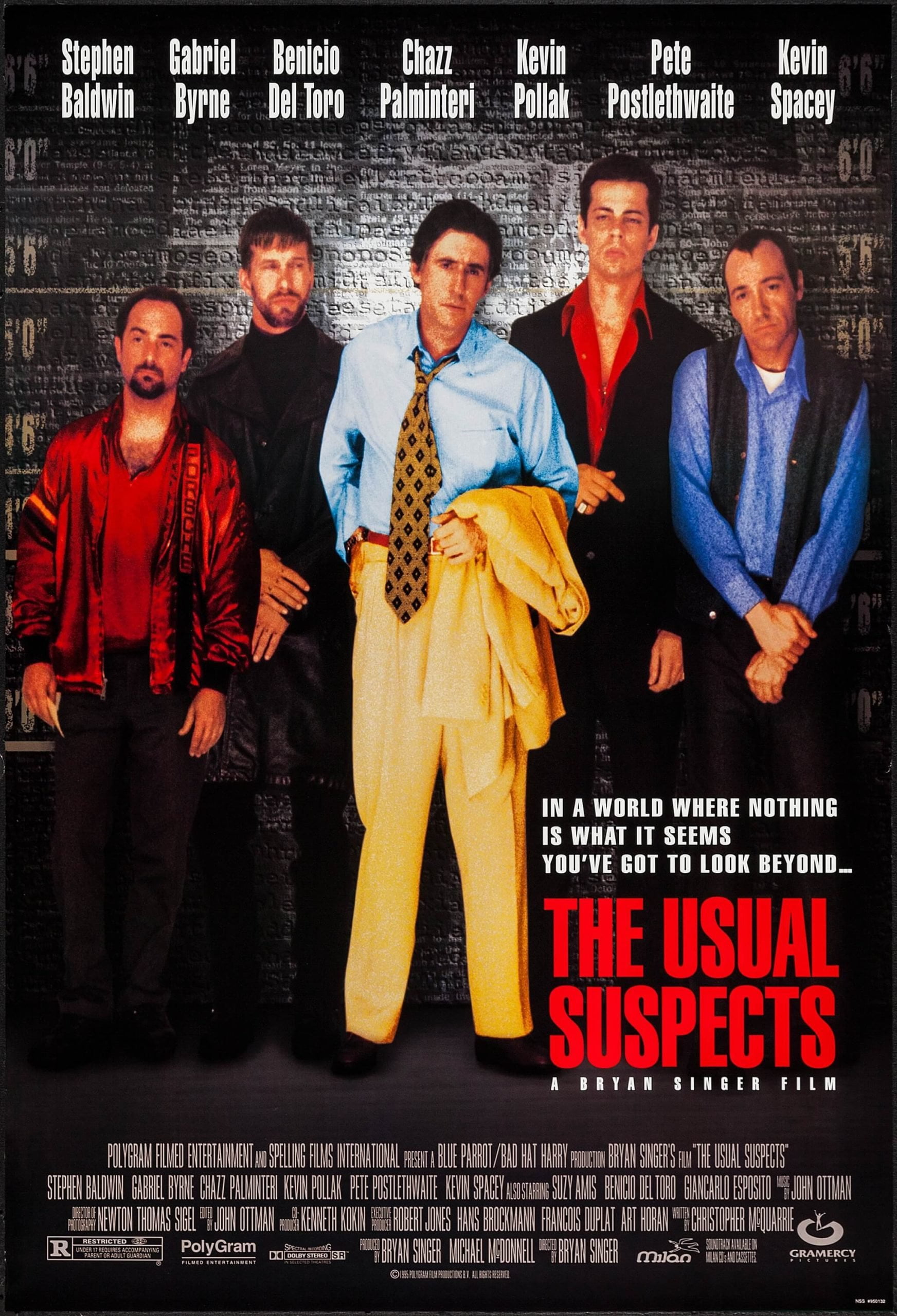
Roger 'Verbal' Kint is not merely a witness — he is a survival specialist who disguises his identity with extraordinary precision. By voluntarily inhabiting the weaknesses of a cripple and a fool, he becomes the last person anyone suspects. This manufactured identity is his most powerful weapon: it allows him to grasp the truth of events, protect himself, and deceive every detective and audience member alike.
🎭 'Verbal' Kint: The Identity Disguise of the Perfect Liar
The deepest theme of The Usual Suspects is the absence of truth and the fluidity of identity. The trajectory Roger 'Verbal' Kint traces is not simply the giving of testimony — it is the construction of a perfect persona in the service of survival. By casting himself as a cripple with a bad memory and no stake in events, Verbal succeeds in slipping beneath the suspicion of Detective Dave Kujan entirely. This 'stupid cripple' disguise is his most powerful survival tool.
🚶♂️ Phase 1: Building a Persona from Weakness
When Verbal is first brought to the station, he emphasizes his physical limitation (the limp) and his intellectual limitation (his apparent dullness) at every turn. This plants in both the audience and the detective the assumption: "this man is incapable of telling the full truth." By voluntarily degrading himself to a peripheral figure, he paradoxically secures the most central and controlling position in the room.
When he reconstructs events, he frames his account not as direct observation but as "things I was told" or "things I barely remember." This deliberately lowers the credibility of his testimony — and tricks Kujan into believing that the interrogation is a genuine process of uncovering reality.
🧩 Phase 2: The Artistry of Assembling a Lie from Surrounding Objects
Where Verbal's account is most ingeniously disguised is in its source material. The police station office where Kujan presses him for answers becomes both a stage and a research archive. Verbal does not rely on memory alone — he draws on bulletin board notices, manufacturer brand names on cups, even the spatial arrangement of the office furniture, treating every mundane detail around him as 'evidence' for his fabrication.
This process creates in the audience the illusion that "everything Verbal says might be true" and lends weight to every piece of information he presents. It inverts the modern belief structure that truth must be supported by objective objects and evidence — using that very structure as the engine of deception.
🚀 Phase 3: A Truth Completed by Non-Existence
At the film's climax, Verbal puts the capstone on his lie. Every narrative he has constructed was, in fact, an assemblage of fabricated elements drawn from objects in the station. The completion of this enormous act of deception reaches its peak in his final action.
He gradually straightens the leg he had been dragging, and walks away with a sure stride. This physical transformation is not recovery — it is the symbolic act of shedding the persona of "the stupid crippled witness" entirely. And the moment he lights a cigarette with a gold lighter, he is no longer a victim or a witness but Keyser Söze himself, resurrected.
His final line — "The greatest trick the Devil ever pulled was convincing the world he didn't exist" — is the core sentence that threads through every theme of this film. By making the world believe he did not exist — that is, by allowing himself to be dismissed — he established the most powerful possible presence. That is what he demonstrated.
Why It Matters
Verbal Kint's identity disguise is the device that elevates the film from a crime thriller to an 'epistemological mystery.' The character forces the audience to ask: 'What exactly is the truth we believe in?' The argument it delivers is that what we accept as 'fact' may in any given moment be nothing more than the most persuasive story on offer. This is read as a powerful metaphor for how media and information manipulate individual perception and collective belief in contemporary society, maximizing the film's artistic depth.
Other Reading dives1
Back to the title
The Usual Suspects
17 deep dives in total