The Score-less, Transcendent Performance
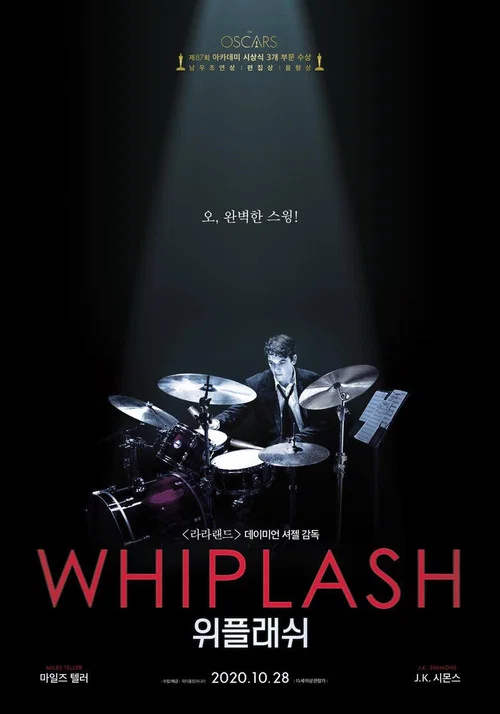
Andrew's explosive score-less performance goes beyond a mere display of skill — it symbolizes the moment of 'awakening' in which he casts off the shackles of Fletcher's control and instruction to claim his artistic agency. This iconic scene showcases a raw artistic explosion of survival instinct and fury beyond technical perfection, maximizing the film's thematic consciousness.
The Score-less Performance: Rebellion Against Controlled Perfection
This scene, which adorns the film's climax, is the point where all of Andrew Neiman's psychological and artistic conflicts explode. Fletcher always demands "the perfect result" and drives Andrew through extreme training. His teaching methods pushed Andrew's talent to its highest level, but at the same time they were a prison constricting his self and his sanity.
Against this backdrop, when Andrew begins to play without sheet music it means more than "he has improved." It is a declaration of refusal — refusing all the rules and control systems Fletcher has designed — and a commitment to complete the performance relying solely on the "fury" and "instinct" welling up from within.
1. What "No Sheet Music" Symbolizes
In music, sheet music symbolizes knowledge and system — "learned perfection." Fletcher's studio is a world-order full of that sheet music and those rules. By contrast, performance without sheet music means unpredictability — "pure creativity."
When Andrew plays without sheet music, his playing reaches the realm of "survival instinct" that goes beyond technical accuracy. This means he has awakened as an independent artist with his own artistic language — not merely imitating Fletcher's teachings. What Fletcher is wary of is not Andrew's ability but the very fact that the source of that ability is no longer coming from himself.
2. Fletcher's Reaction: The Paradox Between Being Overwhelmed and Recognition
Fletcher's reaction upon witnessing this performance creates the most important paradox of the scene. At first he tries to control and hem Andrew in — but ultimately he is overwhelmed by the performance. Fletcher has been obsessed his whole life with the standard of "greatness," and demanding performance that meets that standard is tantamount to his reason for being. Andrew's performance shakes Fletcher's lifelong definition of "greatness."
The smile Fletcher wears is not simple satisfaction. It is the rapture of having finally found the ideal "great genius" he always wanted — and simultaneously, complex proof that he too is a lonely artist imprisoned by the maddening value of "the greatest music" rather than any empathy for others.
3. Acquiring Agency Through Performance
Through this performance, Andrew gains more than mere recognition of his ability — he acquires his artistic agency. He is no longer a passive being reacting to Fletcher's whip. He is an active creator who sublimates the explosion of his own emotions into music by his own will. In this moment, Andrew is reborn as a true artist — throwing himself not at the realistic values of "a good job" or "a stable life," but at the value of "perfect art."
Why It Matters
This iconic scene condenses the film's thematic consciousness — 'the cost of artistic perfectionism' — visually and aurally. Fletcher tries to prove his educational philosophy through Andrew, but ultimately collapses before Andrew's spontaneous and uncontrollable explosive force. This poses the most tragic and intense question the film asks: artistic achievement is not necessarily connected to human happiness or stability. Andrew's performance is not a simple success story, but a warning — showing how the madness named 'greatness' can destroy a person's soul.
Other 명장면 dives4
- arrow_outward
Fletcher's Sociopathic Instinct
Terence Fletcher's character is interpreted as more than a harsh teacher — a figure with a cunning, sociopathic instinct who exploits the psychological vulnerabilities of others. He fixates solely on the value of 'perfect art,' completely excluding human empathy or ethical responsibility. Fletcher's behavior is less about educational method and more akin to 'hunting' his students.
- arrow_outward
The Real Performance and the Low-Budget Production Story
The dramatic immersion of Whiplash comes not from mere direction but from the genuine drum playing and physical dedication of lead actor Miles Teller. Even produced on a small budget, the vivid performance Teller delivered after three months of jazz drum intensive training is the core device that maximizes the film's realism — making audiences feel Andrew's pain and achievement with a vividness that goes beyond mere acting.
- arrow_outward
Color Symbolism and Madness
In Whiplash, color goes far beyond mere costume — it is a core device that visually shows a character's inner state and the degree to which they have assimilated into the 'madness' toward perfection. Bright colors symbolize purity or immaturity; black and dark gray signify brutal skill, controlled power, and ultimately the state of having assimilated into madness — tracking Andrew Neiman's mental journey.
Back to the title
Whiplash
14 deep dives in total